A Hollywood study says roughly half of a script is just characters in conflict. Yet most new writers still try to “keep the peace” on the page. So let’s drop into a scene where nothing explodes, no one shouts—yet tension quietly rewires your audience’s emotions.
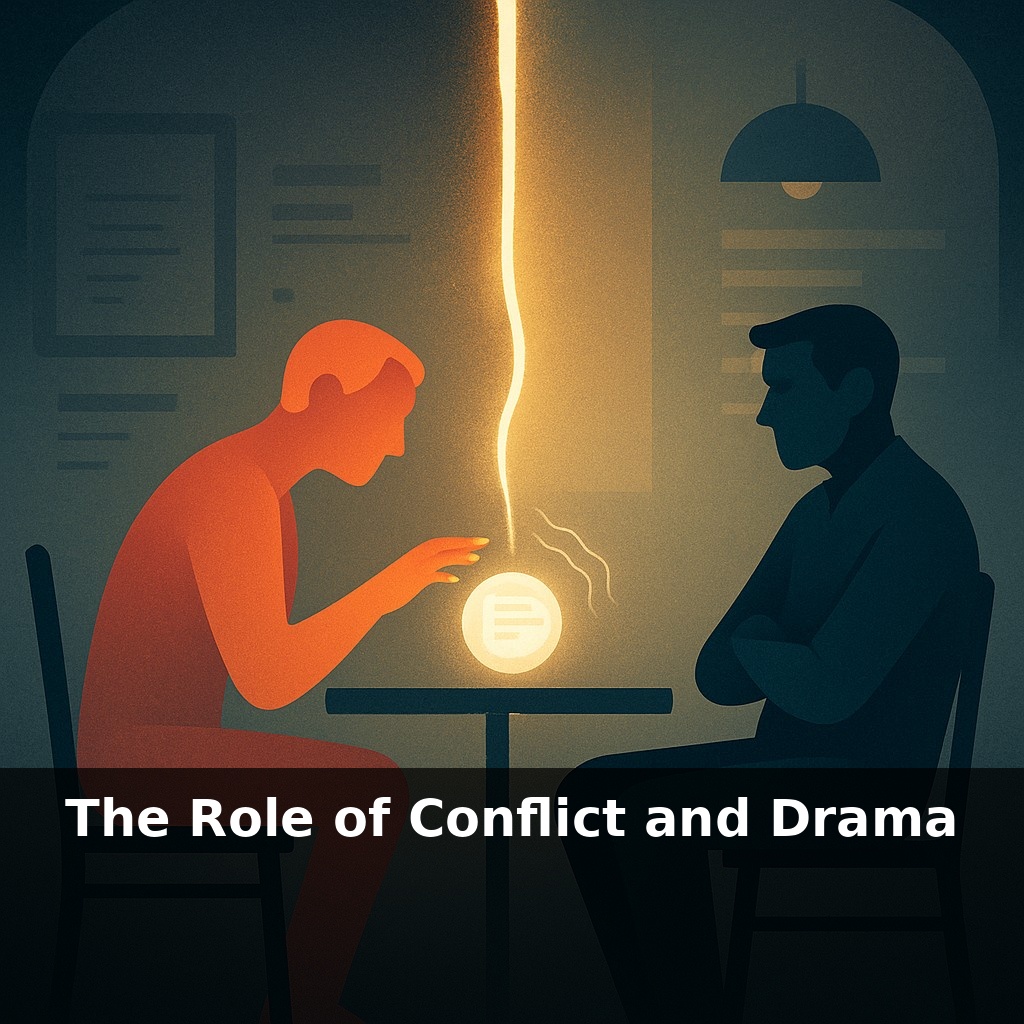
Conflict isn’t just arguing or car chases—it’s the gap between what a character wants and what the world (or they themselves) will allow. That gap is where story lives. A character reaches for something, the universe swats their hand away, and in that tiny sting we recognize our own lives: the job you almost got, the text you didn’t send, the apology you couldn’t give.
Modern research backs this up: when that gap widens, audiences lean in. Streaming data shows viewers bail fastest during “smooth” stretches where nothing gets in the way. The moment obstacles appear—social pressure, bad timing, moral dilemmas—attention spikes again.
So instead of asking, “What happens next?” strong storytellers keep asking, “How does this get harder, messier, riskier?” Not to punish characters, but to reveal who they become when the easy option disappears.
Conflict is also a tool you can tune, not just a fire you light and walk away from. Some stories crank it up fast—think of a tight basketball game where the score stays within a few points the whole time. Others ratchet slowly, letting small frictions echo and combine until they feel huge. Research on hit series shows it isn’t sheer volume of fights that hooks people, but how clearly we sense the pressure increasing and the cost of failure rising. Even quiet scenes can feel volatile if something crucial is at stake and both outcomes would change the character’s path.
Think of conflict in three layers that can stack, overlap, and trade places across a story: friction, crisis, and consequence.
Friction is the smallest unit. It’s the awkward pause, the missed call, the offhand remark that lands wrong. Individually, frictions seem trivial; together, they prime us to expect rupture. Skilled writers seed dozens of these tiny snags early so later explosions feel inevitable rather than random. In practice, this means asking in every scene: who is slightly out of sync here? Time, information, desire, or obligation—something should be misaligned.
Crisis is when a choice can’t be dodged anymore. Friction has narrowed the hallway so much that your character has to pick a door and walk through it. That promotion means betraying a friend. Telling the truth means losing the relationship. Research on binge‑watching patterns shows spikes not just when chaos erupts, but when a character’s decision locks the story onto a new track. A clean crisis usually offers two bad options or one tempting bad choice versus a costly good one. The more specific the loss on each side, the sharper the pull.
Consequence is where many drafts go soft. A huge fight, a big twist—and then… everyone more or less carries on. Audiences feel it immediately. In strong narratives, consequences do visible damage to the story’s “status quo architecture”: routines break, alliances reconfigure, resources vanish, rules change. Each consequence should either: - remove a safety net, - create a new obligation, or - echo emotionally in a later, quieter moment.
The trick is cycling these layers. A crisis without prior friction feels melodramatic. Consequences without fresh friction afterward feel final, even if there’s an hour left. Think in loops: friction narrows possibilities, crisis nails one path, consequence reshapes the world—creating new frictions that start the next loop at a higher level.
One helpful test: if you can delete a conflict beat and nothing downstream changes—no choice, no relationship, no resource, no belief—then what you have isn’t drama yet, it’s noise.
Watch how this plays out in something as simple as a breakup text. Friction: one character types, deletes, retypes—and finally hits send at the worst possible moment: right before the other walks into a big presentation. That timing choice turns everyday discomfort into crisis: read it now and tank the meeting, or wait and risk saying the wrong thing on stage with a heart in free‑fall. Whatever they choose, consequence must leave a visible dent. Maybe they nail the talk but can’t remember a word of it—and their ex interprets the delayed reply as indifference, doubling down on leaving. Later, a quiet networking event feels charged because the promotion that hinged on that speech is now tied to heartbreak.
You’ll see this blueprint in Parasite’s birthday party, in the heist going sideways in Ocean’s Eleven, even in Ted Lasso’s locker‑room secrets. None rely on sheer volume of shouting; they rely on each beat cornering someone into a costlier next move.
Algorithms will soon choreograph branching crises the way GPS reroutes traffic: constantly scanning for clogged paths and offering fresh collisions. In VR, you might decline a confrontation—only to find the system quietly raising the emotional “interest rate” elsewhere: fewer allies, costlier delays. Expect tools that suggest not lines of dialogue but chains of consequence, flagging where your world stays oddly intact after upheaval, nudging you to let one small rupture rewrite the game’s rules.
Treat each draft like a lab, not a verdict. Nudge one scene’s clash higher, drain another of overt drama, and watch how the rhythm of interest changes—like DJing volume between tracks. Over time, you’ll feel where to cut, where to collide, and where to let pressure hum so your stories don’t just move, they accumulate charge.
Before next week, ask yourself: 1) “Where in my life right now am I unconsciously *creating* drama—through overreacting, repeating the same story, or looping others into my frustration—when a calm, direct conversation would actually move things forward?” 2) “If I treated the next conflict (at work, with a partner, or with family) as a *signal* instead of a threat, what would it be trying to tell me about my boundaries, needs, or unspoken expectations?” 3) “The next time I feel triggered, what’s one specific question I can ask the other person—like ‘What did you mean when you said that?’ or ‘What outcome do you want here?’—that would shift us out of drama and into problem-solving?”