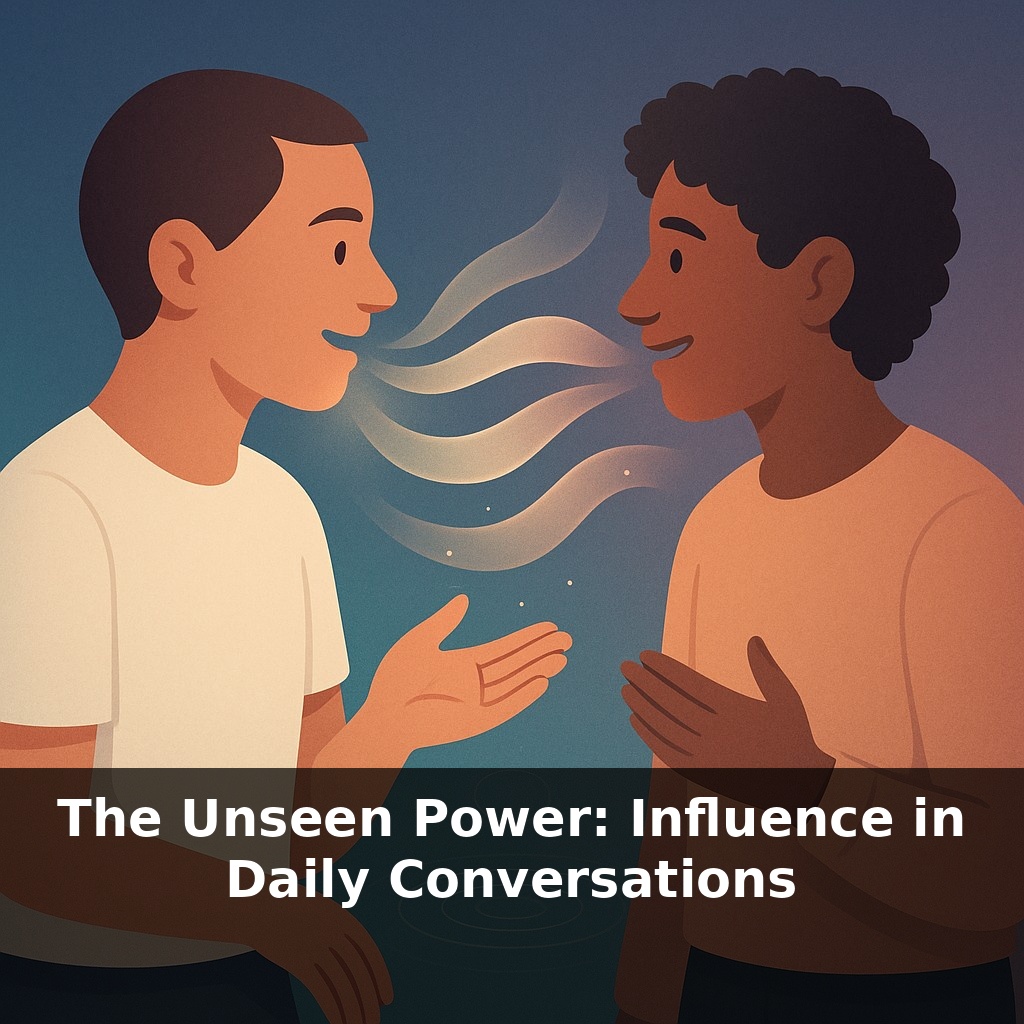
The Unseen Power: Influence in Daily Conversations
📝 Transcript
In one classic study, people agreed to small requests far more often when they were given a quick reason—sometimes even a silly one. You’ve felt this today already: in a hallway chat, a group text, a checkout line. Influence is happening there, quietly, whether you notice it or not.
Most of this influence doesn’t look like a “persuasion technique” at all. It shows up as the extra-soft tone you use when asking a favor, the way you instinctively match a friend’s pace while walking, or the slight pause before you say “yes” or “no.” Tiny, almost invisible shifts.
Researchers find that giving even a brief reason for a request changes how people respond, that mirroring someone’s posture can change how generous they are, and that open gestures can alter how compelling you seem onstage. These adjustments often feel as casual as straightening a picture frame—no big deal—but they tilt entire conversations.
Instead of thinking about big, dramatic persuasion moments, we’ll zoom in on these micro-moves: the phrasing of a single sentence, the timing of a question, the direction of your gaze when someone is deciding what to do.
Some of these shifts run on scripts you didn’t write. Think about how your voice changes with a boss versus a close friend, or how your “sure, no problem” text sometimes masks a reluctant yes. Those patterns are shaped by old experiences, cultural norms, and invisible “rules” you absorbed long before this week’s conversation.
Influence here isn’t just about getting others to move; it’s also about noticing when your own responses are being nudged. The real leverage begins when you can slow a moment down in your mind and ask: “Who’s steering this—my choice, or my autopilot?”
Most people think the “power moves” in conversation are the big ones: a perfect argument, a mic‑drop comeback, the charismatic speech. But the research points somewhere much quieter—toward the tiny levers that shape how moments *feel* before anyone has decided what to think.
Two of the most underestimated levers are *framing* and *timing*.
Framing is about the mental box you hand someone to put an idea in. “Can you stay late?” lands differently from “Can you help me finish this so tomorrow is less stressful for both of us?” Same basic request, but the second frames it as shared relief, not sacrifice. Your brain doesn’t receive “raw” information; it receives stories about what the information *means*—gain or loss, threat or opportunity, burden or cooperation. A small tweak shifts which story lights up.
Timing is the emotional weather around your words. A reasonable suggestion offered while someone feels rushed can sound like pressure; the same suggestion during a calm moment can feel supportive. You’ve probably felt how a two‑minute pause before replying to a heated message can change what you write—and how the other person responds. That gap gives your nervous system room to downshift, which quietly rewrites the conversation’s trajectory.
Then there are the subtle cues that set up a decision before it appears. Priming is one example: the ideas and emotions that are already “on the screen” of someone’s mind. Talking briefly about teamwork before proposing a group project, or about past successes before a tough challenge, doesn’t guarantee agreement—but it tilts attention toward certain possibilities. People notice what their mind has been warmed up to see.
Non‑verbal signals layer on top of this. A slightly slower nod, a softer exhale before you speak, turning your torso a few degrees toward someone when they’re struggling to explain themselves—these aren’t dramatic gestures, yet they often decide whether the other person feels judged, opposed, or accompanied.
None of this requires you to become calculating. It’s more like learning to read and adjust the dimmer switches in a room, instead of only flipping the main light on and off. When you start to notice these small levers, conversations stop feeling like fixed events and start looking more like adjustable environments you co‑create with the other person.
You’ve already seen how a single sentence can tilt a moment. Now zoom in even tighter: not on *what* you say, but on the tiny “how” details you usually skip over.
Think of a tough update at work. You can drop it into a group chat at 5:58 p.m., or bring it up early in a 1:1 when the other person has coffee in hand and time to react. Same content; different nervous system on the receiving end. Notice how often conflict isn’t about the message but the *moment* it arrived.
Or consider tone. Saying “I actually agree with you” with a quick, sharp “actually” can feel like a correction. Stretch that word, soften the start—“I *actually* agree with you”—and it lands as solidarity. One word, two emotional trajectories.
Even brief priming can reshape a conversation’s path. Before giving critical feedback, you might ask, “What are you most proud of from this project?” That answer doesn’t dilute the critique; it anchors the person in competence before you add pressure.
Sentient software will soon track pacing, pauses, and hesitations the way fitness watches track steps. Your future calendar app might suggest, “Move this tough conversation to mid‑morning; both of you decide better then,” or highlight emails where your tone drifts from your intent. As synthetic voices become harder to distinguish from real ones, the skill shifts from “How do I sound convincing?” to “How do I verify what—and who—I’m hearing?”
As you start noticing these levers, you may catch moments where silence does more work than arguments, or where a raised eyebrow redirects a decision faster than a paragraph ever could. The experiment isn’t to control people, but to see conversations as living jazz sessions—each tiny note, pause, and rhythm choice reshaping what’s possible next.
Start with this tiny habit: When you open a chat or email you’re about to send, pause and add exactly one “bridge” phrase from the episode—like “What I’m really hoping we can solve here is…” before your main point. This keeps you focused on shaping the frame of the conversation instead of just reacting. Do it for just one message a day—pick the one that feels even slightly important. Over time, you’ll start noticing how that one added sentence gently shifts the direction and tone of your daily conversations.
From this course
The Art of Subtle Persuasion
5 episodesUnlock all episodes
Full access to 5 episodes and everything on OwlUp.
Subscribe — $1.99/monthLess than a coffee ☕ · Cancel anytime