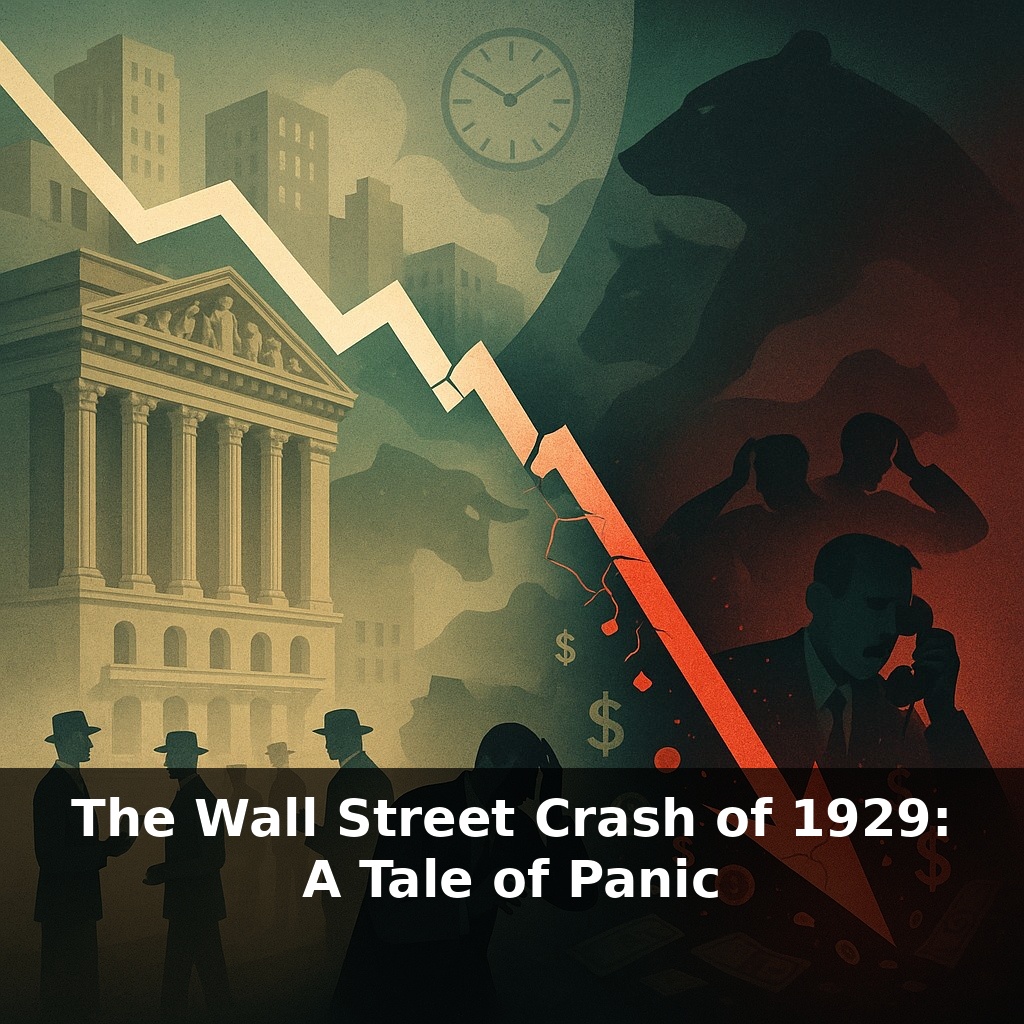
The Wall Street Crash of 1929: A Tale of Panic
📝 Transcript
Traders once watched nearly a quarter of the U.S. stock market’s value vanish in just two frantic days. One moment, easy money and soaring prices; the next, phones jammed, orders colliding, and no one sure what anything was worth anymore. How does optimism flip to panic that fast?
The shock of those two days wasn’t just about prices; it was about promises suddenly breaking. For most of the 1920s, buying stocks on margin felt almost routine: put a little money down, borrow the rest, and trust that rising prices would cover the loan. Brokers extended credit, banks quietly funneled deposits into the market, and layers of risk piled up like trays in a busy kitchen—each one balanced on the one below. As long as stocks climbed, the stack held. But beneath the excitement, interest rates were shifting, farm incomes were weakening, and global debts from World War I strained the system. When prices finally cracked, the problem wasn’t only that values fell; it was that the entire web of credit tightened at once, transforming a sharp market break into a systemic crisis.
Banks, meanwhile, sat at the crossroads of all this risk. Many weren’t just holding deposits; they were quietly lending to brokers, speculators, and sometimes directly to investment pools tied to specific stocks. Corporate profits in radios, autos, and utilities fed the story that “modern” industries could only go up, and newspapers amplified each new record high like a sports score. Overseas, gold flows and tariffs nudged capital in sudden directions, tightening funding in places where it had seemed plentiful. When confidence slipped in New York, those linkages meant tremors were felt in London, Berlin, and beyond.
For most of 1929, the story still looked triumphantly upward. Stock ownership had crept from a niche pursuit of professionals to a middle‑class aspiration. Investment trusts—early ancestors of today’s funds—promised access to “expertly managed” portfolios, often stuffed with the very same speculative favorites already dominating headlines. Layers of leverage stacked on top of one another: individuals borrowing from brokers, brokers borrowing from banks, banks indirectly exposed through call loans and risky securities. The result was a market where a surprisingly small amount of actual cash supported an enormous tower of paper claims.
Monetary policy added a twist. As the Federal Reserve tried to curb speculation without choking the broader economy, it sent mixed signals: public warnings against “speculative excess,” coupled with uneven actions that left many investors guessing. When leading figures like Irving Fisher insisted in October that stock prices had reached a “permanently high plateau,” it reinforced the belief that any dip was just a buying opportunity. Quietly, however, some insiders formed “pools” to push up specific stocks, then unload them into the enthusiasm of latecomers.
The break came not as a single dramatic headline, but as a series of mounting stresses. Early October saw key industrial stocks falter. Margin calls began to bite traders who had never imagined stocks could fall so far, so fast. As selling pressure grew, the New York Stock Exchange’s ticker fell minutes—then nearly an hour—behind real prices, blurring who owed what.
On Black Thursday, that banker support pool led by Richard Whitney briefly slowed the slide by placing conspicuously large buy orders in visible “blue chips.” For a moment, it worked; newspapers reported cheers on the trading floor. But the pause distracted from deeper problems: bank balance sheets already strained by questionable loans, farm communities weakened by years of low prices, and a world trading system increasingly cluttered by barriers and unpaid debts.
Once those underlying weaknesses met falling prices, the crash shifted from event to process. Forced liquidations spread, credit lines were reevaluated, and what had looked like diversified prosperity revealed itself as a tightly coupled machine. When one gear slipped, the rest had little slack.
One way to see how fragile 1929 really was is to follow the money outward from Wall Street. When prices broke, investment trusts that had promised professional management suddenly faced redemptions they couldn’t meet without dumping assets. That pressure didn’t stay in New York. Insurance companies that had quietly bought those same securities saw their balance sheets erode, constraining the long‑term loans they offered to businesses and households. Railroads and manufacturers that relied on rolling over short‑term notes found that lenders now demanded higher yields—or refused altogether. Municipalities postponed bond issues, delaying bridges, schools, and utilities that had been planned during the boom. Internationally, American lenders pulled back from Central Europe and Latin America, where governments had borrowed heavily in the 1920s, forcing abrupt austerity and feeding a feedback loop of shrinking trade. Each balance sheet adjustment, rational in isolation, reinforced the downturn when everyone tried to adjust at once.
The legacy of 1929 is less a warning label—“don’t panic”—and more a design manual. Modern rules about who can lend, how much leverage is allowed, and when trading must pause are like reinforced beams added after a bridge collapse. Yet stress keeps migrating: into shadow banks, exotic derivatives, and tokenized assets. The uncomfortable implication is that safety is never “done”; it’s a moving target that has to be hunted, measured, and tested in real time.
The real puzzle is how to notice the next fracture before it spreads. Today’s pressure points hide in algorithmic trading, private credit funds, and cross‑border dollar loans that few voters ever hear about. Like a city built on old subway tunnels, modern finance rests on layers of past choices—solid enough most days, until weight shifts in just the wrong place.
Here’s your challenge this week: Build your own “1929 Crash Stress Test” for your money. Today, list every investment or savings account you have and calculate how much money you’d lose if markets suddenly fell 30%, 50%, and 90%—just like the worst phases after Black Thursday and Black Tuesday. Then, change at least one concrete thing before the week ends (for example, move a set dollar amount into cash or a safer fund, or reduce any leveraged/borrowed investing to zero) so you could live through a 1929-style panic without being forced to sell.
From this course
The Curious Case of the Stock Market Roller Coaster
5 episodesUnlock all episodes
Full access to 5 episodes and everything on OwlUp.
Subscribe — $1.99/monthLess than a coffee ☕ · Cancel anytime