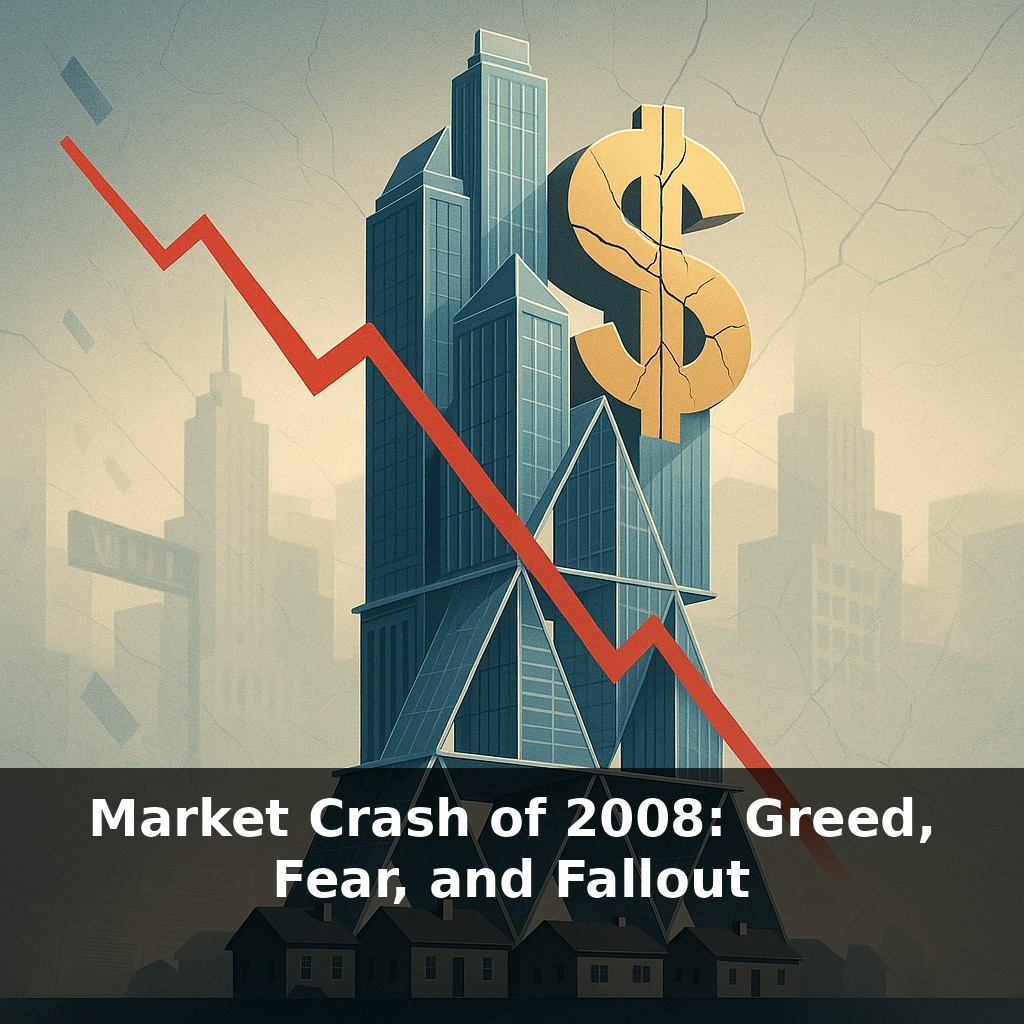
Banks were selling AAA‑rated investments built on people who could barely afford their mortgages. Ratings said “safest in the world”; reality said “one missed paycheck from disaster.” Somewhere between those two stories, the global financial system quietly snapped.
Behind those glittering labels sat a brutally simple story: debt stacked on debt, then sliced, repackaged, and sold as if risk could be chopped so thin it almost disappeared. A single shaky mortgage might seem small, but multiply it across millions of households whose paychecks never quite kept up with their payments, and you get a quiet pressure building in the background. Lenders stretched standards, then bent them, then treated “no income, no assets” as a feature, not a bug. Each link in the chain took a fee, passed the risk along, and told itself the danger now lived somewhere else. Like a recipe that keeps doubling the sugar while assuming someone later will balance it with salt, the system baked in fragility—then scaled it worldwide.
On the surface, it still looked calm: bonuses were flowing, quarterly earnings sparkled, and homeownership numbers made politicians smile. Yet beneath that calm, incentives were quietly twisting behavior. Bankers earned more for volume than for caution. Rating agencies were paid by the very firms whose products they judged. Homebuyers saw prices climbing and felt late to the party. Like a cooking show that rewards speed over taste, the whole setup encouraged getting deals out the door, not checking whether anyone could digest them. By 2006–2007, tiny cracks—rising late payments, slowing sales—were visible, but easy to dismiss as “contained.”
When the first wave of subprime borrowers stopped paying, the damage didn’t stay neatly inside those original loans. It jumped balance sheets. The reason: those shaky payments had been sliced into mortgage‑backed securities, then re‑sliced into CDOs, and wired into the core of big banks, insurers, and money‑market funds around the world. No one held “a bad loan”; they held layers of claims whose true exposure was maddeningly hard to see.
As defaults crept up in 2007, prices for these structured products began to wobble. That created a brutal accounting problem: if markets don’t want to buy what you’re holding, what is it worth? Mark‑to‑market rules forced institutions to recognize losses as prices fell, even if the underlying cash flows hadn’t fully collapsed yet. Each markdown weakened balance sheets, making creditors nervous. Nervous creditors demanded more collateral or pulled short‑term funding altogether.
This mattered because major institutions weren’t just invested, they were leveraged. A dollar of capital might be supporting thirty or more dollars of assets. Small price moves in those assets now translated into existential questions: do you still have enough cushion to survive? Repo markets and commercial paper—usually boring plumbing—suddenly became battlegrounds where trust evaporated.
Overlaying all this was the vast, largely unregulated world of credit‑default swaps. Firms like AIG had sold enormous amounts of protection on MBS and CDO tranches, collecting steady premiums in good times. When losses surged, they had to post collateral—fast. What had looked like low‑risk income transformed into a cash drain big enough to threaten failure.
By September 2008, the system was brittle enough that one large bankruptcy could flip anxiety into outright panic. Lehman’s collapse signaled that governments might not always step in. Overnight, counterparties questioned whether money parked “safely” with big names would be returned. Short‑term funding froze, not because everyone was insolvent, but because no one could prove they weren’t quickly enough to calm the fear.
Some of the earliest warning signs didn’t come from Wall Street at all, but from places that looked boring and safe. In 2007, a group of money‑market funds in Europe quietly admitted they held complex U.S. mortgage products they suddenly couldn’t value. For everyday savers, these funds were supposed to be cash‑like—some even marketed themselves as “as safe as a bank deposit.” When one U.S. fund, the Reserve Primary Fund, “broke the buck” in 2008—its share price dipped below $1—it was a psychological shock. If even your cash‑equivalent could lose money, what was safe?
Consider how this spread to seemingly unrelated corners: local governments in places like Norway and small U.S. towns discovered their “conservative” investments were tied to exotic structures linked to U.S. housing. University endowments and pension funds found themselves exposed through layers of fund‑of‑funds and structured notes. Many trustees didn’t even know they owned these products until the losses arrived.
Future fallout from 2008’s playbook may surface where oversight is thinnest—crypto platforms, shadow lenders, climate‑exposed assets. Instead of banks hoarding toxic paper, think of balance sheets quietly “marinating” in long‑term exposures that only turn dangerous when conditions suddenly change, like food left out too long on a hot day. Your challenge this week: trace one financial product you use back two layers and ask, “Who’s really on the hook if this goes wrong?”
The deeper lesson of 2008 isn’t just that systems break; it’s how quietly they drift into danger while everyone feels clever and safe. Today’s glossy apps and frictionless payments can hide the same slow creep—like calories in “healthy” snacks. As credit, tech, and policy keep intertwining, the real skill is learning to spot when convenience starts to taste a bit too sweet.
Before next week, ask yourself: Where in my own financial life am I “chasing returns” the way investors chased subprime mortgage profits in 2006–2007, and what would it look like to scale that risk back today (e.g., reallocating from a single hot stock or crypto into a diversified index fund)? If my job or income had faced a 2008-style shock tomorrow, which bills or debts would immediately put me under pressure, and what one concrete step could I take today—like calling a lender to understand hardship options or automating a small emergency-fund transfer—to improve that resilience? Looking at the incentives that drove ratings agencies, mortgage brokers, and Wall Street traders in the episode, where in my own work or business do my incentives quietly push me toward short-term gain over long-term stability, and what is one specific practice I can change this week (a different sales metric, a new client check-in, a revised bonus target) to realign them?