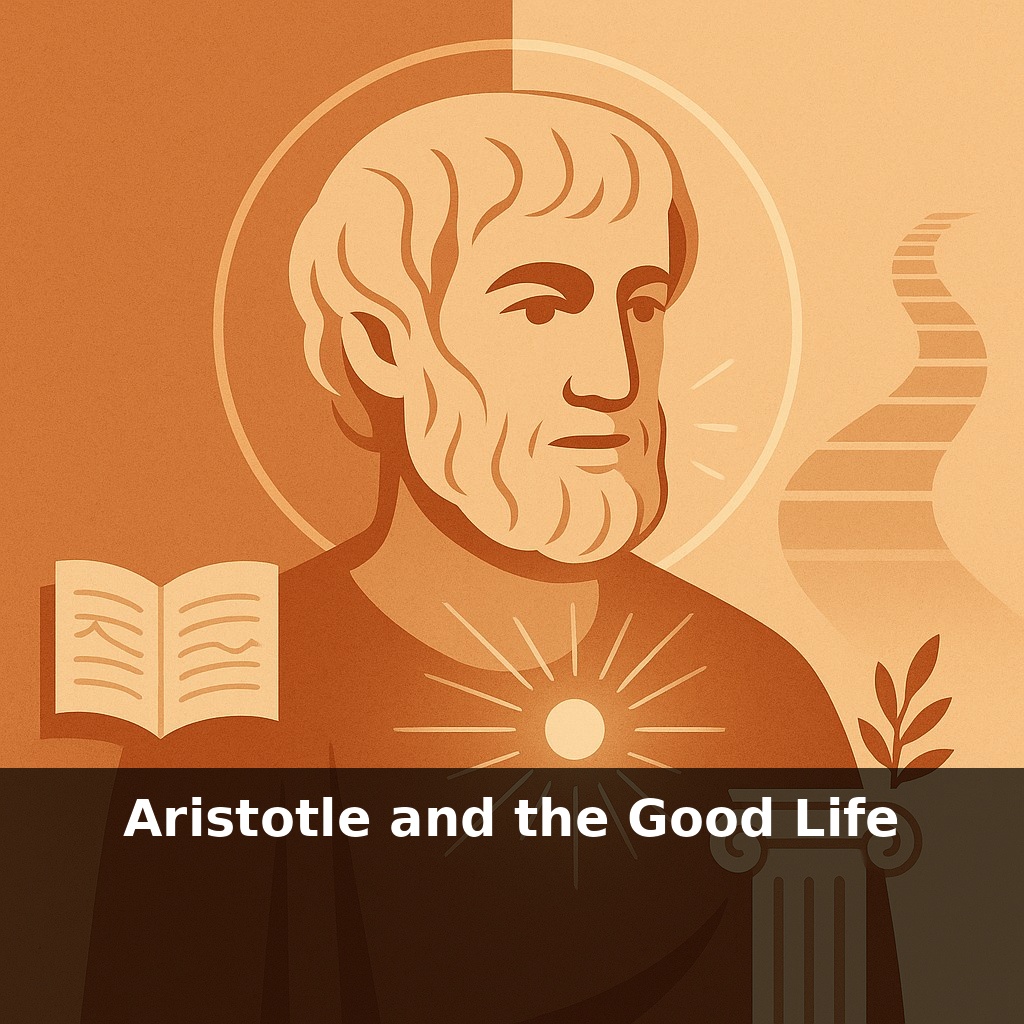
Aristotle and the Good Life
📝 Transcript
“Happiness,” Aristotle claimed, “is an activity.” Not a mood, not a lucky break—something you *do*. Picture two people with similar jobs, incomes, and health. One feels strangely empty, the other quietly fulfilled. Same circumstances, different *daily habits of the soul*.
Aristotle thinks the gap between those two lives isn’t mysterious at all: it comes down to *excellence in how you live, repeatedly, over time*. He calls this excellence “virtue,” and it isn’t about being unrealistically pure or nice. It’s about *skillfully hitting the right note* in situations that pull you toward extremes—fear and recklessness, stinginess and waste, passivity and aggression.
Crucially, this isn’t something you either “have” or “don’t have.” For Aristotle, you build it the way a musician builds mastery: by practicing small, deliberate choices until they become second nature. And you don’t practice alone. Your character is shaped in families, teams, cities—anywhere your actions affect others.
So in a world obsessed with hacks and shortcuts, Aristotle invites a harder, deeper question: *What kind of person are your routines slowly turning you into?*
Aristotle sharpens the point: a “good life” isn’t just inner peace; it’s a pattern of *rational* choices stretched across a whole lifetime. That means three demanding questions: Are your decisions guided by clear thinking, or by impulse and algorithmic nudges? Are you reliably steering between harmful extremes, especially when stressed or watched by others? And are you using your best hours on tasks that genuinely deserve contemplation? Already in antiquity, he warns that comfort, status, or even talent can’t substitute for this. Tools and luck help, but your *steady way of choosing* is what ultimately rules.
Aristotle now ups the difficulty: it isn’t enough to act “nicely” in a vague way. He thinks human flourishing has a *structure*, almost like a well-designed product. Three layers matter.
First, the *moral* layer: the familiar qualities we see in coworkers and friends. Courage in hard meetings. Generosity with time or credit. Honesty when a small lie would be easier. Aristotle famously maps these as “means” between destructive extremes: courage between cowardice and rashness, generosity between stinginess and waste, truthfulness between boasting and self-erasure. But the point isn’t to split the difference mechanically. It’s to land on what’s fitting in *this* situation, for *these* people, with *these* stakes.
That’s where the second layer comes in: *practical wisdom* (phronesis). This isn’t raw IQ or a stack of degrees. It’s the hard-won ability to read a room, weigh trade‑offs, and decide what matters *now*. A leader who knows when to delay a feature for safety, a friend who senses when advice will help and when it will wound—these are phronesis in action. Aristotle insists that without this, the moral qualities misfire: you might be “brave” at the wrong time, “generous” in ways that harm.
The third layer is *intellectual* virtue at its peak: deep understanding and contemplation. Here Aristotle sounds almost alien to modern productivity culture. He thinks the highest use of our minds isn’t endless problem‑solving but sustained attention to things worth knowing for their own sake—science, philosophy, art, the underlying patterns of the world. Not because these pay off instrumentally, but because exercising our best capacities on worthy objects is itself part of flourishing.
Modern research keeps stumbling onto versions of this framework. Google’s Project Aristotle found that the most effective teams weren’t those with the highest combined IQ, but those with strong “psychological safety”: people felt free to speak, question, and admit mistakes. That’s what environments rich in courage, honesty, and practical wisdom look like from the inside. Positive psychology’s findings about deliberate virtue‑building and life satisfaction are, in a way, Aristotle with better data and fMRI machines.
And he is blunt about luck: health, relationships, basic security really do matter. They don’t *guarantee* a fulfilling life, but their absence can crush even strong character. The hopeful twist is his insistence that, within the limits of our circumstances, how we train our attention and responses still carries surprising weight.
A product manager facing a launch delay has three live options: ship a buggy feature to impress investors, bury the bad news to keep the team “motivated,” or own the delay, protect users, and explain the trade‑offs clearly. The third path looks worse on this quarter’s slide deck, but it quietly trains courage, truthfulness, and responsibility—traits teammates start mirroring. Over a few cycles, you don’t just “hit targets”; you change what people think is normal.
Or take someone in mid‑career burnout. Instead of quitting in a blaze of frustration, they run a different experiment: decline one prestige project that clashes with their values, mentor a junior colleague, and set a hard boundary on weekend work. No life‑overhaul, just three sharper choices. Six months later, the job is the same on paper, yet relationships, reputation, and self‑respect feel surprisingly different.
This is Aristotle’s wager: you don’t need perfect conditions, just enough stability to keep choosing slightly better actions, until they choose *you* back.
As cities start rating success by green space and mental health, not just GDP, Aristotle slips into urban planning meetings. Algorithms that once optimized for clicks may be asked to “aim” at long‑term civic thriving, like rerouting traffic toward cleaner air rather than faster commutes. Schools could grade less on test scores and more on how well students collaborate across differences—treating each classroom like a small prototype of a healthier democracy.
Aristotle would likely ask not “Are you happy?” but “What are you aiming at today?” In a world of nudging algorithms and infinite feeds, that question gets sharper: whose aims are you living by—your own or a platform’s? Treat each notification, meeting, or scroll as a tiny vote for a future self; the pattern of those votes is where your life quietly turns.
Before next week, ask yourself: “In the last 24 hours, which activities actually felt worth doing for their own sake (not for money, status, or praise), and what does that reveal about what *my* good life might look like?” “If Aristotle says friendship of virtue is central to eudaimonia, which one friend actually challenges me to be better—and how could I spend one deeper, more intentional hour with them this week?” “Looking at my day, where do I mindlessly chase pleasure or distraction (social media, snacking, busywork), and what small, specific swap could I make *today* that would move me one inch closer to living with more courage, temperance, or practical wisdom instead?”
Unlock all episodes
Full access to 8 episodes and everything on OwlUp.
Subscribe — $1.99/monthLess than a coffee ☕ · Cancel anytime