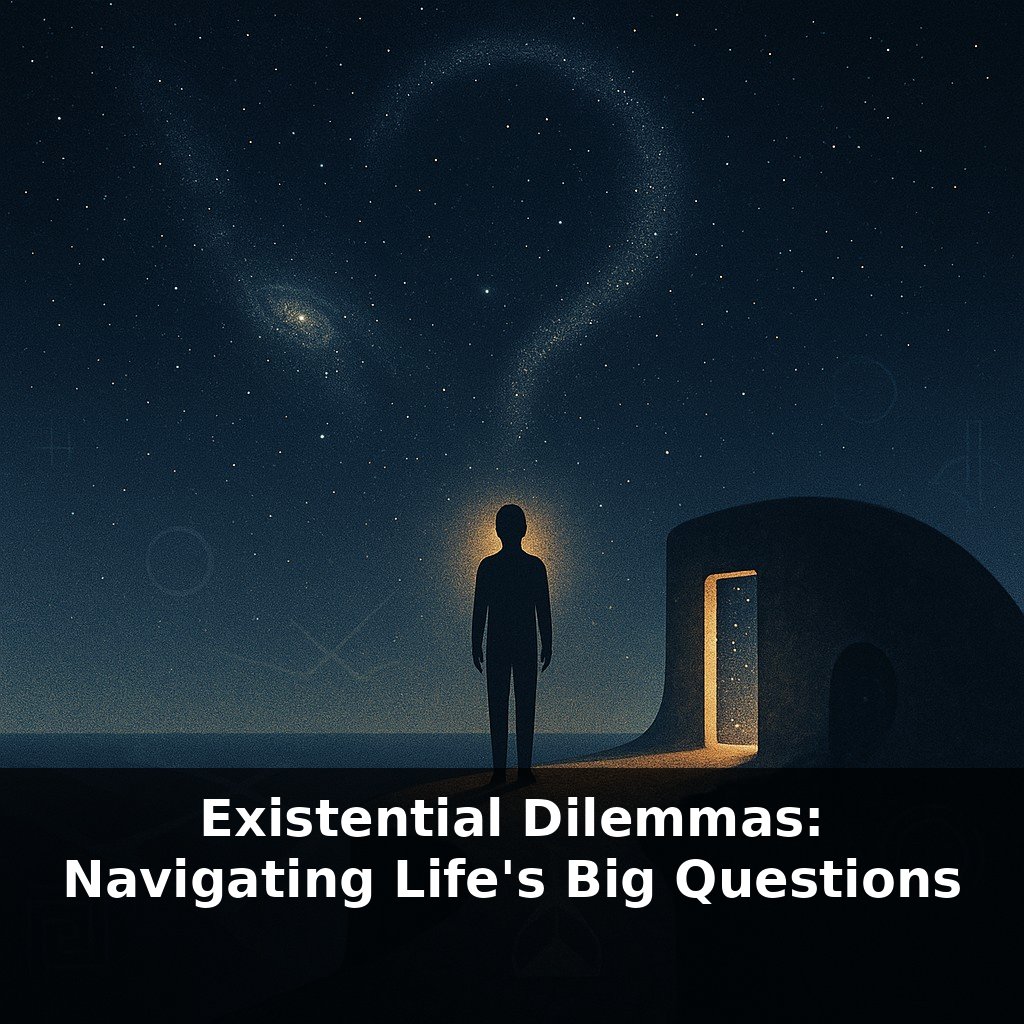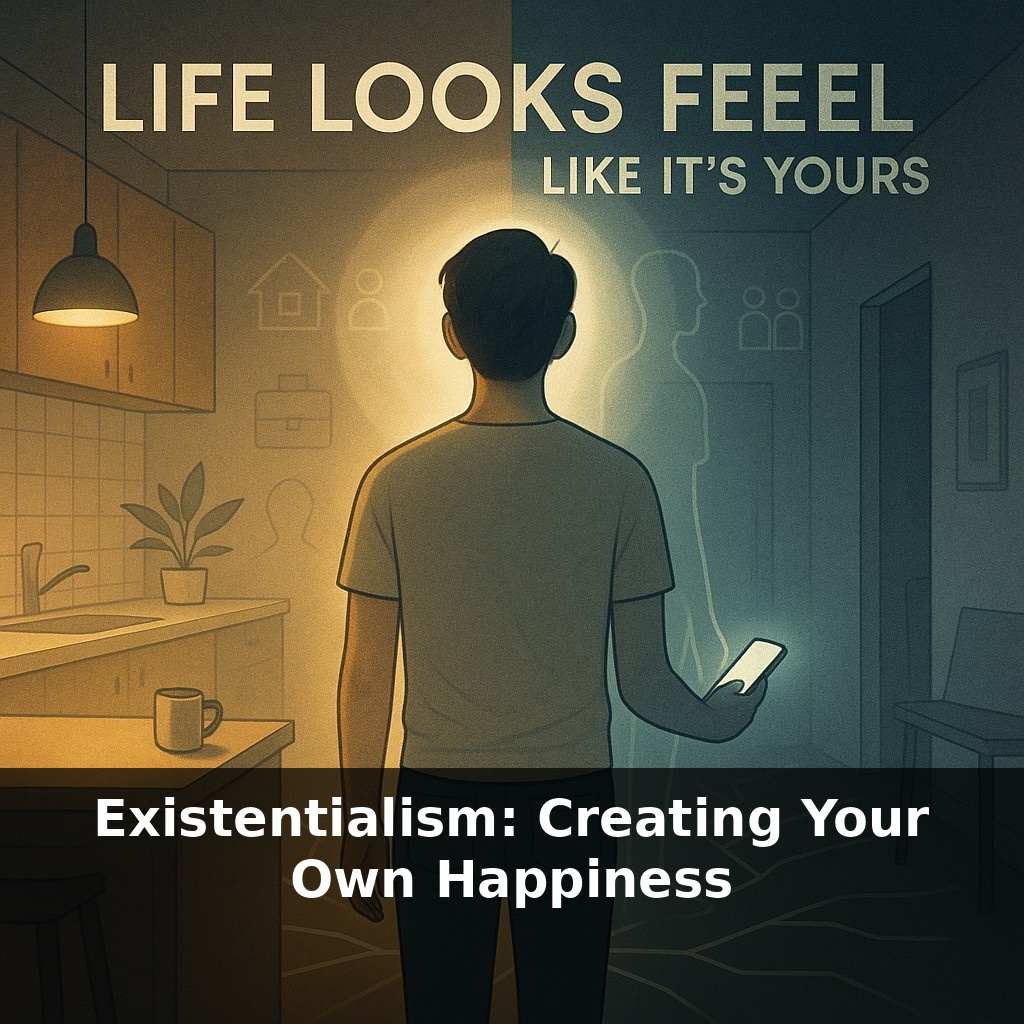
Jean-Paul Sartre once told a packed Paris audience: “We are condemned to be free.” Now, jump to you, standing in your kitchen after a long day, scrolling your phone, feeling oddly empty. This episode starts right in that gap: when life “looks fine” but doesn’t feel like it’s yours.
In the last episodes, we met traditions that told us what a “good life” should look like: live virtuously, maximize overall happiness, follow the moral law. Existentialism walks in and quietly flips the table: what if there is no built‑in script at all?
Sartre, Camus, and their peers looked at a world scarred by war, genocide, and absurdity, and refused both easy optimism and quiet despair. If no one is coming to hand you meaning, then your career ladder, your relationship goals, even your “five‑year plan” are just starting points—not destinies.
Instead of asking, “Am I happy yet?” existentialism asks, “Is this *my* life or a borrowed one?” That question can feel unsettling, like stepping off a moving walkway at the airport and realizing you now have to walk on your own legs—but it’s also where a different kind of happiness begins.
Sartre and Camus didn’t write from an armchair; they wrote with war, occupation, and resistance fresh in their lungs. That’s why their questions land so hard on ordinary moments: picking a college major, staying in a safe job, saying yes to a relationship that looks good on paper. Each choice quietly answers, “Whose script am I following?” Think less of a single “true calling” and more of a series of drafts: you try a path, notice the fit, revise. Like rearranging furniture, the room is the same, but how you inhabit it can change everything about how it feels to live there.
When Sartre says there’s no script, he isn’t telling you to blow up your life tomorrow; he’s shifting *where* the pressure sits. In earlier traditions we’ve covered, the pressure is mostly *outside* you: live up to virtue, maximize utility, obey the moral law. Here, the pressure moves *inside*: can you look at your own daily choices and say, “I stand by this,” without hiding behind “that’s just what people do”?
Existentialists zoom in on small, ordinary betrayals of ourselves. You laugh at a joke you secretly find cruel. You nod along in a meeting though you disagree. You post a vacation photo that suggests you’re relaxed, while your stomach is in knots. Sartre calls this *bad faith*: not lying to others, but first lying to yourself—pretending you’re just a role, a title, a personality type, rather than an agent who could, in principle, do otherwise.
Camus approaches from another angle: the sense that life can feel absurd, especially when routines are polished but hollow. His twist isn’t to deny the absurd, but to ask whether you can respond with defiance instead of resignation—by choosing projects, loves, and loyalties *because you affirm them*, not because they came pre‑packaged.
This doesn’t mean chasing constant intensity. It can look very quiet from the outside. A nurse who stays in a demanding job not out of inertia but out of a lucid, recommitted “yes.” A parent who admits, “I didn’t choose this path freely at first,” and then gradually turns it into a conscious commitment instead of a silent complaint. A college student who drops the major that impressed everyone else and accepts the anxiety of starting over.
Here, joy isn’t the spike you get when something nice happens; it’s closer to the energy that comes from no longer running a subtle con on yourself. Vos and colleagues found that therapies built around these themes—freedom, responsibility, mortality, meaning—can measurably ease depression. Viktor Frankl observed that even in camps, prisoners who could locate *some* personal “why”—a person to return to, a task to finish, a stance to maintain—were more likely to survive.
None of this guarantees a smooth life. It does offer a different wager: that it’s better to feel anxious in a life that is becoming genuinely yours than comfortably numb in one that never was.
You can see this most clearly in mundane crossroads. Take someone who has coasted into a lucrative role in a tech firm. The work is fine, the perks are good, but their calendar feels like a sequence of obligations authored by other people. An “authentic” shift doesn’t have to mean quitting; it might start as quietly as refusing to stay late just to look dedicated, or choosing one project that actually matters to them and staking their name on it. The outer picture barely changes; the inner stance does.
Or think of a couple who followed the expected script: dating, marriage, mortgage, kids. Years in, one partner realizes they’ve never really said “yes” to this shape of life, only “okay.” Instead of blowing it up, they begin renegotiating routines—who works when, how weekends are spent—treating their shared life less like a contract they signed under pressure and more like an ongoing co‑authored draft. Choices that once felt like gravity start to feel, incrementally, like commitments.
Your challenge this week: For seven days, pick *one* recurring situation where you usually run on autopilot—maybe your commute, your lunch break, or a nightly scroll in bed. Don’t try to overhaul it. Instead, each time it happens, pause for 20 seconds and silently ask: “If I took my freedom seriously here, what tiny, different action would I take *today*?” Then do that one small thing: take a different route, eat somewhere else, call someone instead of scrolling, change one sentence you’d normally say at work.
At the end of the week, look back over those micro‑detours. Notice not only what changed externally, but how it felt to insert even a sliver of deliberate choice into a slot that used to feel non‑negotiable.
As AI starts drafting your playlists, routes, even dating options, “going with the flow” quietly changes meaning. Whose flow is it? Existentialists would ask whether you’re still steering the ship or just trimming the sails. Schools and workplaces may need to train “freedom muscles”: noticing when you’re deferring to the algorithm, the norm, the policy. Like hikers learning to read the sky, not just follow GPS, we’ll need literacies for choosing our own storms—and our own clearings.
So the “good life” here isn’t a finish line; it’s more like tending a small garden on a balcony you didn’t design but now inhabit. Some days you prune, some days you just sweep leaves and keep the plants alive. The point is that your hands are in the soil. Technology, culture, even family can suggest seeds—but only you can decide what is worth growing.
Before next week, ask yourself: 1) “If I fully accepted that life has no built-in meaning, which expectation or ‘supposed to’ from my family, culture, or social media would I *drop today*, and what tiny freedom would that give me this week?” 2) “Looking at how I actually spent yesterday—hour by hour—where was I most ‘awake’ and engaged, and if I treated that as a clue to my chosen meaning, what would I deliberately schedule 20 more minutes of today?” 3) “In a moment today when I catch myself thinking ‘I have to’ (go to work, answer this message, be polite, etc.), how would my choice look different if I paused and asked, ‘If I’m radically responsible for my life, how do *I* choose to show up right now?’”