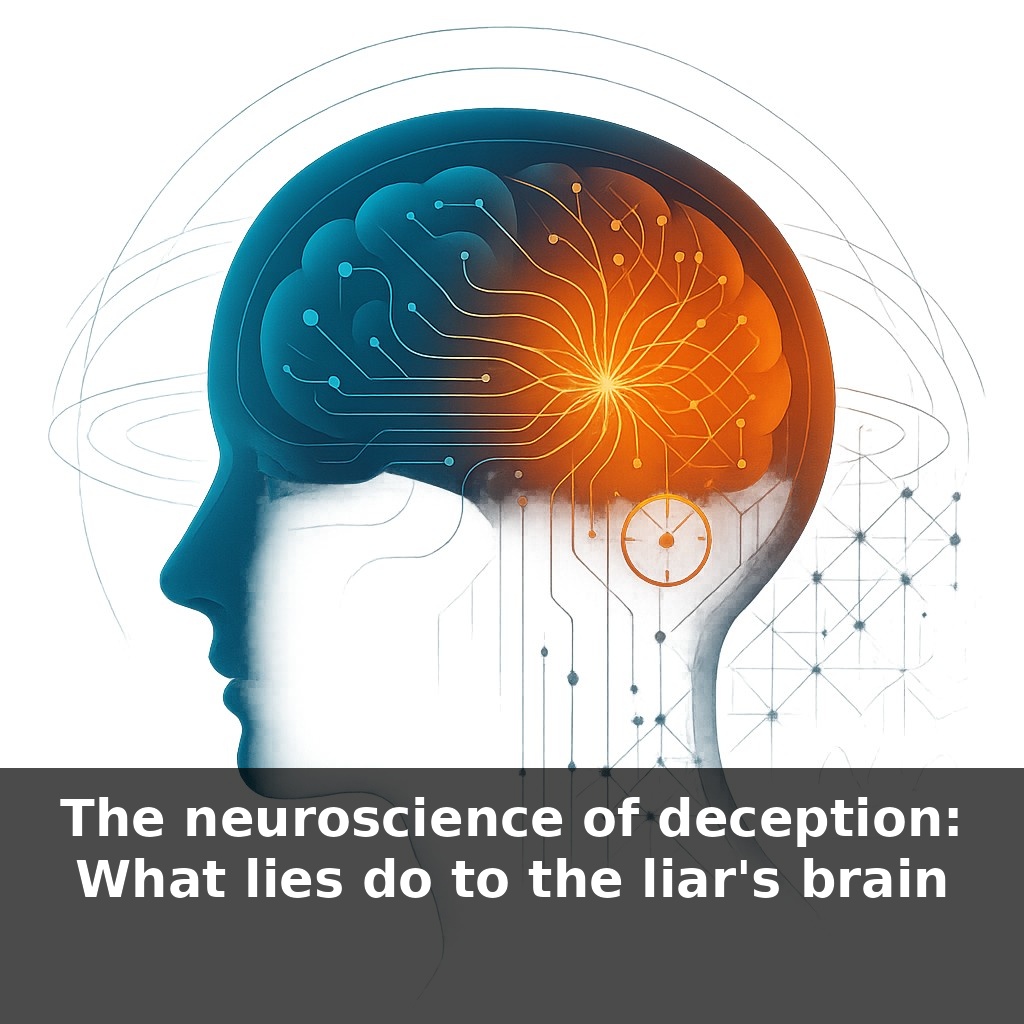
A lie starts in the brain about a blink slower than the truth. In that tiny delay, whole regions light up, argue, and negotiate. In this episode, we step inside that split second—where your mind weighs honesty, risk, and reward before a single word leaves your mouth.
That extra blink isn’t just delay—it’s mental choreography. Different regions start taking on temporary “roles,” like musicians picking up new instruments for a difficult piece. The prefrontal cortex leans harder on planning and inhibition, while the anterior cingulate flags internal disagreement: the version of events you know versus the one you’re about to present. At the same time, memory systems quietly rearrange details so the story won’t fall apart under basic questions. This isn’t merely about saying something false; it’s about maintaining a fragile, short-lived model of reality that can survive scrutiny. And the more often you do it, the more your neural circuits adjust, making the entire process feel smoother, less jarring, and disturbingly routine over time.
As this neural “performance” unfolds, other systems quietly join the act. The parietal regions juggle details in working memory, keeping dates, names, and sequences suspended just long enough to be rearranged. Deeper structures that tune into bodily states track fluttering heartbeats or tense muscles, feeding subtle feedback into the story you craft. Meanwhile, emotional circuits begin to recalibrate: initial spikes of discomfort can fade if the behavior is repeated, shifting the internal cost-benefit equation. Over time, what once felt jagged and effortful can start to feel oddly smooth, even when the stakes rise.
In lab experiments, that fragile alternative storyline leaves a measurable fingerprint. Participants take just a fraction longer to answer when they fabricate—on average 200–300 milliseconds. It sounds trivial, but across hundreds of trials it’s a robust pattern: inserting even a small distortion forces the system to pause, re-route, and double-check internal consistency. Time, in this case, is a proxy for mental effort.
Under the scanner, that extra effort shows up as increased oxygenated blood in a distributed network. Meta-analyses of dozens of imaging studies converge on a similar picture: regions that normally help with control, monitoring, and juggling information all “turn up the volume” when people deliberately misreport. Importantly, the specific spots can shift with context. Lying about a crime, about feelings, or about a simple card in your hand each recruit overlapping but not identical patterns. There is no single neural switch that flips from “truth” to “lie.”
Electrical recordings tell a complementary story. When researchers place EEG electrodes on the scalp, deceptive responses often show boosted power in beta and low-gamma bands—frequencies associated with focused processing and complex integration. These rhythms suggest the system is stitching together conflicting inputs: what actually happened, what must be concealed, and what needs to be said aloud without sounding off.
Yet the most unsettling finding isn’t about momentary strain; it’s about adaptation. In a 2016 study from UCL, people were asked to send slightly misleading information for personal benefit. Early on, a deep emotional hub signaled strongly when they distorted. But after dozens of repetitions, that signal dropped by about 22%, just as the magnitude of the distortions grew by roughly 25%. The pattern implies a sliding internal scale: each successful misreport can make the next one feel less charged and easier to escalate.
This helps explain why simple, low-stakes distortions can, over time, set the stage for larger breaches. What began as a sharp internal alarm gradually softens into background noise, while the cognitive machinery that supports fabrication becomes more practiced, efficient, and ready on demand.
Think of a junior accountant asked to “smooth” quarterly numbers. The first adjustment feels clumsy: extra checking of spreadsheets, awkward pauses in emails, a nagging sense that something’s off. By the tenth tweak, the edits come faster, the justifications more fluent. Neuroimaging work suggests that as these patterns repeat, circuits for calculation and language streamline the routine, while internal “do not cross” signals grow quieter, making the altered version of events easier to handle on the fly.
In social settings, a similar arc appears. Someone who often tells flattering distortions about their achievements becomes more adept at updating details mid-conversation—names, timelines, impressive-sounding specifics—without obvious strain. Studies using EEG hint that this fluency coincides with more efficient coordination in networks that integrate attention and self-representation, allowing the person to pivot between versions of events with less detectable hesitation and fewer tell-tale micro-delays in their responses.
If future tools can flag deception in real time, border checks and job interviews might start to resemble airport security for thoughts. That could deter fraud the way speed cameras slow drivers, but it also invites quiet forms of self-censorship. As brain-based screening spreads into insurance claims, corporate audits, even dating apps, we’ll face a tension: protecting others from harm versus preserving the right to hold back, stage-manage, or simply keep a private narrative.
As detection tech sharpens, our quiet edits to stories may leave sharper neural footprints than the big, dramatic falsehoods we fear. Like a jazz musician riffing on a theme, repeated tweaks can become automatic—but that same flexibility might be redirected. The open question is whether we’ll use that plasticity to justify more, or to notice sooner when we’re drifting.
Before next week, ask yourself: 1) “Where in my life do I tell ‘harmless’ half-truths (to my partner, colleagues, or myself), and how does my body feel in the exact moment before I decide to bend the truth?” 2) “The next time I’m tempted to lie, what specific discomfort am I trying to avoid—shame, conflict, embarrassment—and what would it look like to tolerate that feeling for 60 seconds instead of escaping it?” 3) “If repeated small lies really train my brain to feel less guilt over time, what is one recurring lie I’m willing to retire starting today, and what honest sentence will I use instead when that situation comes up?”