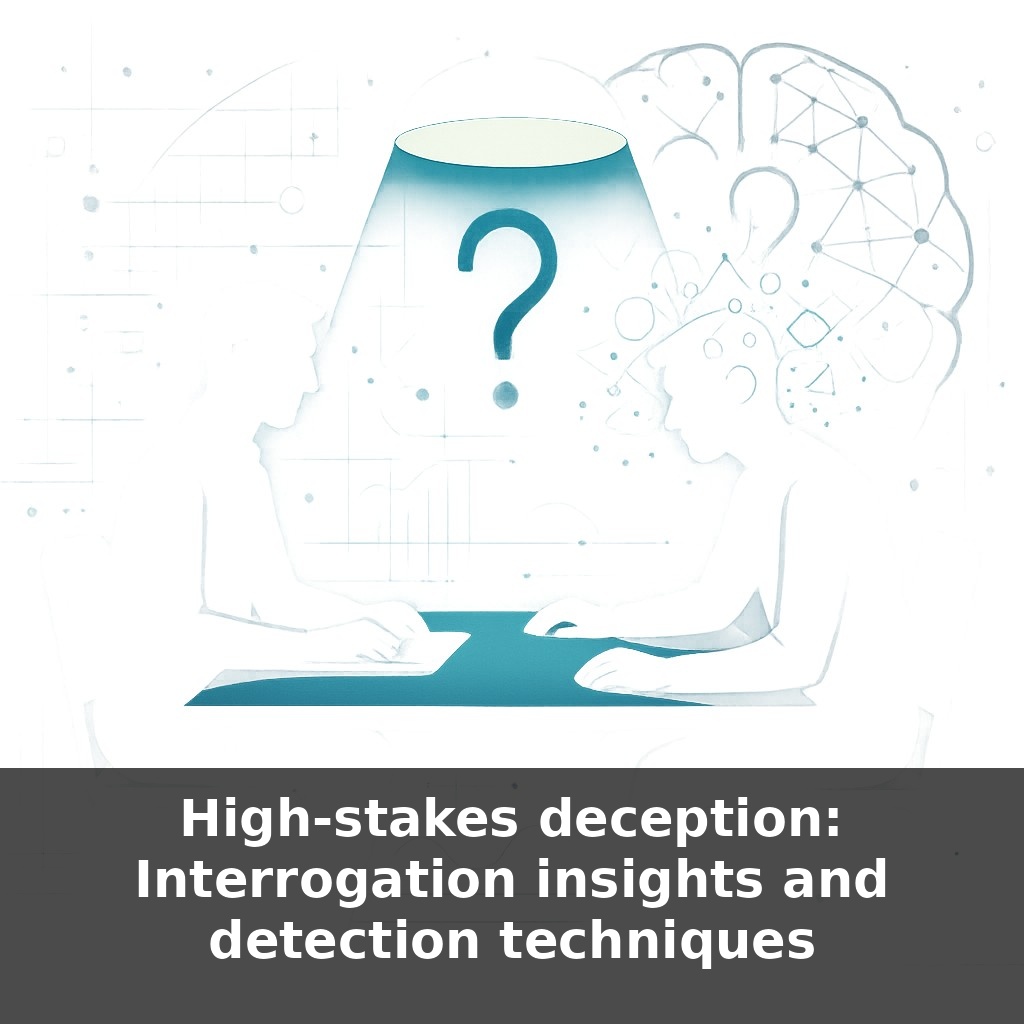
Under bright lights in a windowless room, two people face each other—only one knows a secret. Here’s the twist: even trained professionals guess truth from lies barely better than a coin flip. So how do some interrogators quietly push their accuracy dramatically higher?
In high‑stakes interviews, the turning point isn’t when the suspect “looks nervous” or “won’t make eye contact.” It’s when the interviewer quietly takes control of what *the mind has to juggle*. Modern protocols don’t wait for lies to “leak out”; they engineer situations where lying becomes mentally expensive and truth-telling is the easiest path available.
That shift changes everything: questions become more like stress tests for a story than casual prompts for a narrative. Instead of hunting for a single “gotcha” moment, skilled interviewers design sequences that pressure-test timelines, knowledge, and perspectives from multiple angles. A simple request—“walk me through that again, but this time backward”—can fracture a fabricated account while leaving a genuine memory mostly intact. And all of this happens under a surface of calm, respectful conversation rather than confrontation.
The next layer is *how* skilled interviewers quietly set those mental traps. They don’t improvise clever questions on the fly; they plan like chess players. Before the conversation even starts, they map out what evidence they have, what the person probably knows, and where those two lines might cross. Then they decide which cards to keep hidden and which to reveal later, and in what order, so each new detail forces the story to either shrink, shift, or break. Rapport isn’t just politeness here—it’s the soft landing that makes people keep talking even as the ground under their story is slowly rearranged.
Our everyday image of “interrogation” is still shaped by TV: raised voices, slammed folders, a sudden accusation that makes the suspect “break.” The research reality is almost inverted. The most effective interviewers often sound more like meticulous auditors than aggressive detectives: calm, curious, and relentlessly structured.
Three families of techniques sit at the center of that structure.
First is the Strategic Use of Evidence (SUE). Instead of dumping what they know, skilled interviewers temporarily act a little ignorant. They invite a broad, detailed account *before* revealing key facts. Only later do they introduce specific pieces of evidence—phone records, CCTV, message logs—at points where a deceptive story has already committed to concrete claims. The power isn’t in confrontation; it’s in timing. When the story and the evidence collide, liars tend to revise, backtrack, or suddenly “remember” new details, while truth-tellers mostly refine, not rewrite.
Next is Cognitive Credibility Assessment (CCA). Here, the focus shifts from *what* is said to *how memory behaves*. Interviewers ask for more than a simple narrative. They probe for sensory details, secondary perspectives (“What could a bystander have seen?”), and unexpected angles that genuine memories usually contain. Then they add deliberate cognitive strain: reversing the order of events, changing temporal focus (“Tell me what you knew *before* you entered the room”), or asking for maps and sketches. Liars, already juggling a constructed story, often show uneven richness: polished central claims, but thin or generic side details.
Finally, rapport-based approaches like the PEACE model weave all this into a humane conversation. Building respect and allowing uninterrupted initial accounts aren’t just ethical choices; they’re tactical ones. People talk more, reveal more anchors to test, and feel less need to defensively “stick to a script.” The interviewer’s restraint—no early accusations, no leading questions—creates space for internal contradictions to surface on their own.
Together, these methods turn the interview from a battle of wills into a slow, methodical exploration where inconsistency has fewer places to hide.
A counterterrorism team might start with a low‑stakes topic: weekend routines, favorite foods, childhood neighborhoods. They’re not “warming up” randomly; those answers create a baseline of how this person naturally structures time, space, and detail. Later, when the conversation shifts to the night of a suspicious meeting, the interviewer quietly looks for mismatches: Does this person suddenly avoid concrete times? Do their spatial descriptions shrink from streets and landmarks to vague “over there” gestures?
In corporate fraud probes, internal investigators use a similar rhythm. An executive is first asked to walk through an ordinary budget approval. Then, without warning, the interviewer zooms into one abnormal quarter and asks for the *same* level of texture: Who pushed back? Which emails felt tense? Which numbers didn’t add up at first glance?
Detecting deception is like tuning an old‑fashioned radio: the truthful signal is there, but you need the right frequency (structured questions) and a quiet room (rapport) to separate it from the static of nerves, culture, and noise.
As these methods spread beyond police work—into hiring, compliance, asylum interviews, even campus discipline—the stakes widen. Subtle shifts in how questions are asked could shape who gets a job, a visa, or an acquittal. AI tools may soon flag “odd” wording mid‑conversation, the way spell‑check highlights typos, nudging interviewers toward certain suspicions. The real test will be whether laws and oversight mature fast enough to keep this power from drifting into quiet, normalized surveillance.
As these tools move into everyday life—performance reviews, campus hearings, even online moderation—the frontier shifts from “Can we catch liars?” to “When *should* we try?” Like traffic cameras quietly multiplying at intersections, subtle interview tweaks could change behavior long before any formal accusation is made. The next challenge is governing that invisible pressure.
Before next week, ask yourself: 1) “When I’m in a high-stakes conversation (like a performance review or tough client call), what specific ‘baseline’ behaviors do I usually see in the other person—and how could I quietly test that baseline by asking a neutral, low-pressure question first?” 2) “The next time I sense someone might be hiding something, instead of going ‘gotcha,’ how can I gently increase cognitive load—by asking for a detailed timeline, having them retell events in reverse order, or requesting concrete sensory details—and what do I notice change in their story or body language?” 3) “In my own communication, where am I most tempted to ‘spin’ the truth, and how might I prepare one clear, honest explanation in advance so I’m not forced into defensive or deceptive behavior when the pressure is on?”