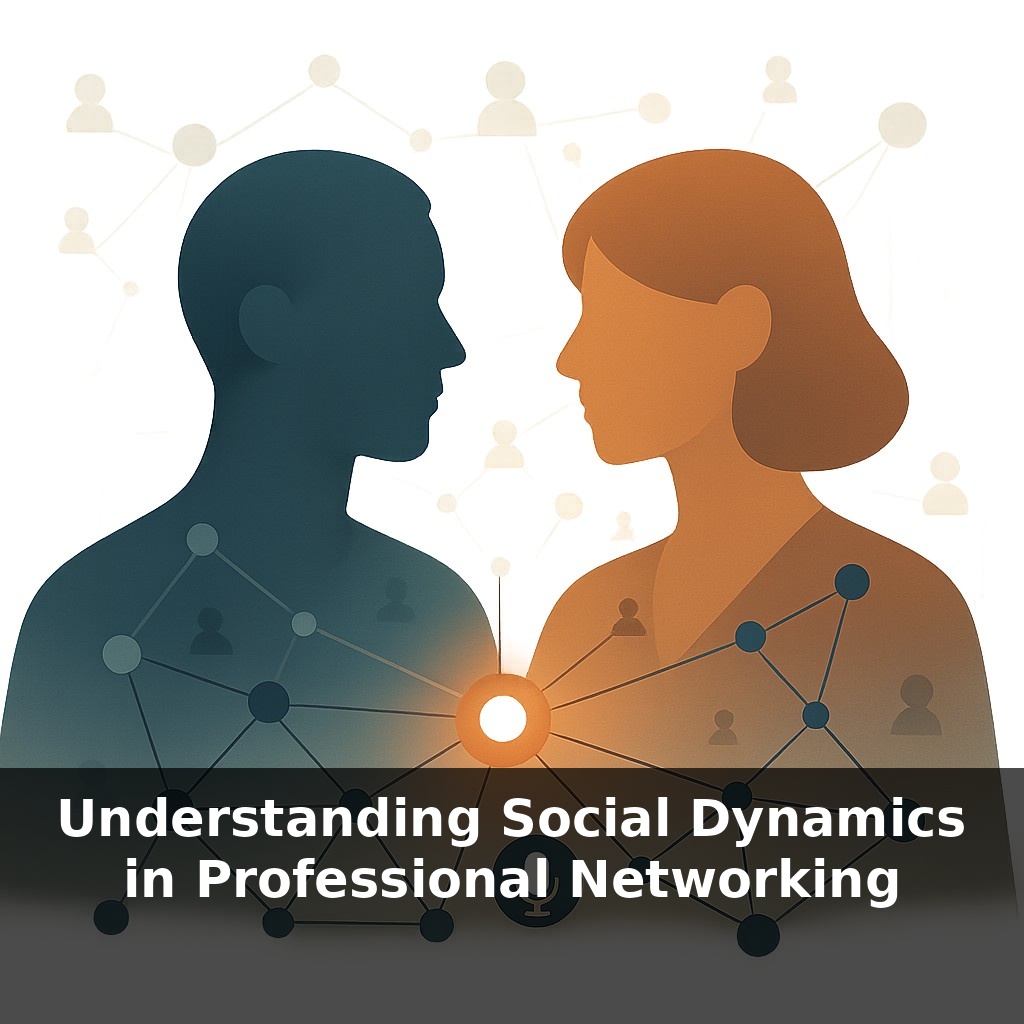
Understanding Social Dynamics in Professional Networking
📝 Transcript
“Most people think career growth is all about hard work and talent. Then a colleague you barely know mentions a role, and suddenly your path changes. In this episode, we’ll explore why those almost-strangers often matter more than your closest work friends.”
A surprising number of “random” career breaks aren’t random at all—they’re the visible tip of hidden social patterns. While you’re replying to emails, grabbing coffee, or tagging someone on LinkedIn, your brain is quietly following rules it never told you about: you drift toward people who feel familiar, you connect colleagues who “should really meet,” and you occasionally reach across teams when something intrigues you. Each of those micro-moments is reshaping your professional network in ways that can either trap you in a bubble or quietly open doors. In this episode, we’ll unpack three of the forces doing this shaping—homophily, triadic closure, and structural position—and look at how organizations already exploit them, from internal talent marketplaces to algorithmic “people you may know” nudges. The goal isn’t to turn you into a walking spreadsheet of contacts, but to help you see the structure you’re already living inside—and learn to tweak it on purpose.
So instead of asking “Do I know enough people?” a better question is “Where do I sit in the flow of information and opportunity?” Network research shows that people who act as bridges across teams, functions, or even social circles quietly accumulate an edge: they hear about roles sooner, spot emerging projects, and get pulled into decisions that never hit a job board. Organizations know this—OD teams map collaboration data, and platforms like LinkedIn actively steer you toward structurally useful connections. In this episode, we’ll zoom out from individual relationships and look at how your overall pattern of ties can amplify or mute your impact.
When researchers map real organizations, they don’t just see dots and lines—they see power, bottlenecks, and blind spots. One striking pattern: people who sit on the shortest paths between many others (high betweenness centrality) are dramatically more likely to be tagged as “high potential.” Not because they’re necessarily smarter, but because they’re constantly in the flow of questions, problems, and decisions. Others learn to rely on them.
This is where network theory shifts from abstract to practical. In most companies, formal org charts suggest that access runs vertically—manager to director to VP. Actual influence often runs sideways, diagonally, and sometimes through that quiet IC who somehow knows everyone in product, sales, and ops. When Cross and Parker found those with high betweenness centrality were 50% more likely to appear in leadership pipelines, they were quantifying something leaders intuitively spot: people who connect otherwise separate pockets of the organization become hard to ignore.
Digital platforms have baked this into their design. LinkedIn’s “People You May Know” isn’t just a convenience; it systematically nudges you toward structurally valuable edges—second-degree contacts, colleagues in adjacent functions, alumni in different industries. That 30% bump in connections per user isn’t random growth; it’s algorithmic steering that subtly shifts where you sit relative to information flows and opportunities.
Here’s the twist: bigger isn’t always better. An average professional may have a couple hundred online contacts, but only a small fraction are strong ties. The rest are potential bridges. The real differentiator is how varied those bridges are. Studies of R&D teams show that when members connect across disciplines, sites, or cultures, innovation can jump by a quarter or more. Diversity of perspectives isn’t just morally appealing; it’s mathematically advantageous.
Think of leaders you’ve seen who always seem “early” on trends inside the company. Often, they’re not clairvoyant—they’re simply plugged into multiple clusters that rarely talk directly. That vantage point lets them spot patterns, translate between groups, and propose ideas that feel both fresh and feasible. Over time, others start routing possibilities through them.
A concrete example: a mid-level engineer at a fintech company volunteers to sit in on a weekly customer-support triage call. It’s not in her job description, but she’s curious about recurring bugs. Within a month, product managers start pinging her for “the real story” from customers, and support leads loop her in before big releases. She hasn’t changed roles, but her visibility into three different groups quietly upgrades her influence.
Another case: a marketer joins a cross-company book club that includes HR, data science, and legal. Months later, when HR pilots an internal talent marketplace, the marketer is one of the first to hear about stretch projects in analytics and offers to help shape internal messaging. That one extracurricular tie becomes a hinge for a lateral move.
Here’s where this becomes practical: those “extra” meetings, side projects, and informal communities are often where new weak ties appear without feeling like networking. Over time, they stack into a distinctive signature of who hears about what, and when.
Silent signals inside these maps matter. As tools surface “who tends to ask whom” or “who clusters where,” organizations may start hiring not just for skills, but for how a person reshapes the graph. That shifts development, too: future training might coach people to rotate through projects the way farmers rotate crops—refreshing soil, preventing monocultures of thought, and keeping the overall ecosystem resilient when markets or strategies suddenly change.
So the question shifts from “Do I know the right people?” to “What patterns am I quietly reinforcing?” Treat your next week like a field study: notice who never hears your updates, whose updates you never see, and where conversations seem to “die.” Those silent gaps are invitations; each small, curious outreach is like planting a new path through a dense forest.
Here's your challenge this week: Attend (or schedule) one professional interaction where you *intentionally* play “social cartographer” for 20 minutes—your only job is to quietly map the social dynamics in the room or call. Count how many times status signals show up (who speaks first, who interrupts, who people turn their bodies toward, who gets follow-up questions) and write down at least three concrete patterns you notice. Before you leave, ask one thoughtful, asymmetric question (something that lets the other person talk about their expertise while you listen) and track how it changes their level of engagement. By the end of the week, share your top two social-dynamics insights with a peer or mentor and ask them if they’ve noticed the same patterns.
From this course
The Psychology of Networking
7 episodesUnlock all episodes
Full access to 7 episodes and everything on OwlUp.
Subscribe — $1.99/monthLess than a coffee ☕ · Cancel anytime