In one global study, only about a quarter of top executives were women—yet those same companies relied on their invisible labor to keep teams running. You’re in a meeting: titles say one thing, everyone defers to someone else. That gap between chart and reality? That’s today’s topic.
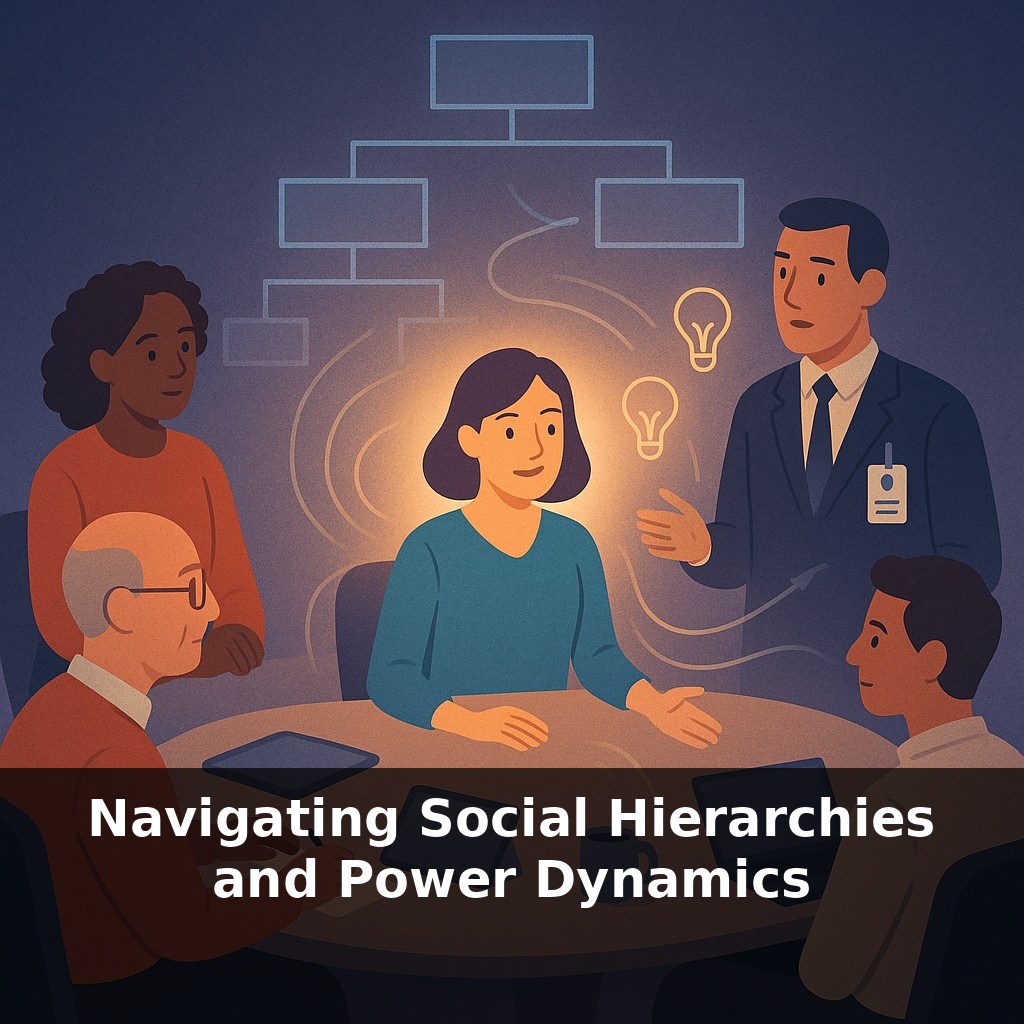
Power at work rarely looks like a movie villain twirling a mustache; it’s closer to subtle stage-lighting that makes some people’s ideas glow and leaves others in shadow. Two people can say the same sentence—and one reshapes the project while the other gets ignored. That’s not just personality; it’s hierarchy and power dynamics in motion.
Today we’re moving beyond titles into how power actually flows: who gets looped into early drafts, whose Slack messages get instant replies, whose “quick feedback” quietly redirects months of work. We’ll look at why some people become informal hubs, how “power with” beats “power over” for performance, and how you can read these currents without becoming manipulative—or disappearing into background support.
Some of this “stage-lighting” is structural—like who controls budgets, hiring, or access to senior leaders. But a surprising amount comes from quieter sources: who’s trusted with bad news, who’s asked to “sense-check” a plan, who people copy when they’re unsure how formal to be. These are all micro-signals of power. You might notice them in whose calendar gets protected, whose deadlines are treated as movable, or whose preferences silently become “the way we do things.” Learning to read these signals isn’t about gaming the system; it’s about seeing the real game you’re already playing.
Most workplaces actually run on two overlapping hierarchies: the one you can print, and the one you can only feel. You already know they diverge—but the useful question is: *diverge how?* The answer usually lives in three layers you can start to map.
First, **formal power sources**: who controls resources (headcount, budget, tools), who sets priorities, who decides “go / no-go.” This isn’t just the CEO; it might be the PM who owns the roadmap everyone else must align to, or the operations lead who can block launches on compliance grounds. Spot these by tracking whose approval repeatedly shows up as the last checkbox before anything important moves.
Second, **expert power**: the people whose opinion can quietly reroute decisions because they’re seen as the authority. That senior engineer who never presents in all-hands but whose thumbs-up determines whether a design ships? Classic. Expertise power often spikes when risk is high—security, legal, finance—and drops when things are routine. Notice when the room pauses and turns to one person for “sanity check”; you’ve found a node.
Third, **relational power**: the connectors who can move information—and emotions—across boundaries. They might not sign off on budgets, but they can get your idea pre-sold in three teams before the formal meeting. You’ll see them in cross-functional chats, side-channel calls, and “quick coffees” that mysteriously smooth later discussions.
Here’s the twist: these powers don’t simply stack; they **trade off**. A director with weak relationships can be outmaneuvered by a mid-level manager everyone trusts. A technical expert with zero empathy gets consulted less over time, no matter how brilliant. An information-holder who hoards details for leverage eventually gets bypassed as others route around them.
Think of your own role along two axes: how much **decision authority** you formally have, and how much **pull** you have via expertise and relationships. Your goal isn’t always to “climb” but to **widen**—so that when stakes are high, people instinctively pull you into the conversation early.
To do that ethically, shift your focus from “How do I win this interaction?” to “How do I increase the total options and safety in this room?” The people who rise and stay there aren’t just powerful; they make others feel more powerful when they’re around.
The quickest way to see these layers in action is to watch moments of friction. A senior VP insists a launch must happen Friday. Nobody argues directly, but after the meeting, three people huddle: a staff engineer, a sales lead, and a project coordinator everyone trusts. None outrank the VP, yet they quietly reshape the plan—flagging a risk, alerting a client, nudging the date. By Monday, the “decision” has evolved into something safer and smarter. That’s not rebellion; it’s how real influence often travels.
Or flip it: a brilliant analyst hoards data, correcting others in meetings but never sharing context ahead of time. At first, this looks like strength. Then leaders start inviting someone else who packages the same insights in a way others can use. Information without generosity becomes self-cancelling.
A useful test: whose absence would stall three different projects this month—not just for approvals, but because conversations simply don’t move the same without them? That’s where the living structure really is.
The next wave of hierarchies will be partly human, partly algorithmic. As tools log who comments, tags, and amplifies ideas, “influence scores” will quietly shape whose proposals surface. That means your digital trace—how you show up in docs, chats, async threads—becomes as important as meeting-room presence. Your edge won’t be louder takes, but pattern-spotting: noticing who gets ignored by the system, then using your visibility to route attention their way.
Treat this like learning a city, not memorizing a map: walk the alleys, notice who everyone greets, which cafés (channels) ideas pass through, where traffic jams form. Hierarchy literacy isn’t about gaming people; it’s about seeing the full terrain—so you can choose, moment by moment, whether to amplify, redirect, or quietly clear a path.
Before next week, ask yourself: Where in my day-to-day life (team meetings, group chats, family plans, or friend hangouts) do I quietly defer to someone’s status or confidence, even when I actually disagree? When you notice a subtle power move—like someone interrupting you, dismissing your idea, or deciding for the group—how could you respond in the moment with one clear sentence that protects your boundary (for example, “I’d like to finish my thought” or “Let’s consider this option too”)? In your closest relationships, whose unspoken “rules” tend to set the tone (who picks the restaurant, who talks the most, who never gets questioned), and what’s one conversation you’ve been avoiding that would gently rebalance that dynamic?