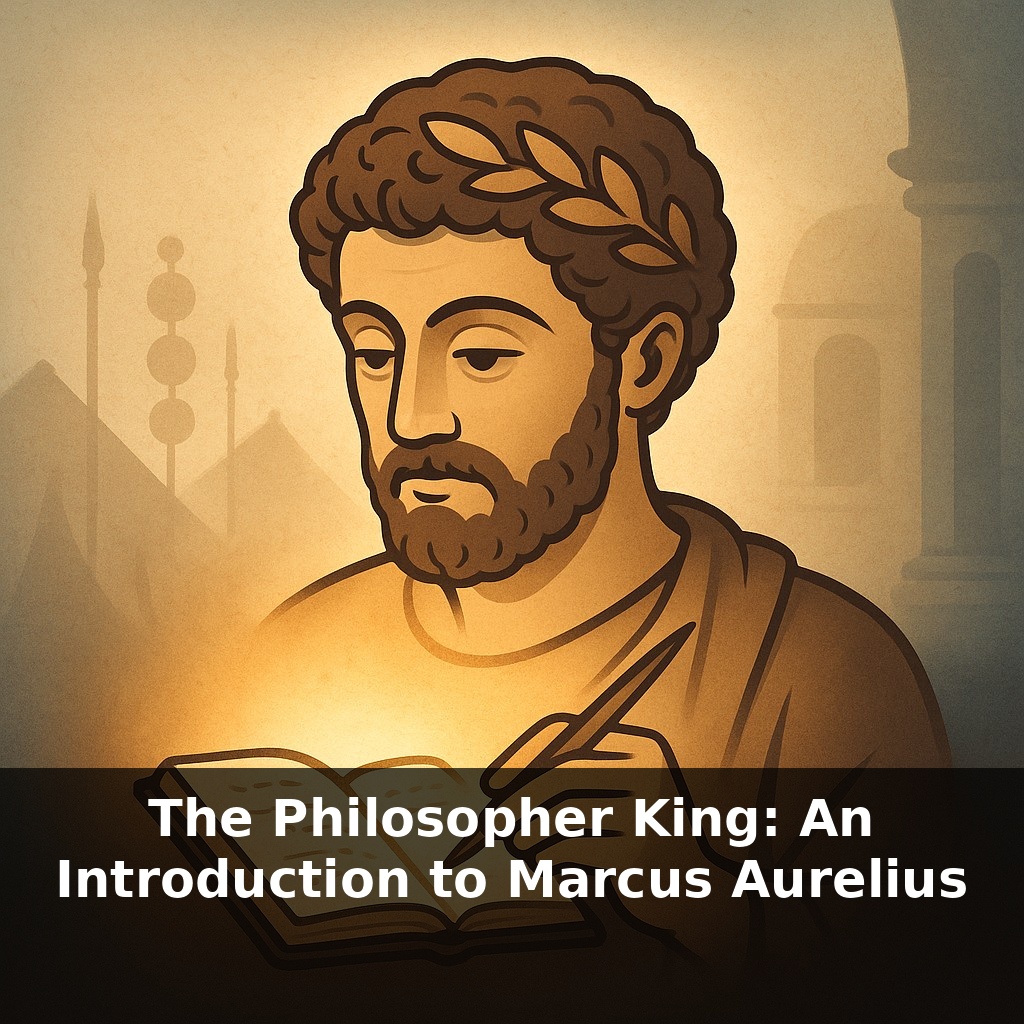
The Philosopher King: An Introduction to Marcus Aurelius
📝 Transcript
A Roman emperor once spent his nights writing private notes on how not to be corrupted by power. Not speeches, not laws—quiet reminders to himself on how to stay decent while commanding legions. Two thousand years later, we’re still reading his diary for guidance.
Marcus Aurelius didn’t write for an audience, a senate, or history books. He wrote in cramped military camps, between meetings, during sleepless nights, capturing fleeting thoughts before they slipped away. These notes—later called *Meditations*—weren’t polished essays. They were more like mental debugging logs, where he hunted down ego, anger, and fear the way a careful coder traces hidden bugs in a system.
Born into privilege, trained in rhetoric, and raised near the center of Roman power, Marcus was expected to rule—but he insisted first on learning how to think. He studied philosophy not as an ornament, but as a discipline for living: a way to face bad news from the frontier, betrayal at court, or the latest outbreak of disease without losing inner stability.
In this episode, we’ll meet Marcus not as a marble statue, but as a working leader wrestling with pressure, doubt, and responsibility.
Marcus didn’t just think about virtue in the abstract; he tested it under pressure. His empire faced border invasions, budget shortfalls, and a devastating plague that killed thousands—including, possibly, the very people advising him. Yet in his notes he keeps circling the same themes: responsibility, perspective, and the discipline to respond rather than react. It’s a mindset closer to a modern CEO in crisis mode than a distant legend in a toga—juggling conflicting reports, limited time, and human flaws, starting with his own, and still asking, “What is the right thing to do *now*?”
Marcus’s path to the throne wasn’t a straight line of glory; it was a long apprenticeship in limits. As a young man, he was adopted into the imperial family, paired with a co-emperor, and constantly reminded that power in Rome was never fully secure. Behind the title “emperor” stood a fragile reality: fickle legions, ambitious generals, and a population that could turn quickly if grain shipments failed or taxes rose too high.
This is where Stoicism became more than an intellectual interest. Marcus was surrounded by teachers—Junius Rusticus, who put Epictetus into his hands; Sextus of Chaeronea, who modeled calm, principled behavior; and others who showed him that philosophy could function like a rigorous training regime. Not to escape politics, but to endure and improve it from within.
When he finally ruled, he shared power with Lucius Verus, an arrangement that could easily have dissolved into rivalry. Instead, Marcus let his co-emperor take the more glamorous role leading campaigns in the East, while he handled less visible, grinding administrative work. During the Antonine Plague and the Marcomannic Wars, he repeatedly chose unpopular measures—new taxes, currency debasement, selling palace treasures—to keep the state functioning. The denarius lost silver, but the frontiers held.
Think of his rule less as a series of heroic gestures and more as continuous, unglamorous debugging of a massive, creaking legacy system: the Roman state. He patched legal codes to soften absolute power over slaves and protect minors, resisted scapegoating during plague, and tried to steer the succession responsibly, even though his choice of his son Commodus ultimately failed.
The paradox is stark: a man who wrote privately about humility also carried titles like “Father of the Fatherland.” A thinker devoted to rational self‑command spent most of his reign in war camps. His life raises uncomfortable questions that still matter: Can you exercise vast power without being consumed by it? How much compromise can an ethical leader accept before they’re no longer ethical?
In later episodes, we’ll zoom in on specific entries from *Meditations* and match them to these moments: frontier crises, tough financial calls, personal loss. The goal isn’t to idolize Marcus, but to see how a fallible human tried—day after day—to align decisions, emotions, and authority with a demanding philosophical standard.
Marcus’s situation wasn’t an abstract thought experiment; it was a pile of hard constraints. He couldn’t stop the northern tribes from probing Rome’s borders, couldn’t wish away the plague, couldn’t print infinite wealth without wrecking the economy. What he *could* do was choose where the pain landed, and why.
Consider the currency change: shaving silver from coins looks like a dry technical tweak, but it’s closer to a modern CFO deciding which budget to cut in a downturn. Undercut soldier pay too far and the legions revolt; squeeze the provinces and you ignite resentment; slash public spending and your cities rot. Marcus chose a controlled dilution of the denarius to keep the war effort going, absorbing criticism in exchange for strategic breathing room.
Likewise, softening laws around slaves and minors wasn’t a revolution, but it was a deliberate nudge of a massive system. Each reform is a bit like updating legacy code in production: you can’t rewrite Rome overnight, but you can refactor one unstable module at a time, so fewer people get crushed when the system fails.
Instead of treating Marcus as a relic, think of him as an early case study in “cognitBuilding on this, we can see how his habits, such as testing assumptions, logging failures, and iterating under pressure, are similar to 'live tech' for decision-makers. As leaders today juggle climate risk, AI policy, and polarized publics, following his example becomes crucial. Your challenge this week: pick one recurring high‑stakes choice—budget, hiring, or time—and, each night, briefly log why you chose as you did, then note one small tweak you’d trial next time.
Marcus’s notes weren’t meant as a monument; they were more like a backstage checklist before each day’s performance. That’s why they still feel usable. You can treat your own decisions the same way: not as verdicts, but as drafts. Leadership then becomes less like carving stone, more like regularly updating a living document you’re willing to revise.
To go deeper, here are 3 next steps: 1) Read Books 2 and 7 of *Meditations* (Gregory Hays translation) this week, and listen to Ryan Holiday’s “Daily Stoic” episode on Marcus Aurelius’ morning routine right after, pausing to compare how each treats preparation for the day. 2) Open the “Daily Stoic” or “Stoa” app and complete today’s Stoic exercise specifically through Marcus’ lens: focus on impermanence and your role as a “citizen of the cosmos,” echoing his reflections in Book 6. 3) Watch Donald Robertson’s YouTube lecture “Marcus Aurelius: How to Think Like a Roman Emperor,” then immediately apply one technique he outlines (like negative visualization or the view from above) in a real, mildly stressful situation you’re facing today.
From this course
The Stoic Emperor: Lessons from Marcus Aurelius
5 episodesUnlock all episodes
Full access to 5 episodes and everything on OwlUp.
Subscribe — $1.99/monthLess than a coffee ☕ · Cancel anytime