Battle plans that changed world history have often been written by people whose names never reached the headlines. Tonight, we’ll step into their war rooms, follow their quiet decisions, and trace how invisible choices on maps became turning points on battlefields.
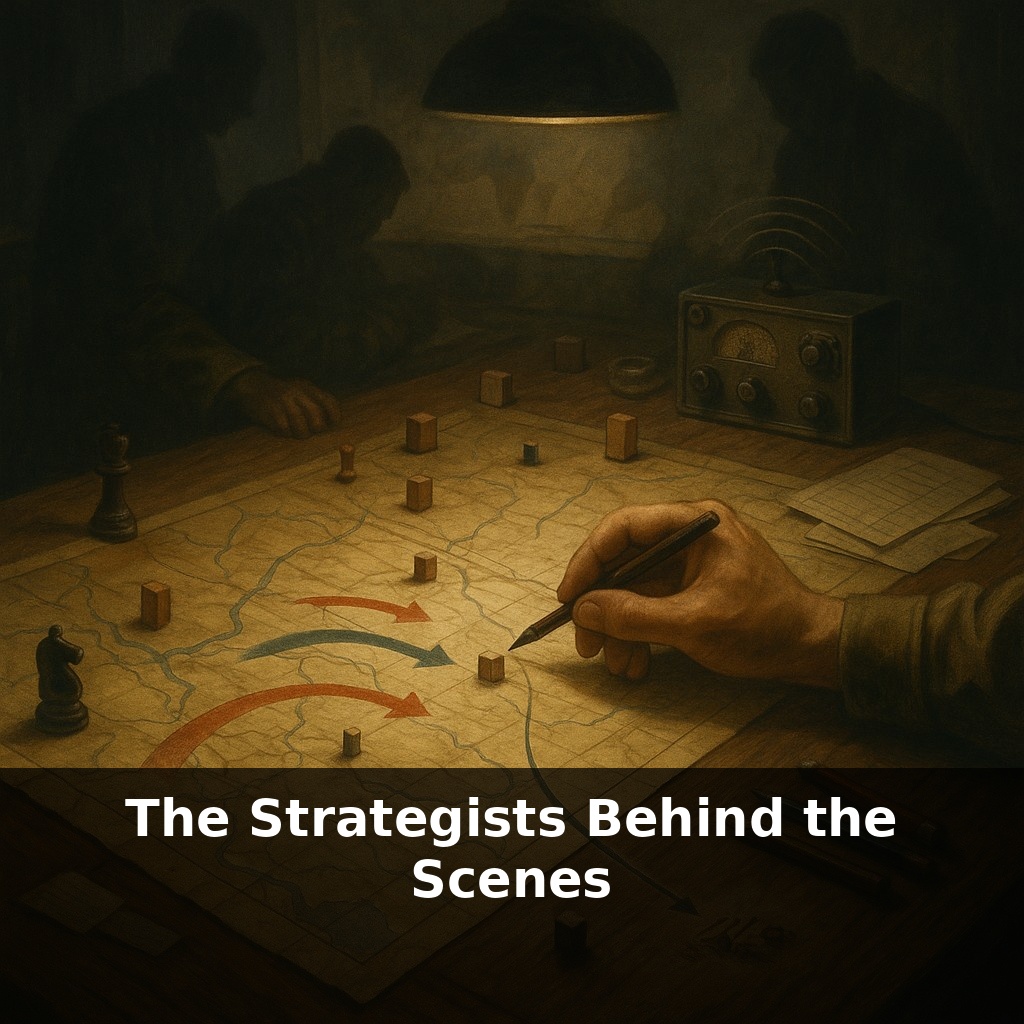
Some of the most decisive moves in wartime never echoed over gunfire—they whispered through radio intercepts, supply ledgers, and scribbled sketches of terrain. While headlines fixate on charging infantry and roaring tanks, a different kind of struggle unfolds in cramped offices, map-filled basements, and windowless bunker rooms. Here, patterns in weather reports, shipping manifests, and enemy habits are sifted and rearranged until a hidden weakness appears. It’s less like a heroic charge and more like slowly tuning an instrument until a single clear note cuts through the noise. In this episode, we’ll follow the people who tuned those notes: the codebreakers who saw attacks before they came, the engineers who turned hills into traps, and the planners who reshaped entire campaigns with a few lines on a chart.
Most of these quiet specialists never set foot on the front line, yet the front line bent around what they discovered and designed. Their world is one of constraints: too few ships, not enough fuel, limited time, messy intelligence. Within those limits, they search for leverage—one detail that, if used well, can shift an entire campaign. A misfiled weather update, an overlooked ridgeline, or a pattern in convoy departures can matter more than another battalion. In modern forces, only a tiny fraction fire weapons directly; the rest refine these hidden levers, turning scattered fragments of information into opportunity.
The public story of a victory usually begins when the shooting starts. The real story often starts months earlier, with someone you’ve never heard of staring at something that does not look like a battlefield at all.
At Midway, that “something” was a jumble of Japanese signals. It was Joseph Rochefort’s team in Station HYPO that squeezed meaning from that chaos. They did not merely “help” the fleet; they turned a vast Pacific Ocean into an ambush site so precise that U.S. carriers were waiting in the right patch of water on the right morning. Official communiqués praised Admiral Nimitz. Nimitz himself, in a letter hidden for decades, quietly pointed to Rochefort as holding a “major share” of the victory. History, for a long time, did not listen.
Two centuries earlier, Tadeusz Kościuszko stood on American soil studying not messages but ridgelines and river bends near Saratoga. His answer to British power was not a rousing speech; it was three miles of fortifications at Bemis Heights that funneled, slowed, and finally trapped an army of roughly 6,000. The surrender he engineered on paper and earth did more than win a battle: it convinced France that the American cause was viable. Muskets and courage were necessary, but the critical blow was struck with surveyor’s tools and geometry.
In the Gulf War, Colonel John Warden pushed an idea that at first sounded almost arrogant: hit the vital systems of Iraq so thoroughly from the air that the ground campaign would become an afterthought. His “Instant Thunder” blueprint mapped power grids, command centers, air defenses—targets that seemed abstract compared with enemy tanks. Yet within 43 days, 94% of those targets were hit. The ground offensive lasted about 100 hours. It looked effortless because the hard part had been done by people whose war was fought in briefings and targeting cells.
Across these stories, a pattern emerges. The spotlight gravitates to the commander giving orders at the moment of contact. But beneath that moment lies a layered architecture of decisions made by specialists—intelligence officers, logisticians, operational planners. In the modern U.S. military, only about 2% wear a combat-arms designation. The remaining 98% build the scaffolding that lets that tip of the spear land exactly where it matters. When their work is classified, or politically inconvenient, or simply too technical for a clean legend, it vanishes from the tale we tell—and the war seems to have been won by willpower alone.
Strategists like Rochefort, Kościuszko, and Warden stand out because we can tie their ideas to famous victories—but they represent a wider ecosystem of minds working out of sight. In many campaigns, the real breakthroughs come when someone notices a quiet mismatch: fuel deliveries that don’t line up with unit locations, construction materials showing up far from any official project, aircraft maintenance schedules that subtly shift before major offensives. These details don’t look heroic, but they sketch the outline of what an opponent *can* and *cannot* do.
Think of a symphony where most listeners only follow the melody; the conductor, though, hears the second clarinet miss a beat and knows the whole piece is about to drift. Behind every headline-grabbing assault, there are people listening for those small, off-tempo notes—analysts flagging odd procurement orders, logisticians modeling bridge capacities, targeteers debating which single node will quietly collapse a network. Their names rarely appear in memoirs, yet their fingerprints are all over the moments we remember as inevitabilities.
The next generation of “unseen heroes” may never deploy in uniform. They’ll tune models, secure orbital relays, and probe quantum-safe ciphers—shaping outcomes long before any shot is fired. As tools grow opaque, authority may rest with those who best understand their limits, not just their power. The real struggle could be less about seizing ground and more about who curates data streams, audits algorithms, and decides when to pull the plug on an automated plan.
Your challenge this week: pick any famous victory—military, political, or even a sports upset—and hunt for one overlooked mind behind it. Skip the headline names. Read footnotes, staff lists, technical annexes. Note what that person *actually* changed. By Sunday, ask: how different is the story once the hidden strategist moves to the foreground?