A war can turn on a blueprint no soldier ever sees. A bomb that skips like a stone, a tank that keeps moving when others stall, a wooden boat that swallows a whole squad. These weren’t theories on a map—they were last‑minute inventions that quietly rewired the battlefield.
Barnes Wallis, Mikhail Koshkin, Andrew Higgins—three names that rarely make the headline reels of World War II, yet their work quietly bent the war’s trajectory. They weren’t the ones drawing arrows across continents, but the ones staring at unsolved problems that killed people by the hour: walls of water feeding German industry, panzers grinding forward, shorelines that might become mass graves if troops landed too slowly. Their world was tape measures, stress calculations, and test rigs that failed in public. If generals thought in theaters, these engineers thought in inches and seconds. Their job was to turn vague demands—“hit that dam,” “stop that tank,” “land that division”—into machines that could survive cold steel and hot shrapnel. Like a jazz band improvising around a single riff, they adapted, scrapped, and rebuilt until something finally worked under live fire.
Wallis, Koshkin, and Higgins each confronted a different kind of dead end. Wallis faced targets protected not just by concrete, but by physics: steep dam walls, torpedo nets, shallow approach routes. Koshkin’s team had to design a tank for a country with brutal winters and bad roads, then prove it by driving prototypes hundreds of miles under their own power. Higgins wrestled not with steel monsters, but with mud, tides, and sandbars, reshaping boat hulls until they behaved more like stubborn river currents than obedient hardware. Their constraints weren’t obstacles to design; they were the raw material of it.
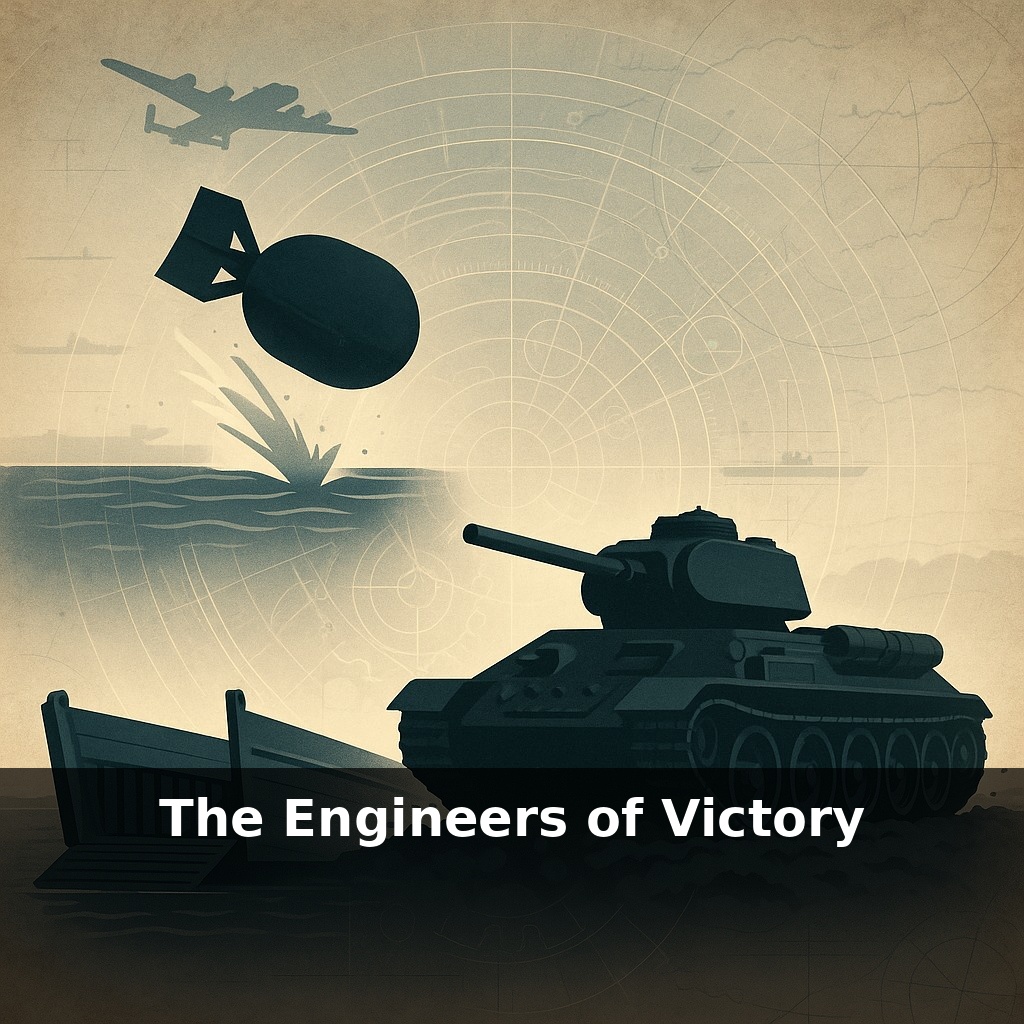
Wallis began with a problem that sounded simple and turned poisonous the moment you did the math: how do you smash a vertical wall hidden behind water, nets, and flak guns? Conventional bombs either missed the dam face or exploded too shallow. His answer, “Upkeep,” was less a bomb than a precisely choreographed movement through air and water: dropped at a fixed speed, height, and spin so it would skip over the surface, clear the nets, kiss the dam, then sink and detonate at depth. Crews had to fly their Lancasters at about 60 feet at night—so low they bolted spotlights under the fuselage as crude rangefinders. The physics could be modeled on paper; the timing lived or died in a pilot’s nerves.
Koshkin’s team faced the opposite geometry problem: not how to destroy a wall, but how to make a moving fortress that wouldn’t become a steel coffin. Their T‑34 had to combine firepower, mobility, and protection without collapsing Soviet industry. The sloped armor wasn’t just thicker; it angled incoming rounds so more of them glanced off. Wide tracks bit into mud and snow instead of sinking. Its diesel engine reduced fire risk and extended range. Yet on paper virtues met ugly realities: early gearboxes failed, vision for the crew was poor, and many tanks simply broke down before reaching the front. The miracle was not one perfect design, but that factories east of the Urals could keep pushing out thousands while learning on the fly.
Higgins worked at the shoreline where strategy literally ran aground. Existing landing boats were too deep, too slow, or couldn’t unload under fire. Drawing on swamp boats and Gulf Coast work craft, he lowered the draft, flattened the bottom, and added that now‑iconic bow ramp. Infantry could rush straight out instead of climbing over the sides. The craft weren’t elegant; they were plywood boxes with engines, cheap enough to scatter by the tens of thousands across oceans.
If generals wrote requirements, these people wrote the footnotes that made them possible. Their solutions lived in the risky middle ground where equations met weather, fear, and human hands.
Wallis didn’t work alone in a quiet lab; his “impossible” requirements rippled outward into crews who had to invent new habits in real time. Pilots rehearsed flying so low that treetops seemed like obstacles on a training course, while ground crews hacked together spotlight systems and crude sighting devices out of parts never meant to share a cockpit. The math stayed in the background; what mattered was whether a tired pilot could hit a narrow performance window in the dark.
Koshkin’s tank wasn’t just a blueprint hammered into steel; it was a rolling conversation between front-line crews and rear-area workshops. Units sent back reports of broken gearboxes and jammed hatches; factories quietly simplified parts, dropped nonessential fittings, and re‑arranged welds so half‑trained workers could assemble hulls in freezing sheds. Each “model year” might last only a few months before another quiet revision.
Higgins’ boats, too, evolved as Marines and soldiers treated them like stubborn instruments that needed retuning after every operation. Crews cut handholds into bulkheads, shifted cargo tie‑downs, and experimented with loading patterns so vehicles wouldn’t bog the bow in unexpected surf. Navy planners adjusted entire timetables once they saw how fast or slow real units could clear a beach under fire.
Seen together, these stories show that the crucial breakthroughs weren’t frozen moments of genius so much as cascades of small, grounded adjustments that tightened the link between big ideas and what metal, fuel, and exhausted humans could actually do on a bad day. Like a piece of music revised between every performance, each iteration nudged theory closer to reality until the “new normal” on the battlefield quietly shifted.
Future wars may reward teams that treat code, sensors, and materials the way those WWII engineers treated steel and explosives: as clay to be reshaped under pressure. Drone pilots, data scientists, and field technicians will end up as co-authors of new tactics, tuning algorithms mid-mission like musicians adjusting tempo to a restless crowd. The nations that win may be those that let these “quiet experimenters” bend rules fastest when reality refuses to match the plan.
Your challenge this week: spot the “engineer of victory” in everyday life. Notice the person who quietly fixes a recurring snag—a broken workflow, a clumsy handoff, a tool nobody trusts. Ask what tiny tweak they made, and why it worked. By Sunday, map how those small, practical hacks steer outcomes more than the grand plans pinned on the wall.