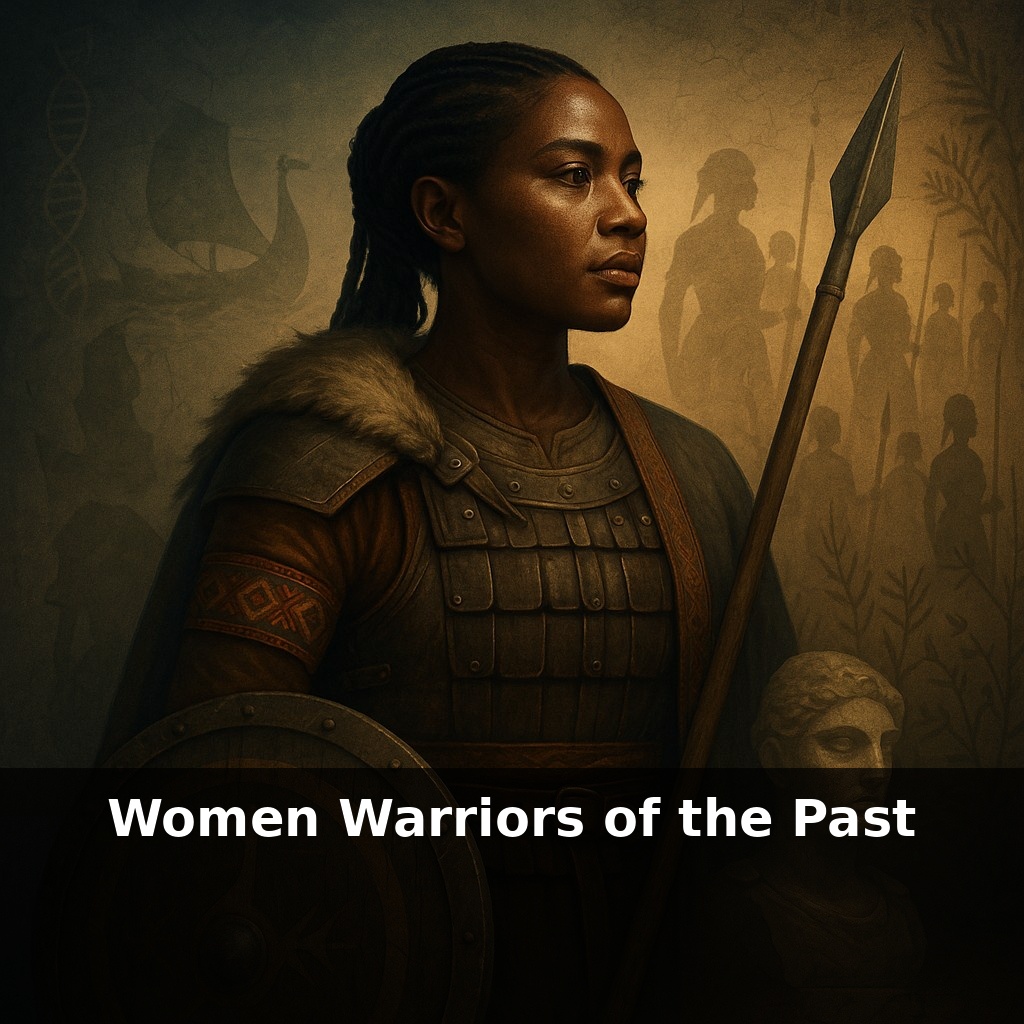
A warrior’s grave in Sweden, once assumed male, turned out—through DNA—to belong to a woman buried with weapons and warhorses. So here’s the puzzle: if even our skeletons break the rules of history, how many other women fighters have we edited out of the past?
Step outside Europe for a moment and the pattern becomes even harder to ignore. In West Africa, the Kingdom of Dahomey fielded an elite women’s regiment so feared that French officers compared facing them to “fighting in a thorn forest.” In Vietnam, Triệu Thị Trinh—said to have refused a life of embroidery and silence—rallied hundreds, then thousands, to resist occupation. Centuries later, on the shattered fronts of World War II, Soviet sniper Lyudmila Pavlichenko turned the scope of her rifle into a battlefield equalizer, her confirmed kills rivaling entire infantry companies. These aren’t side notes to “real” history; they are pressure points where individual women bent the course of wars. Yet most school timelines glide past them, as if the clash of empires happened in a world where half the population merely watched.
Yet when you look at how these stories have survived, they’re often wrapped in labels that blur more than they clarify: “legendary maiden,” “exotic amazons,” “saints,” “she-devils.” Chronicles praise their courage, then rush to insist they were exceptions, not evidence of a broader pattern. Archaeologists long coded any grave with weapons as male; chroniclers smoothed female commanders into mascots, mascots into myths. The archive starts to look less like a neutral record and more like a battlefield itself—where what gets written, translated, and taught is shaped by the victors’ ideas of who is allowed to be dangerous.
Start pulling at these loose threads and the fabric of “male-only warfare” starts to fray. Across early medieval Europe, ballads about “maidens in armor” sound like fantasy—until you match them with burial sites where weapon-rich graves test as biologically female. In Central Asia, steppe nomads trained girls to ride and shoot from childhood; the same skeletal markers that reveal lifelong archery in presumed male warriors are now being found in female remains, too. Once researchers stop deciding in advance which bones “must” be men, different stories leak out of the ground.
Chronicles also hide clues in their throwaway lines. A Chinese source might dismiss a woman commander as “unnatural,” but then casually mention the troops she led, the fortresses she held. Islamic legal texts from the medieval period debate whether women who fought in specific battles deserved a share of the spoils—an oddly technical question if they were mere mascots. Even when records work hard to deny women full warrior status, they accidentally confirm participation: supply lists with women’s names, pay registers, rations assigned to “archer’s wife” who is issued her own bow.
Not all fighting meant front-line swordplay. Raids, sabotage, intelligence, and logistics could decide campaigns long before armies clashed. In colonial Latin America, women organized food networks for rebels, smuggled messages in laundry bundles, and, when needed, picked up muskets. In West and East Africa, oral epics remember queens who rode into battle but also negotiated truces, marshaled labor, and commanded fortified towns. Violence and authority traveled together: to control a city’s gates or grain stores was often as decisive as wielding a spear.
As historians widen the definition of “combatant,” patterns emerge: women appear wherever war demands skills that aren’t brute-force dependent—riding, shooting, planning ambushes, holding sieges. Like a shifting weather front that only becomes visible when you track pressure and wind instead of just rain, women’s roles in war snap into focus when you follow functions—who planned, who supplied, who killed and risked being killed—rather than the armor shown in schoolbook illustrations.
Some of the clearest examples appear when historians zoom in on very specific tasks. On Viking-age ships, for instance, textile impressions and weapon damage on shields sometimes line up with women’s graves inland, hinting that the same hands that spun sailcloth may also have repaired gear between raids. In medieval Japan, samurai households trained women in the naginata polearm not as a curiosity, but because castle defense often fell to whoever was inside the walls when the men rode out. Early modern piracy records from the Caribbean list “ship’s boys” who were only later unmasked as women when court clerks described their clothing at execution. Even in urban uprisings—Paris 1789, Warsaw 1944—women show up in munitions workshops, on barricades, and in neighborhood patrols that blurred into militias. When you track who had access to horses, weapons storage, or city keys, the map of potential fighters expands, and names that once looked like background characters start to resemble field commanders.
As more records, bones, and ballads are re-read with fewer blinders, the “exceptional woman warrior” may start to look less like an outlier and more like the visible peak of a larger ridge. Training manuals, wargames, and even recruitment ads could shift from portraying women as symbolic tokens to modeling mixed-gender units as normal practice. Museums might re-tag exhibits, and school timelines could weave in campaigns led or shaped by women, not as a side note, but as a recurring drumbeat in military history.
The next step isn’t to crown a few “heroines,” but to widen the frame. When you revisit battle maps, ask whose routes are missing: scouts, smugglers, camp-guardians, code carriers. Their traces are faint—side notes, mislabeled bodies, stray pay records—but follow them, and the familiar story of war starts to modulate like a song gaining back its missing harmonies.
Try this experiment: Pick one woman warrior from the episode—say Boudica, Tomoe Gozen, or the Dahomey Amazons—and choose a 20‑minute task today that feels even slightly intimidating (a hard email, a boundary conversation, a physical challenge). Before you start, quickly google a historical image or symbol linked to her and keep it visible (on your screen, as your phone background, or sketched on a sticky note). For those 20 minutes, act as if you’re “borrowing” her tactics—Boudica’s ferocity, Tomoe’s precision, or the Amazons’ discipline—and push through the task without stopping. When you’re done, rate from 1–10 how much that mental “warrior overlay” changed your courage or focus, and decide whether to repeat it tomorrow with the same or a different warrior.