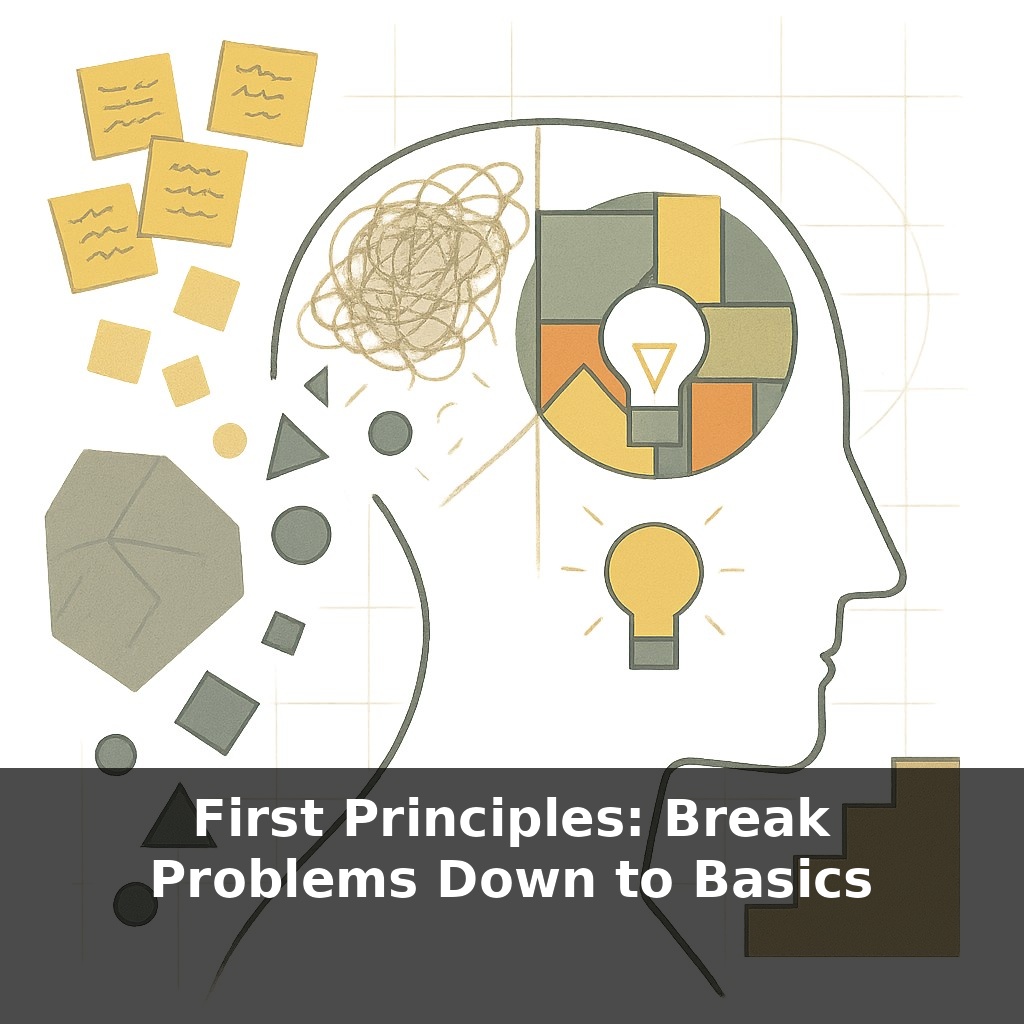
Einstein once said, “Everything should be made as simple as possible, but not simpler.” Now jump to a modern product meeting: smart people, sticky notes everywhere—yet progress crawls. The paradox: the more experience we have, the less often we actually question the basics.
Most teams don’t ship bad ideas because they’re foolish; they ship bland ideas because they’re rushed. A deadline appears, someone says “Let’s reuse last quarter’s playbook,” and suddenly the meeting is about tweaking slides instead of examining reality. The shortcut feels efficient—until you notice every “new” plan is just a recolored version of the last one.
First-principles thinking is the antidote to that quiet autopilot. Instead of starting from “what we did before,” you start from what must be true right now: the physics, the constraints, the real customer behavior, the actual costs. It’s less about being clever, more about being brutally honest.
Used well, it turns vague wishes into crisp levers you can pull. You stop arguing opinions and start interrogating assumptions. And that’s where surprising options appear—the ones no template would ever have suggested.
Most people hear “back to basics” and think of dumbing things down. In practice, the opposite happens: the more fundamental your questions, the more sophisticated your options become. Aristotle chased the kind of truths you can’t wiggle out of. Centuries later, Einstein compressed messy phenomena into just two postulates and rewrote physics. Modern builders do similar work in spreadsheets and whiteboards: teasing apart “how it’s always been done” from what reality actually demands. That shift—from habit to causes—turns constraints into design inputs instead of excuses to recycle the usual plan.
Here’s the quiet problem: most “strategy” is actually inheritance. You inherit your industry’s pricing norms, your team’s habits, your manager’s mental model of “what good looks like.” Then you slightly rearrange them and call it a plan.
First-principles work starts by refusing that inheritance. Instead of asking, “What’s the standard approach?” you ask, “What are the pieces of reality here, and how do they actually behave?”
A practical way to do this is in three passes:
1. **Name the target without solutions.** “Reduce customer churn by 30 %.” “Cut unit cost in half.” “Ship this feature in four weeks.” No playbooks, no tactics—just the outcome and why it matters.
2. **List everything you think is true.** Treat your current understanding as a hypothesis dump: - “Customers cancel because of price.” - “Our tech stack can’t handle real-time updates.” - “Legal will never approve X.” Don’t filter; you’re surfacing the invisible rules you’ve been living under. Experience is useful here—but only as raw material, not as verdict.
3. **Interrogate each “truth.”** For every line, ask: - *Is this a law of nature, or a social/organizational habit?* - *What evidence do we actually have? When was it last tested?* - *What’s the smallest experiment that could disprove this?*
When Elon Musk saw rockets priced like jewelry, he didn’t start with “rockets are expensive.” He broke the problem into aluminum, copper, carbon fiber, labor, testing, failure rates. The gap between raw-material cost and market price wasn’t a curiosity; it became a design target.
You can do the same with less glamorous problems. Negotiating salary? Break it down into: market rates, unique skills, measurable impact, hiring alternatives, timing, decision-makers. Product roadmap stuck? Decompose “must-have” features into: user jobs, regulatory constraints, actual adoption data, engineering dependencies.
One helpful test: **swap the domain.** If “it can’t be done” sounds absurd in another context, you probably found a soft assumption. - “No customer will prepay” → airlines, software, and education rely on it. - “We can’t cut delivery times without more staff” → what if the bottleneck is batching or approval, not people?
Like a good physician, you’re trying to distinguish symptoms (surface problems) from causes (underlying mechanisms). Diagnosis comes before prescription—otherwise you just keep increasing the dosage on the same old treatment.
A simple way to feel this is to watch money, time, or frustration leak out of a process and then rewind it to the frame-by-frame level. Take a bloated onboarding flow: instead of “our signup is too long,” zoom into each field and screen. Which data is legally required, which is only “nice to have,” and which is there because someone once asked for it and no one dared remove it? When a team actually does this, they often delete half the steps without touching compliance. Or think of a recurring meeting that eats your calendar. Strip it down: what outcome justifies gathering these people? Which decisions truly require synchronous discussion? Often, the “must-have” weekly meeting becomes an async doc plus a short, focused call once a month. In product work, a team struggling with feature creep can map every request back to a single user job; anything that doesn’t serve it is postponed or cut. Outcomes tend to look bold from the outside, but from the inside they feel like tidy, almost obvious rearrangements of basic pieces.
Future implications: First-principles work scales strangely well. Applied to climate tech, it can expose where we’re “recycling guilt” instead of emissions, forcing designs around physics, not PR. In healthcare, it can reframe treatment plans from “standard protocol” to precise cause-and-effect chains. For your own career, it can surface which skills are true force-multipliers—as if you’re pruning a wildly overgrown tree back to the few branches that actually bear fruit.
Treat this like learning a new instrument: awkward at first, then oddly addictive. Once you’ve stripped a problem to its skeleton a few times—budget, schedule, relationship, even your own habits—you start spotting hidden hinges everywhere. The reward isn’t certainty; it’s cleaner questions and fewer invisible scripts quietly steering your choices.
Try this experiment: Pick one everyday frustration (like your slow morning routine or overflowing email) and force yourself to ask “why?” five times in a row until you hit a basic constraint (time, energy, tools, or rules). Then, for just 24 hours, ignore the usual “how it’s always done” and design a version from scratch using only those first principles: what you’re trying to achieve, what’s absolutely necessary, and what’s optional. For example, if your goal is “be out the door calm and on time,” you might experiment with laying out clothes in the kitchen, eating the same simple breakfast, and banning phone checks until you leave. At the end of the day, compare how long it took, how stressed you felt, and which “normal” steps you didn’t actually miss.