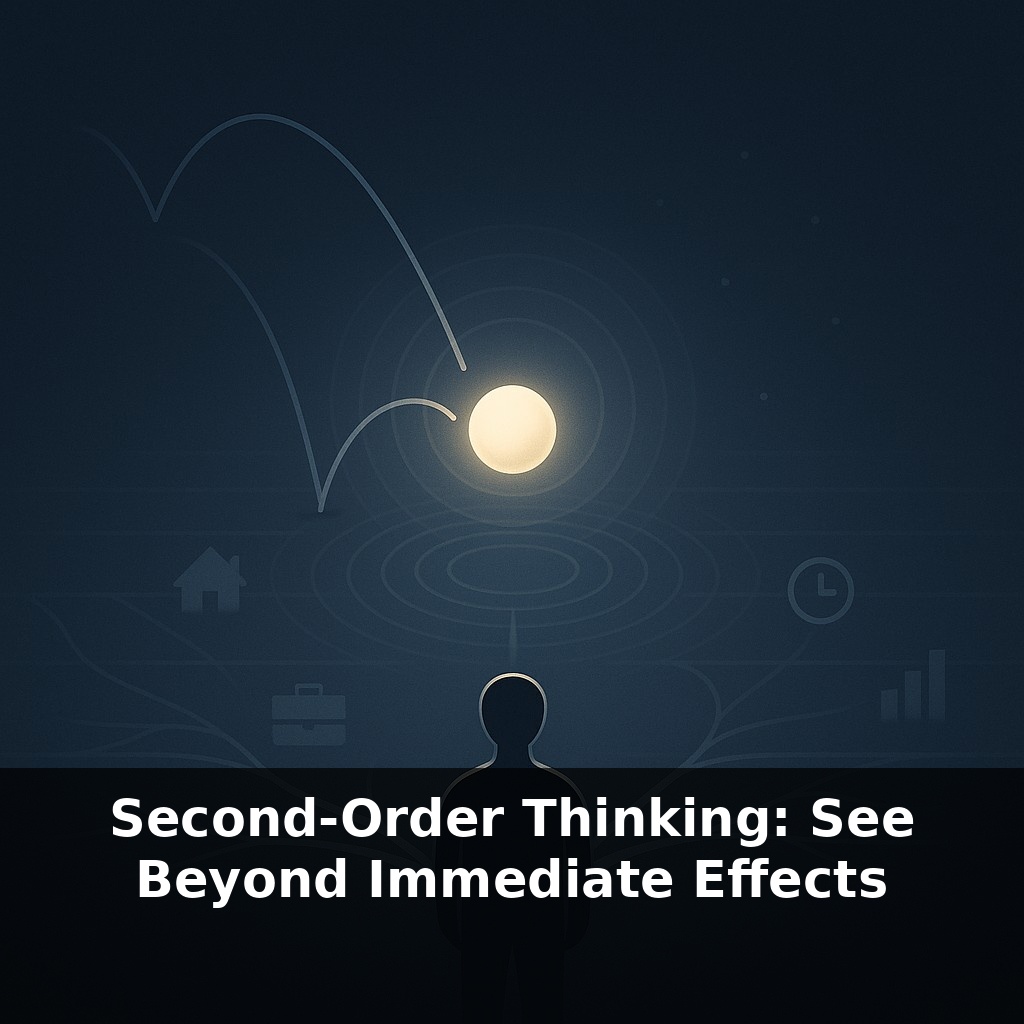
“Most CEOs admit they’re bad at seeing the second bounce of the ball.”
You say yes to a promotion… and six months later you’re working longer hours, missing key family moments, and secretly job-hunting.
Today’s question: what if the real impact of your decisions shows up one step later?
A 2022 McKinsey analysis found something awkward: the companies that planned for multiple futures didn’t just survive uncertainty—they beat their peers by about 30% in long‑term shareholder returns. Not because they had better slogans, but because they kept asking a simple, annoying question: “And then what?”
Think about how we usually decide: we see a benefit, maybe a cost, and move. Accept the offer. Launch the product. Change the policy. In the moment, it feels clear enough. But clarity at step one can hide chaos at step three.
Second‑order thinking turns that quick yes/no into a short chain of cause and effect. If I do this, then what happens next? Who adjusts? What do they do in response? How does that quietly reshape my time, reputation, options?
In this episode, we’ll slow decisions down just enough to see those hidden branches before we commit.
Most of us already do a weak version of this in daily life. You check the weather before leaving, not because you care about the temperature itself, but because you’re quietly asking, “If it rains, what happens to my commute, my clothes, my plans?” But when it comes to careers, money, products, or policies, we stop that chain early. We optimise for the next quarter, the next performance review, the next burst of motivation. In this episode, we’ll look at how to extend that “and then what?” just far enough to change the choices you make this month—not in theory, but in concrete, messy situations.
Here’s the uncomfortable part: first‑order thinking usually works… until the environment starts moving. That’s why it feels so natural. You see a clear gain, a manageable cost, and a short path from action to result. Done. But most real systems—markets, teams, even friendships—don’t behave like simple levers. They push back. They adapt.
That’s where the gap shows up between people who “decide quickly” and people who seem oddly lucky over time. The first group optimises for the immediate transaction. The second group keeps a quiet mental list of second‑order effects: downstream incentives, habits they’re reinforcing, expectations they’re setting, optionality they’re killing or creating.
Look at product discounts. First order: “We’ll boost sales this quarter.” Second order: customers learn to wait for promos, your brand shifts from “worth full price” to “always on sale,” and your future pricing power erodes. Same on the personal side: say yes to every urgent request and you don’t just lose hours today—you train everyone around you to treat your time as cheap.
The 2022 McKinsey result isn’t magic; it’s cumulative small advantages from repeatedly spotting these knock‑ons. Firms that ran rigorous scenarios didn’t merely avoid disasters; they also noticed positive chains others missed. For example, shifting to remote‑friendly policies might, at step one, cut office costs. At step two and three, it expands your talent pool, diversifies perspectives, and makes you more resilient to future shocks.
A simple way to start is to separate effects into three buckets before important decisions:
– Immediate outcome: what happens in the next day or week – Behavioral ripple: how this changes what people expect or repeat – Structural shift: what this locks in or makes easier/harder later
You don’t need perfect foresight; you need two or three plausible paths. The goal isn’t to predict the future precisely, but to stop being surprised by the most obvious futures you could have sketched in advance.
You can see this play out in hiring. First step: you add one “star” performer to hit an urgent target. Feels smart. But watch the later moves: they bring their habits, allies, and standards. Six months on, the team’s culture has tilted around one person—sometimes for the better, sometimes not. The real decision wasn’t “hire or not?” It was “what norms am I quietly importing?”
Or take a manager who bans small process exceptions to “keep things efficient.” At first, that’s fewer judgment calls. Later, high‑initiative people stop raising edge cases, customers sense rigidity, and the org slowly selects for rule‑followers over problem‑solvers.
In medicine, doctors treating chronic pain know that the first prescription isn’t the real fork in the road. The later moves are: dependence risks, reduced mobility, how pain shapes mood and relationships. A short‑term fix can harden into a long‑term trap—or, if handled well, a bridge to rehab and restored function.
The pattern: it’s rarely the first step that matters most, but what it makes likely—or unlikely—three steps later.
Autopilot decision-making will age badly in a world where each choice can trigger chains of reactions across platforms, markets, and cultures. The leaders who thrive won’t be the fastest responders, but the ones who routinely pause to test a few “future snapshots” before they act. Think of it as weather‑proofing your life: you still can’t control the storm, but you can choose higher ground, sturdier materials, and better drainage long before the clouds appear.
Treat this like learning to read a weather map: you’re not guessing the exact raindrop, just noticing the front that’s forming. Over time, those quick mental forecasts compound into fewer “How did we end up here?” moments. Your challenge this week: before any big yes, sketch two ways it could quietly reshape your time, reputation, or freedom later.