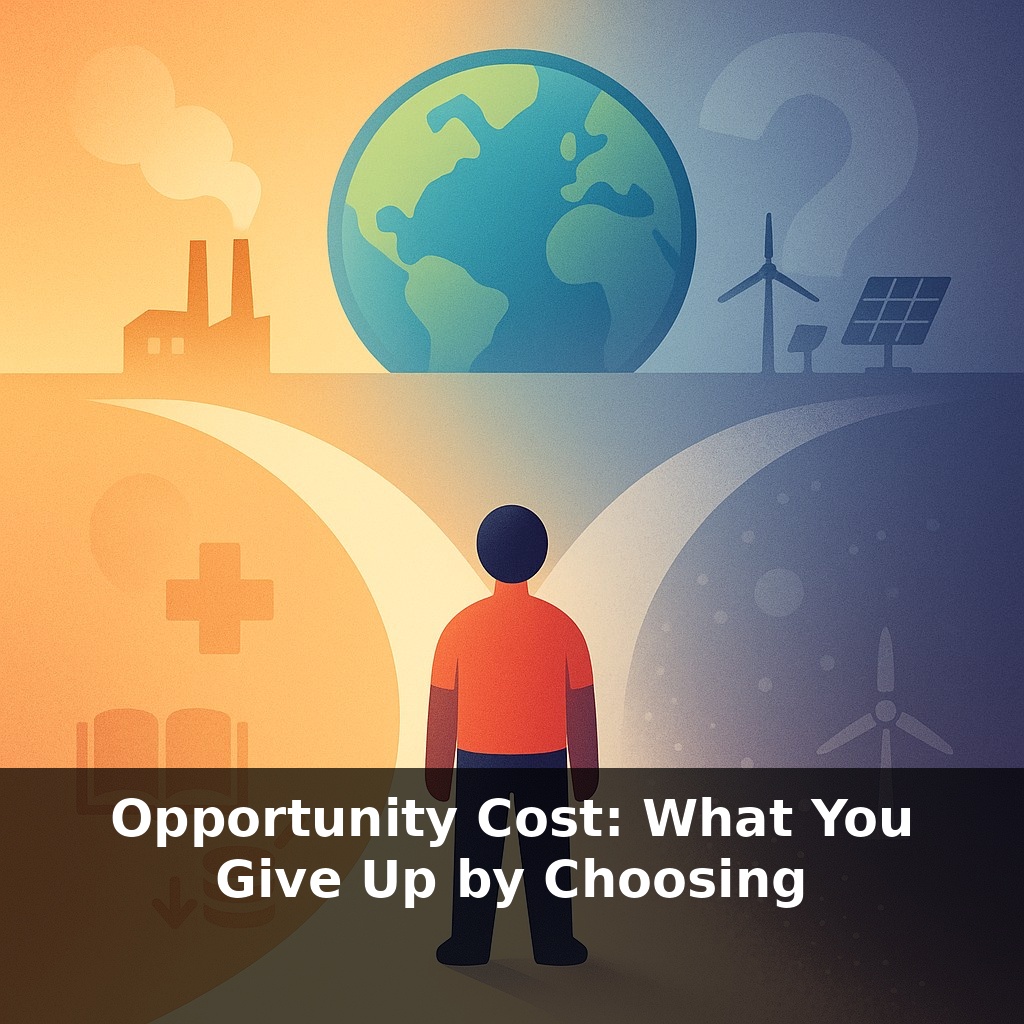
You made a life‑changing decision this week—and probably never noticed. Not the job you took or the person you texted back, but the option you quietly killed when you said yes. In this episode, we’re going to hunt for those invisible “no’s” hiding inside every “yes.”
In 2022, the IMF estimated global fossil‑fuel subsidies at about $1.3 trillion. That isn’t just a line in a budget; it’s a snapshot of what the world chose not to fund instead—clean energy, healthcare, debt reduction, or simply lower taxes. Every choice like that has a shadow price, whether you’re a government writing policy or a person deciding what to do with your next free hour.
Last time, we focused on those invisible “no’s” inside every “yes.” Now we’ll zoom in on what economists call *opportunity cost*: not the price you pay in money, but the value of what you quietly give up. Businesses that track it rigorously have been shown to generate far higher long‑term returns. You don’t need a finance team to use the same logic in your own life—you just need to notice what your current path is silently pushing off the table.
Economists and regulators obsess over this stuff for a reason: ignoring what you’re giving up quietly warps every plan, budget, and life goal. The U.S. government literally requires major regulations to account for foregone alternatives before they’re approved, because the “seen” costs and benefits are almost always misleading on their own. In everyday life, we rarely apply that same discipline. We feel busy, committed, even “all in,” but we almost never stack our current path side‑by‑side with the next‑best use of the same time, money, or energy—like a doctor comparing two treatment plans before prescribing one.
Economists have a dry way of operationalizing all this: they force a comparison. Not “is this good?” but “is this better than the best other thing we could do?” That small shift is what separates a vague preference from a disciplined choice.
You can see this most clearly where the stakes are high. When governments do regulatory impact analyses under rules like U.S. OMB Circular A‑4, they’re not just tallying projected costs and benefits. They’re required to ask: given limited resources, which option creates the most net value compared to the runner‑up? Sometimes that means canceling a politically popular project because another, quieter option saves more lives or money per dollar spent.
Businesses that take this seriously behave differently too. In that McKinsey study, the firms that outperformed weren’t necessarily the ones that found more “good” projects. They were ruthless about ranking them—and saying no to decent ideas when a better one was available. Instead of asking, “Will this investment make money?” they asked, “Will this make *more* than our next‑best use of cash, talent, or attention?” Same budget, different question, very different trajectory.
For individuals, the currency is often time and focus. Two hours of half‑distracted work at night might feel industrious, but compared only to doing nothing. Put it side‑by‑side with two hours of real rest that lets you do tomorrow’s deep work twice as fast, and the picture changes. A “productive” evening might be more expensive than it looks once you price in what it displaces.
This is where the sunk‑cost fallacy bites hard. When you’ve poured months into a project, the instinct is to “get your money’s worth” by continuing. But those past costs are already paid. The only honest comparison is between what you’ll get from continuing versus what you’d gain by freeing that time, attention, or capital for something else. That Harvard Business Review estimate—a hit of up to 30% to project ROI—comes from clinging to the past instead of upgrading to the best available alternative now.
The habit you’re building isn’t pessimism; it’s precision. You’re not just asking, “Is this choice defensible?” You’re asking, “Does this choice still win in a fair fight against what I could do instead—starting today?”
A cardiologist choosing a treatment plan doesn’t just ask, “Will this help?” They compare drugs, procedures, and lifestyle changes, then commit to the option that gives the patient the best expected years of healthy life. Your calendar deserves the same clinical scrutiny. When you say yes to a weekly meeting that drifts with no agenda, what are you denying oxygen to—learning a new skill, calling a friend, working on a side project?
Corporate boards do this in capital reviews: a decent factory upgrade gets shelved because a software overhaul unlocks far more value. Some top firms actually keep a “kill list” of projects that used to make sense but no longer beat the alternatives; reviewing it frees up people and money for bolder bets.
You can quietly copy that move. Keep a short list of recurring commitments—subscriptions, standing calls, routines—and occasionally ask: “If this weren’t already in my life, would it beat everything else I could do with the same time or money?” If not, it’s a candidate for your personal kill list.
A therapist once noted that “every yes is a no to something else,” but the reverse is just as powerful: every no can be a deliberate yes. As AI starts pricing trade‑offs we used to feel only vaguely—like late‑night email versus long‑term health—you may find your priorities shifting. Think of your day like a finite prescription pad: each slot you fill with one “treatment” rules out others. Over a year, those small scripts add up to a radically different life trajectory.
Your challenge this week: Once a day, pick one small decision you already made (how you spent lunch, an hour online, a meeting you joined) and write down a concrete alternative you could have chosen with the same time or energy. Not what you *might someday* do—what you could realistically have done right then. After seven days, look across your notes and ask: if you had actually taken those alternatives, would your week feel meaningfully different?
In the end, this isn’t about perfection; it’s about noticing leverage. A tiny shift in what you trade your minutes for can compound like interest in a savings account. Treat your week like a playlist: each track you add pushes another off. Curate it on purpose, and your “default settings” slowly turn into a life that looks chosen, not inherited.
Start with this tiny habit: When you open your calendar for the day, whisper to yourself, “What am I saying no to if I say yes to this?” and then put a tiny “+” next to the one event that gives you the biggest long-term upside (learning, health, or relationships). When you hover over a low-impact task (like reactive email or a random meeting), pause for two seconds and quietly name the hidden cost: “If I do this, I’m not doing ___.” Each evening while you close your laptop, glance at your day and circle just one thing you’d skip next time, so tomorrow’s “yes” costs you a little less.