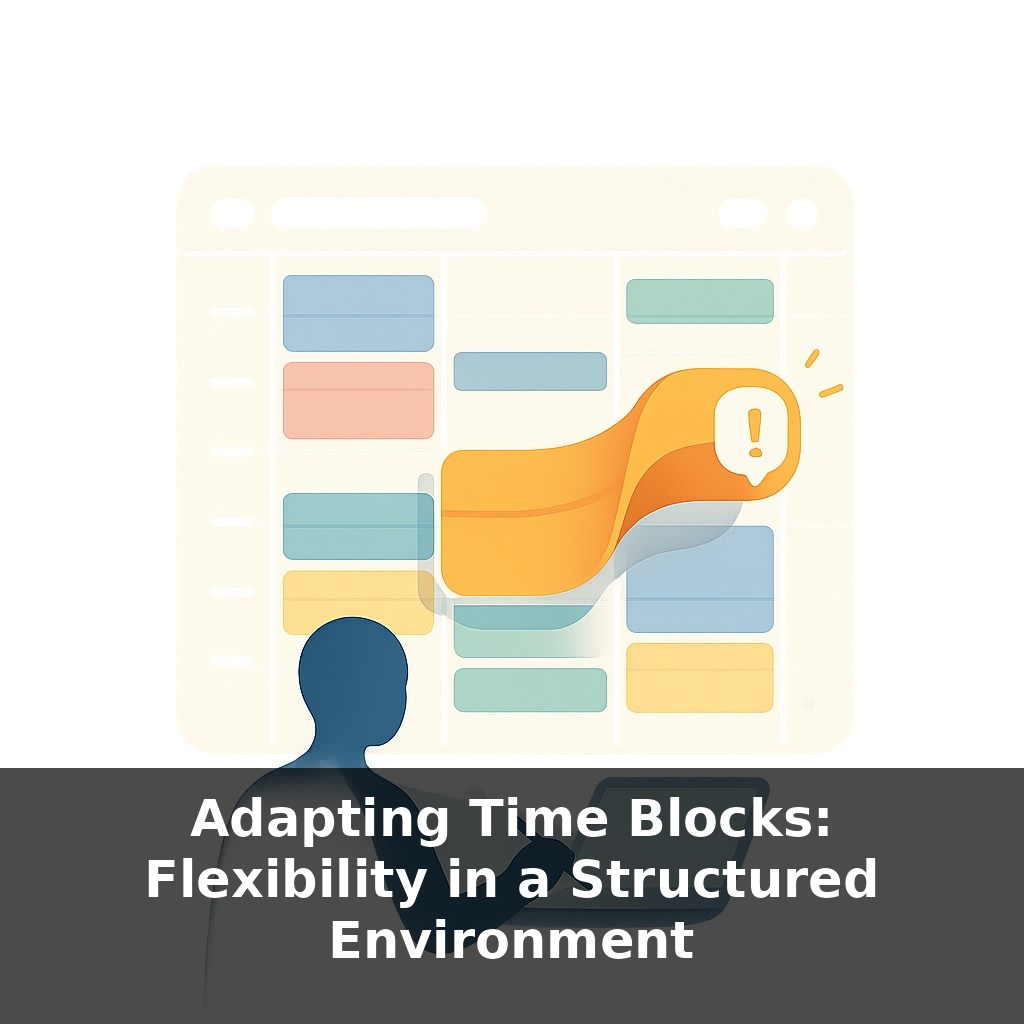
A UC–Irvine study found that after a single interruption, workers can lose focus for roughly the length of a sitcom episode. Now picture your carefully time‑blocked day. One surprise meeting, one urgent ping—does the whole plan shatter, or quietly bend and bounce back?
Cal Newport openly admits he redraws his daily time‑block plan 5–8 times a day. That isn’t failure—that’s the point. A rigid calendar looks impressive at 8 a.m., then reality shows up: a Slack fire, a rushed handoff, a “quick” sync that isn’t. The question isn’t “How do I stop this?” but “How do I design for this without losing the plot?”
Today we’ll treat your calendar less like a stone tablet and more like a control panel. Research from operations management suggests that deliberately leaving 10–20% of your day as buffer time dramatically reduces overruns and stress. Cognitive psychology adds another layer: small, intentional “micro‑re‑plans” help your brain re‑anchor after disruptions instead of spiraling into reactive mode.
We’re going to turn your time blocks into structures that flex, absorb shocks, and still keep you moving toward what matters.
Most people treat their calendar like a contract: once inked, it’s untouchable. But your day behaves more like a live auction—priorities get bid up, surprises enter late, and what looked “cheap” at 9 a.m. feels impossibly expensive by 3 p.m. The goal now isn’t to erase that chaos, but to learn how to rebalance quickly without abandoning your plan. In this episode, we’ll zoom in on what actually happens inside a single block when reality collides with it: how to shrink, split, or swap blocks on the fly—and how to do it fast enough that your brain stays calm and your most important work still gets done.
Adaptive time blocking starts with a simple admission: your first draft of the day is wrong—just not useless. The magic is in how you update it.
Think of each block less as a monolith and more as a “budget” of attention and energy. Finance teams don’t freeze a quarterly budget on day one; they reforecast as new information arrives. You’ll do the same with your hours.
Start by tagging every block with two labels: 1) Importance: critical / important / optional 2) Flex: fixed-time / same‑day movable / anytime‑this‑week
Now, when something collides with your plan, you’re not asking “What do I do?” from scratch. You’re scanning a pre‑sorted list: Which low‑importance, high‑flex blocks can slide to make room?
This is where research on overruns becomes practical. That MIT finding—that modest buffers cut misses by nearly a quarter—only matters if you *use* those buffers deliberately. Treat them as “shock absorbers” for your highest‑importance, fixed‑time work. When a surprise meeting lands, you don’t erase deep work; you trade from the buffer and from optional, movable blocks first.
Next, give each substantial block a “minimum viable version” before the day starts. For a 90‑minute design session, your M.V.V. might be “produce one testable sketch.” For a 60‑minute planning block, “clarify top three priorities and first step.” When time gets squeezed, you can instantly shrink the scope instead of abandoning the block. Execution becomes binary: full version if time holds, minimum version if it doesn’t—rather than zero.
Cal Newport’s habit of redrawing his day repeatedly points to another pattern: decisions are cheaper when they’re scripted. Choose your default reactions in advance:
- If an urgent request appears inside a critical block, *defer the request* to the nearest buffer or admin slot by default. - If a meeting overruns, *auto‑downgrade* the next non‑critical block to its minimum viable version. - If three or more blocks have shifted, trigger a conscious “mini‑reset” at the next natural break: five minutes to re‑sketch the rest of the day.
Over time, you’ll notice something subtle: your calendar still looks structured from a distance, but zoom in and it’s full of intelligent edits, swaps, and scope trims. That’s the hallmark of adaptive time blocking—not a day that went “according to plan,” but a day where the plan evolved quickly enough that your priorities stayed visible, even when everything else moved.
A product manager at a growing startup runs her day with adaptive blocks. By 10:30, an unexpected outage pulls in half her team. Instead of silently watching her afternoon crumble, she pulls up her calendar and runs a 90‑second “triage pass”: only three questions—What *must* ship today? What can trade down to a lighter version? What can ride to another day without real cost? The “nice-to-have” competitor research she’d planned becomes a quick skim and bookmark session, and her longer strategy review hops to Friday. Output drops on paper, but momentum on what matters stays intact.
You can do something similar by pre‑marking one or two “sacrifice candidates” in your week—blocks you’ll happily trade away if reality tightens. It’s like traveling with a small, flexible fund in a foreign city: you still follow your rough itinerary, but you’re ready to splurge on a surprising opportunity or pay for a delay without wrecking the whole trip. Over time, this habit teaches your brain a crucial distinction: changing the plan is not the same as abandoning it.
As AI quietly watches how you actually work—when pings derail you, which tasks overrun, which hours you protect—it will start surfacing patterns you’d miss. Your calendar becomes less like a static map and more like live GPS: rerouting around traffic, suggesting better departure times, flagging when you’re “overbooked” on mental bandwidth. Teams could share these signals, too, spotting systemic overload before burnout hits, the way sensors warn of pressure building in a bridge.
When you treat the day as a series of small bets instead of a rigid script, missed blocks become data, not drama. You start to see patterns: certain people always run long, certain types of work always swell. Let those patterns quietly edit tomorrow’s template. Like tuning an instrument between songs, the adjustments are tiny—but over time, the whole set sounds different.
Start with this tiny habit: When you open your calendar in the morning, slide just one existing time block 15 minutes earlier or later to practice flexibility on purpose. Then, jot a single word next to that block (like “flex” or “buffer”) so you remember it’s allowed to move. If something unexpected pops up during that block, give yourself permission to shrink it to just 10 focused minutes instead of canceling it entirely.