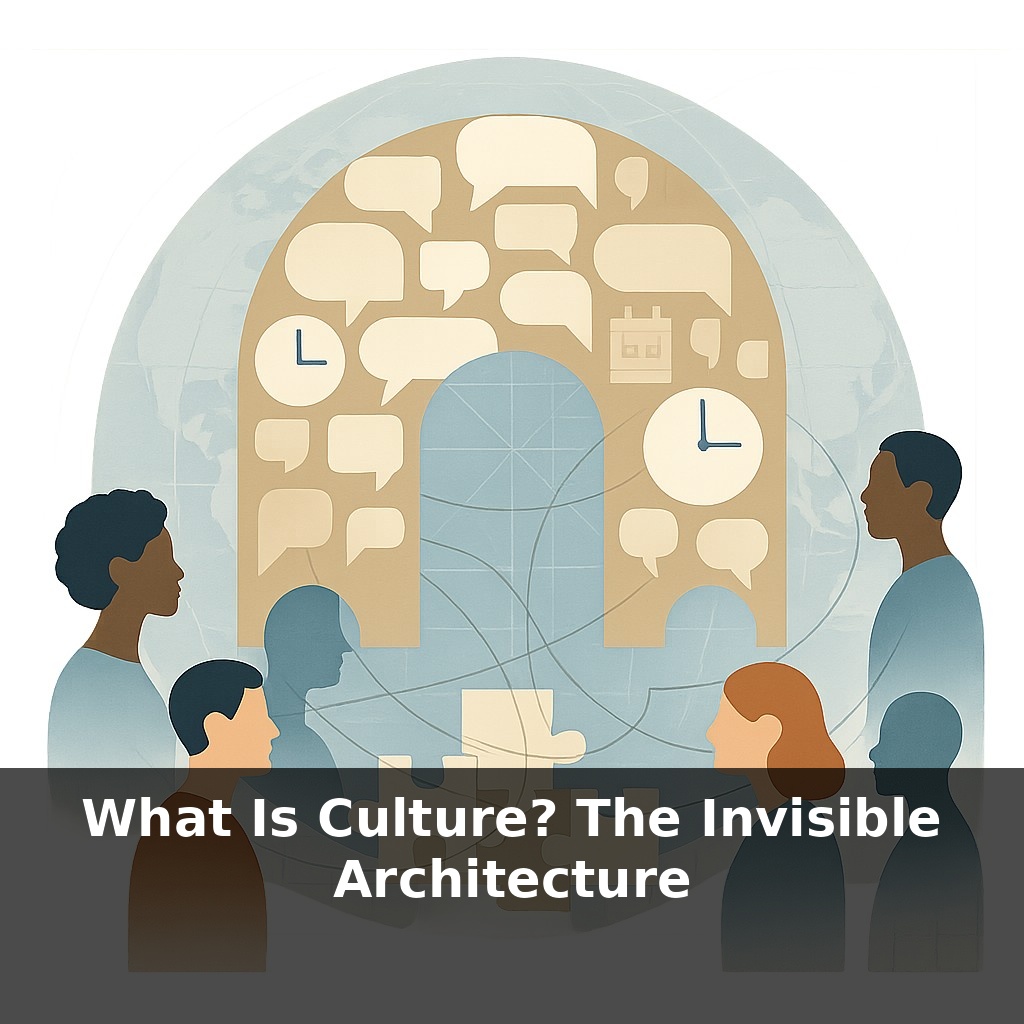
What Is Culture? The Invisible Architecture
📝 Transcript
Right now, as you listen, thousands of conversations are failing—not because people disagree, but because they don’t even mean the same thing by the words they use. Two coworkers say “soon,” one hears hours, the other hears weeks. Same language, totally different worlds.
Culture is the quiet author of those mismatched “soon”s—and of a million other tiny expectations you rarely notice until they collide. It decides whether “being on time” means five minutes early or half an hour late, whether praise should be public or private, whether disagreeing with your boss is “helpful” or “dangerous.” None of this is written on a sign at the office door or announced in a family meeting, yet everyone is supposed to know the script.
Anthropologists call this the “taken-for-granted” layer of life: the background assumptions about what’s normal, polite, ambitious, or shocking. You pick most of it up before you’re old enough to question it, the way you absorb an accent. Then you carry it into every classroom, video call, negotiation, and relationship—convinced it’s just “common sense,” while others quietly follow a different rulebook.
That hidden script isn’t just about manners or timing—it quietly shapes what entire groups see as possible or impossible. It influences which jobs sound respectable, what “success” should look like, and even which emotions are safe to show in public. It guides who speaks first in a meeting, who feels guilty saying no, and who expects rules to be flexible versus absolute. When people from different cultures share a classroom, a city, or a company, these invisible settings collide. The result can feel like personality clashes, but often it’s deeper: conflicting maps of how life is supposed to work.
Culture isn’t one thing; it’s a bundle of overlapping codes that organize how a group makes sense of the world. Some of those codes are obvious—language, holidays, food. Others are so embedded you only spot them when they clash.
Start with sheer variety. UNESCO counts over 6,700 spoken languages, and about 40% are endangered. Every time a language disappears, a whole toolkit for seeing reality shrinks: ways of naming emotions, describing landscapes, talking about time. A word like “family” or “freedom” can stretch or narrow depending on that toolkit, quietly altering what people feel is “normal” to want or protect.
Then there are patterned differences that researchers can measure. In the 1980s, Geert Hofstede analyzed attitudes of IBM employees in dozens of countries and found recurring dimensions: how comfortable people are with hierarchy, how much they prize individual goals versus group harmony, whether they expect rules to be flexible or rigid, and more. These dimensions don’t put anyone in a box, but they do reveal that what feels “professional,” “respectful,” or “fair” is systematically shaped by where and how you learned to be a person.
Organizations sit on top of these deeper layers. A company isn’t just a strategy and an org chart; it’s a culture-making machine. Gallup’s data that deliberately shaped cultures can boost profits by nearly a third isn’t magic—it’s alignment. Leaders decide, often unconsciously, which behaviors get rewarded, whose voices carry weight, and how mistakes are treated. Over time, those choices harden into expectations: Do we stay late or guard personal time? Debate openly or smooth conflict? Follow the manual or improvise?
Now zoom out to the global level. With 281 million people living outside their birth country, cities, schools, and workplaces are braided together from multiple cultural logics. A classroom can hold students whose families define “respect” as quiet compliance and others who define it as active challenge. A hospital team may include staff who view a doctor as unquestionable authority alongside those who see medicine as collaborative problem-solving.
When these codes overlap, people often mislabel the friction as a moral flaw (“lazy,” “arrogant,” “cold”) rather than a cultural mismatch. Yet the same underlying patterns that complicate cooperation also power creativity. Mixed cultural “operating systems” can invent new solutions—if people learn to see the architecture instead of tripping over it in the dark.
Walk into two birthday parties on the same day. In one living room, the cake is cut by the oldest person first, served in silence, and nobody opens gifts until the guests leave. Across town, the birthday kid tears into presents in front of everyone while friends shout opinions about each one. Same event, same age group, same city—yet if you swapped guests between the two rooms, both sides might quietly judge the other as rude or stiff, not “just different.”
You see similar tensions in a startup where a founder expects blunt debate and rapid pivots, while a newly hired team from a large corporation expects careful process and written approvals. No one announced these expectations; they arrive baked in. Or consider a community center where long-time residents value predictable routines, but recent arrivals push for flexible hours and rotating activities. Conflicts surface over tiny decisions—meeting length, who holds keys, how fast to change—but the real negotiation is over whose invisible habits will set the rhythm for everyone else.
As climate, tech, and migration pressures intensify, this “invisible architecture” becomes a design problem, not just a backdrop. Digital spaces will grow their own rituals and taboos that may clash with laws written Building on the patterns we've explored, climate policies that ignore local harvest cycles or sacred sites will stall. Your workplace, neighborhood, and online groups are quietly drafting their future rules—more like slow-cooked recipes than fixed blueprints—through thousands of small, repeated choices.
Noticing this hidden architecture is less about judging and more about getting curious. When reactions feel “off”—a joke falls flat, a silence stretches—treat them like unfamiliar spices in a dish: signals of a different recipe at work. The more you trace those flavors back to their sources, the better you get at cooking alongside others without drowning anyone out.
With this understanding, try these focused steps: Dive into Edgar Schein’s interview on the “Coaching for Leaders” podcast (episode on organizational culture) and pinpoint one of his 3 levels of culture (artifacts, espoused values, or underlying assumptions) to explore in your team. See where the misalignments lie. Read “The Culture Code” by Daniel Coyle and apply one specific belonging cue from Chapter 1, like changing the start of meetings or adjusting greetings, in your next team meeting. Finally, experiment with Miro or FigJam to visually map your team’s “invisible architecture.” Populate this with rituals, stories, and unwritten rules, and invite colleagues to refine this living document together.
From this course
Understanding Culture: How Societies Shape Us
7 episodesUnlock all episodes
Full access to 7 episodes and everything on OwlUp.
Subscribe — $1.99/monthLess than a coffee ☕ · Cancel anytime