“Culture is the collective programming of the mind,” said researcher Geert Hofstede. Now jump to a boardroom in Tokyo, a street protest in Paris, and a family dinner in Lagos. Very different scenes—yet all following deep rules most of us never realize we’re obeying.
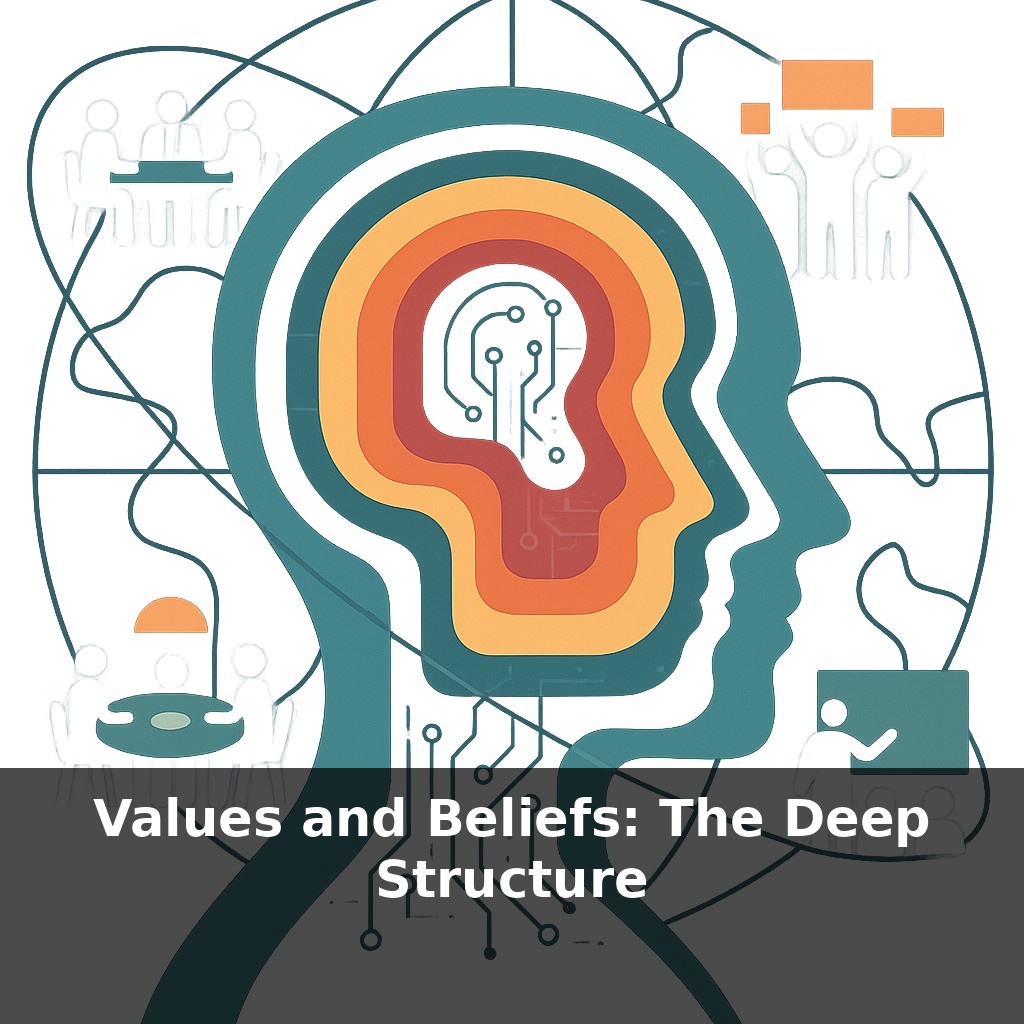
A teenager refusing an arranged marriage in Delhi. A Silicon Valley engineer quitting a high‑paying job over “culture fit.” A teacher in Helsinki letting students grade themselves. On the surface, these look like personal quirks or local customs; beneath them sit organized patterns of “what really matters” and “what’s obviously true” that people rarely articulate. That’s the layer of values and beliefs—the deep structure this episode explores.
Researchers don’t just speculate about this; they map it. The World Values Survey has spent decades asking hundreds of thousands of people across 120+ countries what they consider important in life. Patterns emerge: some societies cluster around duty, tradition, and authority; others around autonomy, curiosity, and equality. These aren’t abstract labels. They quietly shape who we trust, which leaders we elect, how we design workplaces, and even what we feel guilty about when we break the rules.
Neuroscientists add another layer: when people weigh “what really matters,” they recruit brain regions tied to reward and moral judgment, not just logic. That helps explain why clashes over priorities feel less like debates and more like threats. Sociologists see the same depth in law codes, school rules, even office dress policies—each rewards some priorities and punishes others. And policymakers now mine massive surveys and workplace polls to predict which reforms will be embraced, resisted, or quietly ignored, long before a single law is written.
Think of values and beliefs as coming in clusters, not as isolated items on a survey. Cross‑cultural researchers keep finding the same “bundles” that hang together across very different societies. When people prize obedience, they’re also more likely to accept status differences and long‑standing roles; where independence is prioritized, you tend to see more questioning of hierarchies and traditions. These packages of priorities are what make behavior predictable enough that investors, diplomats, and even militaries now brief their teams with cultural value profiles before major decisions.
Shalom Schwartz’s work is central here. Instead of asking, “What do Japanese people value?” or “What do Brazilians value?”, he mapped ten basic values (like security, achievement, benevolence) and how they arrange in a circle of tensions and compatibilities. Pursuing stimulation usually clashes with valuing conformity; caring for close others often supports, rather than opposes, a desire for social justice. Countries line up differently around that circle, but the basic structure keeps reappearing, which suggests we’re looking at shared human dilemmas solved in locally specific ways.
Inside any one country, though, the picture is messier. Generations, regions, professions, and social classes can sit on different parts of the values map while sharing passports and flags. A mining town, a university campus, and a military base in the same nation may feel like separate moral universes, even when people agree on slogans like “freedom” or “respect.” The conflict isn’t over the word; it’s over which concrete priorities that word should protect.
This matters because institutions quietly “lock in” some priorities over others. School grading systems, tax codes, parental leave policies, censorship laws, and startup funding rules all reward specific value bundles. Over time, that feedback loop can shift what feels normal or even imaginable. Under economic shocks or political upheaval, the loop can flip: once‑stable priorities move, sometimes within a single generation, as people renegotiate what counts as survival, success, or dignity.
Your challenge this week: treat your workplace, classroom, or community group as a mini‑culture laboratory. Choose one specific setting you regularly inhabit and do three focused passes through it on different days:
Day 1 – Scan the physical space only. What’s on walls, screens, doors, desks, uniforms, or badges? Note at least five concrete signals that seem to praise some ways of being and discourage others (for example: who gets pictured, which achievements are displayed, what’s locked away versus openly accessible).
Day 2 – Listen only to micro‑decisions. In meetings, chats, or emails, pay attention to how people justify choices: “That’s not how we do things,” “We have to protect X,” “We can’t risk Y,” “It wouldn’t be fair if…”. Write down the exact phrases (no interpretation yet).
Day 3 – Watch how time is allocated. Which activities get long meetings versus quick approvals? Who gets interrupted? Which delays cause visible stress, and which don’t? List at least three patterns.
At the end of the week, sit down for 20 minutes and ask yourself two questions:
1. If an outsider had only my three lists, what would they conclude “really matters” here? 2. Whose priorities seem most reflected in the space, language, and time use—and whose are missing or pushed to the margins?
You’re not trying to judge the culture as good or bad. The aim is to train your eye to see the underlying value bundles in action, the way a radiologist learns to see structures inside what used to look like just a blurry cloud.
Think about how different places answer the question, “Who gets protected first?” After a natural disaster, Japan often highlights orderly queues and shared rations; in the U.S., stories may focus on individual heroism or private donations; in Sweden, officials emphasize universal coverage and equal access. Same storm, different “obvious” priorities.
Companies show this too. At Patagonia, senior leaders have paused production to let staff join climate protests—loss of short‑term profit is accepted to defend environmental commitments. At Amazon, intense delivery targets and optimization routines tell workers that speed and customer satisfaction stand near the top of the priority ladder.
Even small frictions hint at deeper maps. A German manager who insists on sticking to a plan can look rigid to a Brazilian colleague who flexes plans around relationships. Neither is simply stubborn; each is enacting a learned answer to a silent question: “In a crunch, do we honor the schedule or the person standing in front of us?”
When climate policy stalls or AI rules spark outrage, it’s often because hidden value maps collide, not because people “hate science” or “fear progress.” As algorithms learn to predict choices, they’ll also learn to exploit those maps—like wind finding every gap in a window frame. Expect sharper clashes over what counts as “harm,” “freedom,” or “fairness,” and rising demand for leaders who can name these moral fault lines before they crack institutions open.
When you start spotting these hidden priorities, arguments look less like battles between good and evil and more like mismatched recipes: each side combining familiar ingredients toward a different “tastes right” outcome. The next time a debate feels absurd, try asking: “Given their map, what outcome would actually feel like justice to them?”
Before next week, ask yourself: “Where in my life am I saying I value growth or health or family, but my daily choices (how I spend my time, money, and attention) are clearly serving a different, deeper belief?” Then ask: “If I took my strongest ‘away-from’ belief (like avoiding failure, conflict, or rejection) and flipped it into a ‘toward’ value, what specific situation this week would I handle differently, and how?” Finally, when you notice a strong emotional reaction, pause and ask: “What must I be believing about myself, others, or the world right now for this reaction to make sense—and is that belief still one I want running my life?”