Right now, as you’re listening, your brain is pulsing in rhythm with the sound—just like almost everyone else on the planet who presses play at least once a week. A workout, a breakup, a quiet commute: same ears, totally different music. Why does it work on us every time?
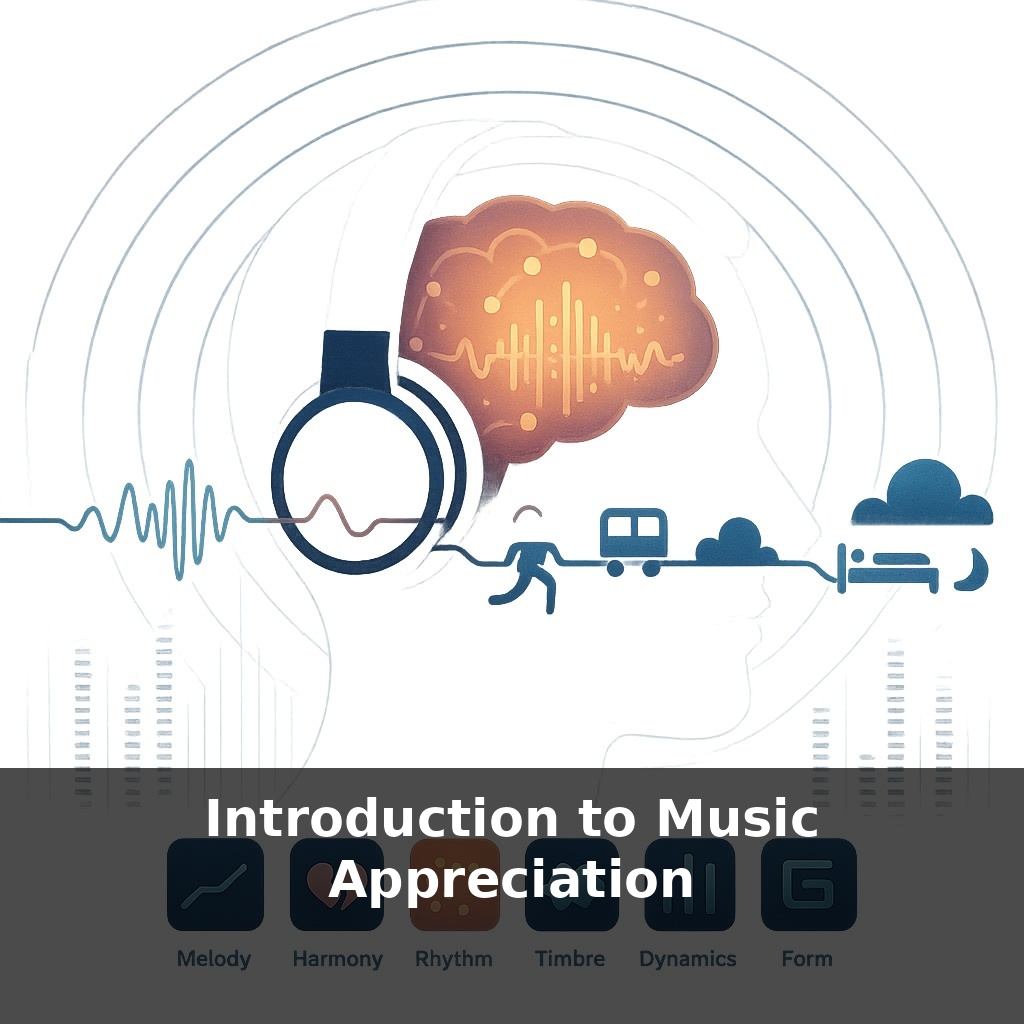
Every song you love is built from the same small set of ingredients—melody, harmony, rhythm, timbre, dynamics, and form—yet your playlists can feel as different as a thunderstorm and a lullaby. That gap between simple tools and endless variety is where music appreciation lives. Instead of just asking “Do I like this?”, you start asking “What is this music *doing* and *how* is it doing it?” You begin to notice the kick drum that locks in with your walking pace, the chord change that suddenly makes a lyric hit harder, the tiny production detail you’d missed on cheap earbuds. Across history, people have used these musical building blocks for everything from prayers to protests. In the episodes ahead, we’ll turn those abstract terms into something you can actually hear—so each track becomes less background noise and more a story unfolding in real time.
Most of your listening probably happens on autopilot: playlists shuffle, algorithms guess your mood, songs drift by while you cook, scroll, or ride the bus. Yet underneath that routine, every track is quietly doing cultural and psychological work. It can mark who you belong with, steady your heartbeat during a run, or turn a dull commute into a private movie scene. A protest chant, a film score, a club track at 1 a.m.—each uses the same tools you’ve heard before, but in different ways and for different purposes. In this series, we’ll slow that stream down just enough to notice what’s usually invisible—and decide what you actually want to hear.
When researchers wired people up in brain scanners and simply *played them their favorite songs*, reward areas lit up almost as strongly as they do for food or sex. That’s how deep music runs in the system: it hijacks circuits that evolved for survival and glues them to patterns in sound.
But those patterns aren’t floating in a vacuum. They’re attached to bodies, places, and stories. A lullaby doesn’t just “have a nice tune”; it’s the sound of being held. A stadium chant isn’t just “catchy”; it’s thousands of strangers agreeing, for a few minutes, to breathe and shout together. Even an AI-generated playlist is built on traces of human choices—billions of skips, repeats, and “like” clicks silently voting on what feels good.
So when you hear a track, you’re not only hearing notes. You’re hearing: - The technology that made it possible (from bone flutes to Auto-Tune) - The social space it was built for (temple, club, bedroom, protest) - The personal meaning you’ve attached to it (first kiss, long drive, awful job)
That’s why the same song can be “corny” at 13, life-saving at 23, and nostalgic at 43. The audio file doesn’t change; *you* do.
One way to sense this is to follow a single musical element as it moves through different worlds. Take a steady pulse near the speed of a resting heartbeat. In a lo-fi hip-hop track, it’s calming focus. In a club banger, it’s invitation-to-move. In a funeral march, it can feel like footsteps toward an ending. Same basic tempo, wildly different jobs.
Or zoom out and think about how a simple four-note idea travels. It might be chanted at a protest, sampled in a rapper’s hook, quoted by an orchestra in a film score. Each time, it carries some of its past lives with it, even if most listeners never notice.
This is where “appreciation” becomes less about judging genres and more about tracing connections. Instead of asking “Is this good?”, you can ask: - What space was this music designed for? - What bodies is it trying to move—or still? - What story does it join that existed before the track?
Like following the path of a migrating bird across continents, you start to see how one small figure of sound can link ceremonies, dance floors, playlists, and private memories into a single, messy, human map.
Think of three ordinary moments: brushing your teeth, standing in a grocery line, scrolling before bed. Each can host a completely different “job” for music. A short piano loop while you brush can act like a timer and gentle wake‑up call. In the checkout line, a store playlist can nudge you to feel just relaxed enough to keep browsing. At night, a sparse ambient track can turn down the mental brightness so your thoughts stop racing.
Concrete details matter. A rapper choosing a rough, breathy vocal tone over a clean one instantly shifts a verse from confident to confessional. A producer who leaves a tiny breath of silence before a chorus quietly trains your body to anticipate release. A film composer sliding in a barely audible high string note can make you tense up before you even know a jump scare is coming.
As you start to hear these moves, you’re not trying to turn listening into homework. You’re just catching the small decisions that make a track feel like a whispered secret in your ear or a flare fired into the night sky.
Soon, your playlists may react to you the way a good tennis partner does—pushing when you’re coasting, easing off when you’re winded. Wearables could quietly swap tracks as your focus dips or stress spikes, and therapy apps might “prescribe” songs the way they do breathing exercises now. At the same time, AI tools will let non‑musicians sketch ideas by humming or speaking, raising new questions: whose style is being borrowed, and how should those invisible teachers be credited?
As you keep listening, treat each track like a short story: who’s speaking, to whom, and why now? Notice how certain sounds become “characters” that follow you across albums, genres, even decades. Your challenge this week: once a day, replay one familiar song and hunt for a tiny detail you’d never noticed—then ask what it quietly adds to the story.