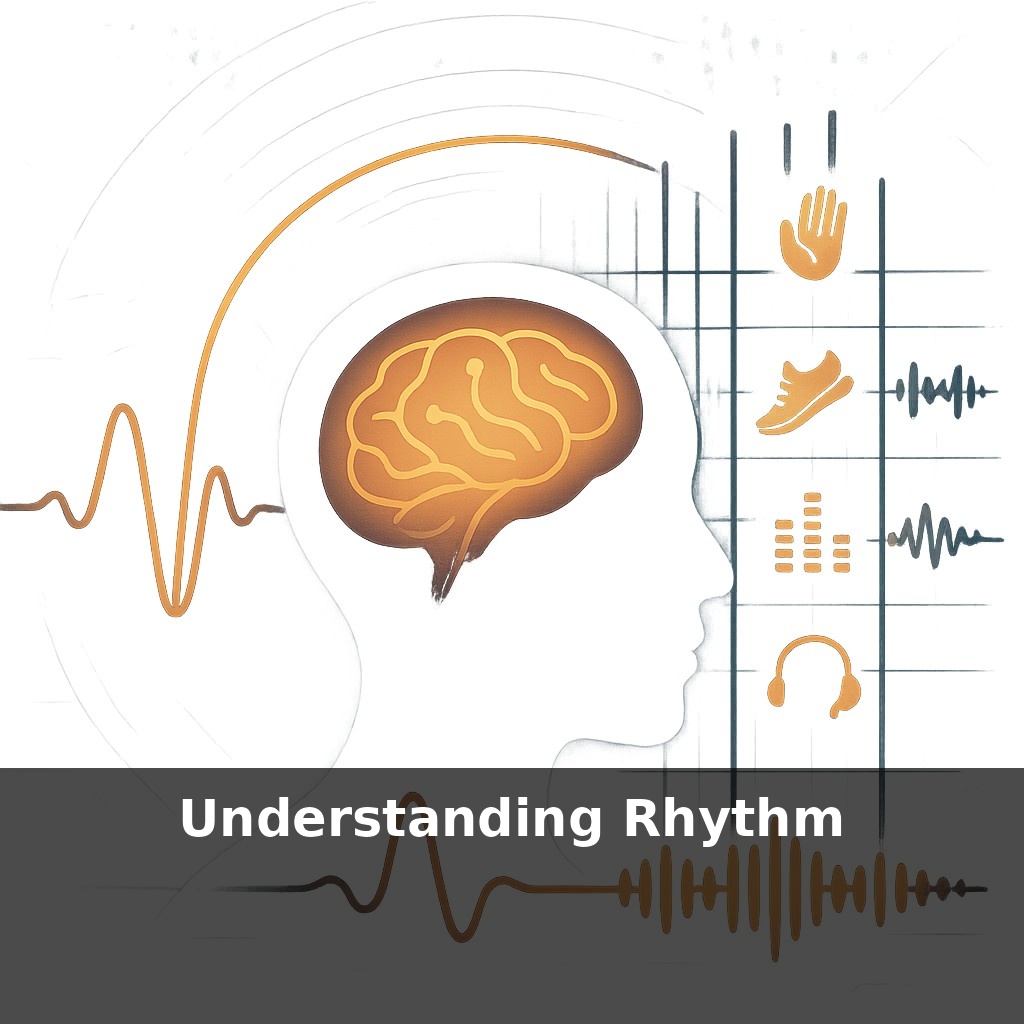
A stadium full of people claps along to a song—and almost everyone stays together without trying. Now zoom in: a bored kid tapping a desk, a runner hitting the pavement, you nodding to a playlist. Same invisible grid. If rhythm is “just timing,” why does your whole body care so much?
Your brain doesn’t just *hear* a beat—it quietly negotiates with it. That negotiation is why some tracks make you stroll, others make you power-walk, and a few force you into that awkward almost-jog the moment the chorus drops. Under the hood, your nervous system is constantly predicting when the next sound *should* arrive, and updating those expectations in real time when the music pushes or pulls against the grid. That tug-of-war is where feel lives. It’s why two songs at the same speed can make your body move completely differently, and why a rigid metronome can feel lifeless while a human drummer with tiny fluctuations feels alive. In this episode, you’ll zoom in on those small shifts—tempo changes, accents, and micro‑delays—and start noticing how they quietly steer your mood, attention, and even how long a song *seems* to last.
Those tiny shifts you’ve started to notice don’t just shape *feel*—they quietly sort music into entire emotional “zones.” A 105 BPM track tends to sit right in your natural walking pace; bump that to 128 and you’re closer to club energy than casual stroll. Producers know this: they’ll lock a verse to one tempo “mood,” then use denser subdivisions or sharper accents in the chorus to fake an energy jump without touching BPM. Drummers, meanwhile, learn to treat the grid like a target, not a cage—pushing fills ahead or behind to steer crowd movement almost as precisely as a good stage light show.
Here’s where it gets sneaky: once your brain locks to a pulse, it doesn’t just wait for the next beat—it fills in everything *between* the beats with expectations.
Start with subdivisions. Take a simple “1‑and‑2‑and‑3‑and‑4‑and” pattern. Keep the pulse the same, but change how busy those “and”s are: sparse eighth‑notes feel open and spacious; sixteenth‑notes can feel urgent or nervous; triplets feel rolling or lilting. Same grid, different “grain size.” That grain is why a ballad with hardly any notes between pulses can feel like it breathes, while a trap hi‑hat flurry at the same underlying pace feels like your thoughts are speeding up.
Now layer in *where* events land. Accents aren’t limited to drums: a piano chord that consistently pops a little louder on “2” and “4” pulls your ear toward that backbeat, even if a kick is chugging on every count. Flip it so the strongest hits are on “1” and “3” and you’ve got a completely different body response—march instead of bounce. Melodies do it too. Stretch one note slightly longer than the rest or place the highest pitch on a weak part of the bar and your attention snaps there, even if you don’t know why.
Then there’s syncopation: sounds that matter arriving in the “wrong” places. Your internal grid predicts a strong event on a beat, but the song withholds it, or places something juicy just before it. That mismatch is a controlled jolt of surprise. Miss it occasionally and you get a playful, toe‑tapping feel. Stack multiple layers of syncopation and your body can feel like it’s surfing over the barline instead of stepping squarely on it.
Crucially, different instruments can suggest competing grids at once. A bass might insist on solid downbeats while a guitar strums off‑beats and a vocal line dances across both. Your brain has to choose which layer to “ride.” Lock to the bass and the track feels grounded; lock to the guitar and it feels lighter and more restless.
This is also where polyrhythms and cross‑rhythms sneak into mainstream music more than people notice. A 3‑note pattern repeating over 2 beats can make a loop feel like it’s constantly turning over, even when nothing else changes. Producers lean on that to keep repetition from feeling static—your body senses motion inside the loop, so the track feels like it’s going somewhere without extra chords or melodies.
Think about how different genres “teach” your ear which layer to trust. In house music, producers often tuck the kick solidly on every beat while letting handclaps or vocals play tricks around it; your body locks to the kick, freeing the top layer to get playful without losing you. In neo‑soul, drummers might lay snares slightly late yet keep hi‑hats tight, so you feel stretched and relaxed at once—like walking on a moving sidewalk that’s just a bit slower than your legs.
The same recording can even feel different depending on what you focus on. Shift your attention from hi‑hat to bass in a D’Angelo track and the groove “tilts” under your feet. Film composers exploit this too: they’ll keep low drums brutally steady while strings smear rhythm across the bar, so action scenes feel grounded but emotionally unstable.
Your challenge this week: pick one song per day and, for a full listen, consciously ride just *one* rhythmic layer—kick, snare, hi‑hat, bass, or a repeating riff. Next replay: switch to a different layer. Notice how the groove’s personality changes with each “anchor.”
Soon, playlists might not just match your taste; they’ll match your *body state* in real time—shifting groove as your smartwatAs we've explored the pervasive nature of rhythm, in games and VR, background loops could morph their internal pulse like a DJ reading a crowd, tightening as you approach a boss fight, loosening as you explore. And as AI learns your favorite “feel fingerprints” across thousands of tracks, you may get custom grooves that fit like a tailored suit, yet still leave space for human players to bend and stretch the grid.
As you start catching these grids inside songs, daily sounds shift too: a subway’s rattle, a typing spree, footsteps in a hallway begin to feel like rough drafts of music. Your playlist stops being background and turns into a lab bench. Follow that thread and “having rhythm” becomes less a talent and more a habit of paying close, curious attention.
Before next week, ask yourself: 1) “Where in my day do I naturally feel ‘in the pocket’—walking pace, speaking pace, even how I tap my fingers—and how could I borrow that exact feeling when I’m clapping or counting 1-&-2-&-3-&-4-&?” 2) “When I listen to one song today, can I genuinely feel the strong beat (the ‘1’) in my body—like a head nod or foot tap—and notice how the weaker beats and offbeats fit around it, instead of just hearing a blur of sound?” 3) “If I loop a simple pattern from the episode (like clapping on 2 and 4 while counting all the numbers), what happens in my mind and body right when I start to lose the groove—and what tiny adjustment (slower tempo, louder counting, relaxed shoulders) helps me lock back in?”