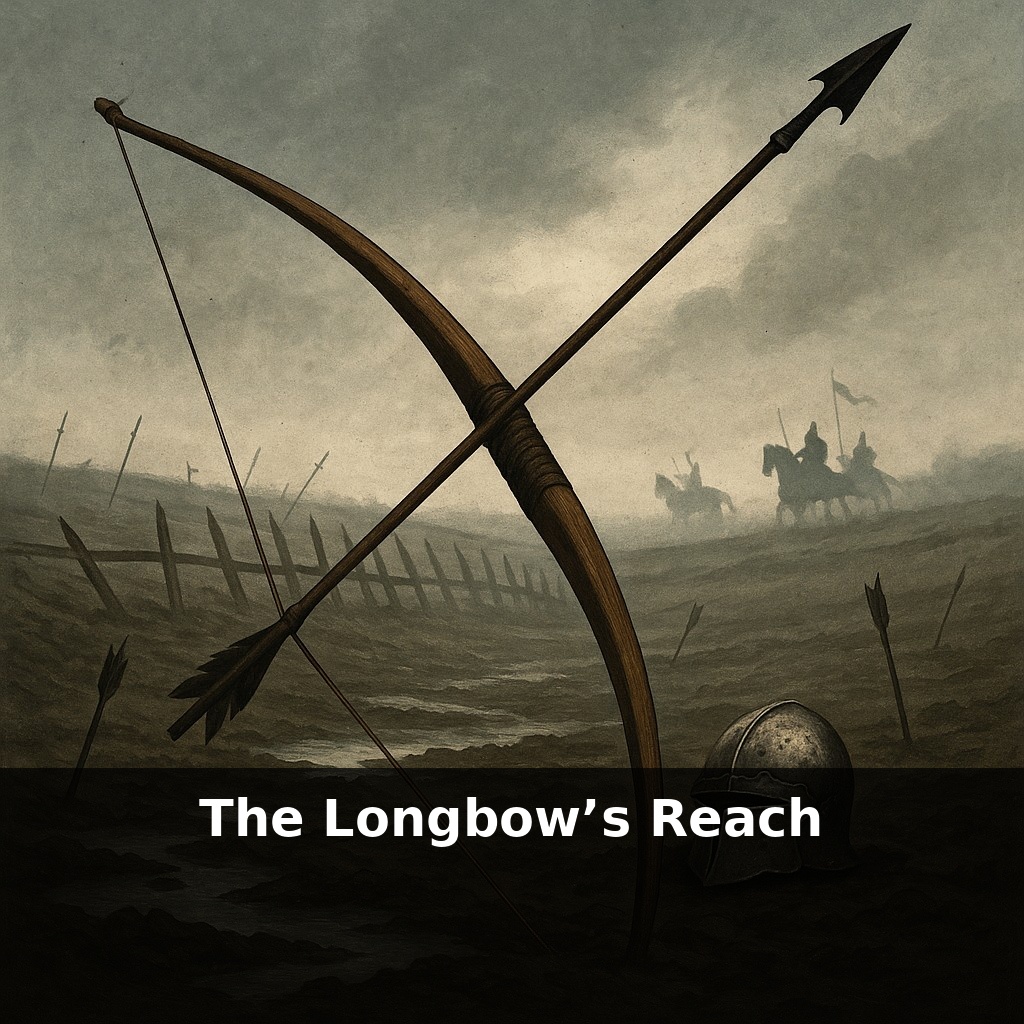
A weapon made of wood and string helped end the age of the knight. On a muddy field in France, a few thousand archers stood behind simple stakes—and by dusk, the flower of French nobility lay in the dirt. How did a peasant’s bow out-reach a kingdom’s heavy cavalry?
The longbow’s true power wasn’t just in how far it could shoot—it was in how far ahead it forced everyone else to think. Commanders had to start reading hills, ditches, and mud like a chessboard, searching for any square that might blunt a storm of arrows. Armorers found their work suddenly obsolete, then urgently necessary again, as old designs failed and new plates, joints, and visors were hammered out in haste. Rulers, too, had to rethink who mattered on the battlefield: not only the mounted elite, but thousands of trained specialists whose skill took a lifetime to build. In a world used to judging strength by the shine of metal and the weight of a charge, the longbow introduced a new metric: whose line could deliver deadly force first, and keep delivering it, like steady rain on a tin roof that finally gives way.
To see why this mattered, zoom out from the clash itself and look at the supply chain and training pipeline behind those arrows. A skilled bowman was more like a lifetime craftsman than a replaceable recruit; his strength, posture, and technique were literally carved into his bones from years of practice. States that wanted this kind of force had to invest early, regulate wood supplies, and protect trade routes feeding in staves, bowstrings, and arrowheads. That meant laws about who could train, where timber could be cut, and how quickly damaged gear had to be replaced between campaigns.
Range was only the beginning; what really changed warfare was how that reach could be organized, timed, and multiplied.
First, think about density. A single arrow is a threat; a synchronized storm is a system. Commanders began arranging units in depth, not just width, so volleys overlapped in time and space. Orders weren’t simply “shoot at will,” but carefully staged sequences: signal shots to test distance, massed salvos to break momentum, then controlled, slower fire to harass and finish. Surviving accounts describe “clouds” of shafts marking phases of battle as clearly as flags or drums.
Second, there was targeting logic. The point wasn’t just to hit something; it was to hit the right thing at the right moment. Horses were often prioritized over riders, banners over anonymous troops, officers’ clusters over scattered men. Disrupting command and control—killing or unhorsing the people who gave orders—could matter more than raw casualties. Chronicles hint at attacks timed to crossings, narrow approaches, or moments when formations had to compress, because that’s when bodies naturally bunched into lethal patterns.
Third, there was integration with other arms. Missile troops didn’t always stand still behind stakes; they could advance to pepper enemy lines, then slip back behind infantry, or swing to the flanks once a charge stalled. In some campaigns, they were used more like mobile artillery: softening garrisons before an assault, denying access to bridges or fords, or making it too costly for the enemy even to form up in ideal ground.
This reach also had political reach. Rulers began mandating regular practice, fining those who skipped training, and reserving certain woods for military use. Local festivals sometimes doubled as unofficial selection days, where the best shots were quietly noted. Over time, that created pockets of communities whose regional identity was tied to their military specialty, much like coastal towns later associated with particular kinds of seamanship.
And finally, there was morale. Units that knew they could be hit long before closing had to march and form up under sustained psychological pressure. Chroniclers describe men advancing with shields raised over their heads, already tired and frayed before the real clash began. A weapon that could shape emotions at a distance was shaping decisions at a distance too.
Take Agincourt as a case study in reach used like choreography. French nobles were funneled into a narrowing strip of churned mud bordered by woods; that corridor wasn’t just bad luck, it was a deliberate “killing lane” created by where the English chose to stand and dig in. The effect was less like a duel and more like forcing an opposing orchestra to play through a storm, their timing and rhythm wrecked before they hit the first note. Earlier at Crécy, the lesson was similar but applied differently: Genoese crossbowmen, slowed by wet strings and lacking pavises, were sent forward too soon, then trampled when they recoiled into their own side’s onrushing horsemen. The technology gap mattered, but so did the tempo gap—one side could keep changing the tempo, the other had to react. Later commanders, watching these disasters, started copying the English not by importing yew, but by redesigning approach routes, rehearsing coordinated advances under fire, and spacing their own missile troops to avoid turning congestion into catastrophe.
Building on the longbow's paradigm-shifting impact, states now face their own “longbow moments”: cheap drones, loitering munitions, and long‑range cyber tools stretch influence far beyond front lines, forcing planners to rethink massed hardware much as nobles once reconsidered gleaming plate. Your challenge this week: when you see news of new military tech, ask not just what it destroys, but what systems of training, prestige, and law it quietly rearranges in the background.
The deeper legacy of that reach is institutional memory: drill books, range markers, standardized gear, even early “data” on distance and wind. Like farmers reading clouds to guess the season ahead, commanders slowly learned to read invisible arcs of threat. The question that lingers for us isn’t who shot farther, but who learned faster once the arrows started to fall.
Start with this specific exercise: Choose one military technology, such as drones or cyber tools, and locate a recent technological development in that field. Dive into an in-depth article or a case study that explores strategic implications and policy shifts related to that innovation. Document how these changes could affect a specific military doctrine or international relations perspective. Engage with a military expert or join an online forum for further discussion and present your findings in a short summary. Each time the big, distant goal pops into your head, repeat this: name one near target out loud, then give it five tiny minutes.