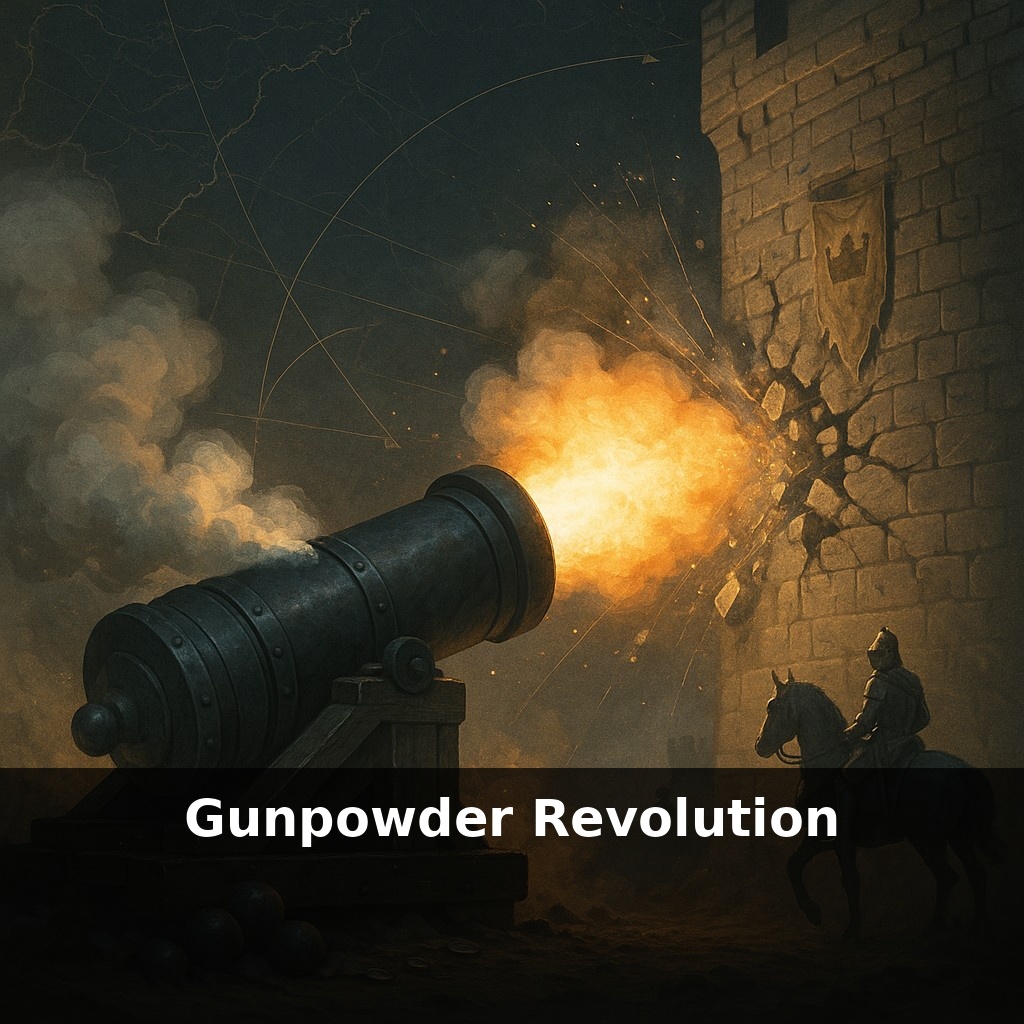
Gunpowder turned castle walls from symbols of safety into deathtraps almost overnight. A single giant cannon could batter stones that had stood for centuries. A king on horseback, a knight in armor—suddenly, both had to answer to a small, smoking barrel of metal.
Suddenly, war became a contest of math, metal, and money. Rulers who could afford bigger foundries, better engineers, and more gun crews didn’t just win battles—they rewrote the map. Stone strongholds that once anchored local lords gave way to sprawling low forts with angled walls, ditches, and earthworks designed to swallow incoming shot like dunes breaking ocean waves.
This wasn’t just prettier architecture; it was a new logic of power. To crack these defenses, attackers needed logistics, siege trains, and months of pay for thousands of soldiers. That meant organized taxation, permanent bureaus, and record-keeping. The gunpowder age quietly pushed Europe from feuding nobles toward centralized states, where war planning looked less like heroic charges and more like spreadsheets—long before spreadsheets existed.
Military power now depended on who could harness this volatile black powder most efficiently. That story doesn’t start in European fortresses but centuries earlier in Chinese experiments with alchemy, fireworks, and crude “fire lances” that spat burning fragments. As recipes stabilized and metalworking improved, the technology moved west along trade routes and battlefields, picked up by engineers in the Islamic world who refined casting techniques and siege tactics. Like a new musical style passed from city to city, each region remixed gunpowder, adding local metallurgy, tactics, and needs. By the time it reached Europe, it was already a traveling revolution.
Gunpowder’s journey from curiosity to war-winner hinged on one breakthrough: putting it behind a projectile instead of around it. Early Chinese “fire lances” only blasted flame and scraps a few meters. Once smiths began sealing powder in sturdy tubes, that same blast could shove stones, iron balls, or lead shot fast enough to rip through timber and packed earth. Now engineers were less interested in sparks and noise and more in boring calculations: barrel length, bore diameter, powder grain size, angle of fire. Tiny tweaks meant the difference between cracking a gate or merely scaring the defenders on it.
In the Islamic world, specialist craftsmen learned to cast huge bronze pieces in single pours, then reinforce them with hoops or clamps. Ottoman siege parks looked like mobile metal forests: bombards for walls, lighter guns to rake battlements, smaller pieces to harass relief forces. European foundries studied captured examples, copying not just shapes but production methods—molds, alloy ratios, even how to transport these monsters without snapping axles.
As metalworking improved, downsizing became as important as upscaling. Long-barreled culverins traded raw weight for accuracy and range, letting gunners sit outside the deadliest return fire. Even more disruptive were handheld weapons. Crude handgonnes evolved into arquebuses with shoulder stocks and simple triggers, then into wheellocks and flintlocks that a trained soldier could fire in rough sequence with his comrades. Reliability crept upward; reload times shrank from minutes to something usable in formation.
That shift rewired battlefields. Instead of dense wedges of armored men crashing together, commanders began arranging blocks of pikemen flanked or studded with shot-bearing infantry. Spanish tercios turned this into an art form, rotating firing ranks and bristling pikes into a human hedgehog that could both shoot and resist cavalry. Armor quietly retreated: first the horse’s barding, then leg defenses, then even breastplates, as weight stopped justifying protection against concentrated volleys.
States followed the technology. Standardized calibers simplified casting and ammunition supply. Central depots stored barrels, locks, and spare parts. Places like the Tower of London effectively became early arms factories, turning out flintlocks at a pace that would have been unthinkable when each weapon was a one-off masterpiece in a village forge.
Artillery didn’t just tear down defenses; it rewrote the “time budget” of war. A medieval siege might drag on through harvests and winters. With organized gun lines, a breach could appear in days, forcing commanders to gamble: storm now and bleed, or sit longer and risk disease, relief armies, or mutiny over unpaid wages. The pressure to decide faster nudged rulers toward standing forces that could actually exploit those brief windows.
On campaign, early gunners were treated less like generic soldiers and more like today’s elite technicians. Many were civilians on contract, prized for their know-how, bilingual in metallurgy and trigonometry. When they defected or were captured, it felt less like losing a unit and more like handing the enemy your research and development team.
One 16th‑century observer quipped that princes now feared “their paymasters more than their foes.” War costs spiked so sharply that kings went bankrupt despite winning. Victory without solvency became a kind of strategic paradox: you could break your enemy’s walls and still lose the long game to unpaid loans and angry financiers.
Artillery’s shockwave rippled far beyond battlefields. Ports that could host gun‑armed fleets rose like new “storm fronts” on trade routes, while inland strongholds faded. Armories clustered near rivers and coalfields, sketching early maps of industrial districts. Cultural weather shifted too: chroniclers dwelled less on heroic duels, more on failed supply lines and busted treasuries. The lesson for today’s planners is uncomfortable: every leap in range or speed also widens the radius of unintended consequences.
Gunpowder pushed warfare onto a steeper learning curve: rulers had to update tactics as often as merchants updated ledgers. Like a storm front rolling across continents, its arrival reordered borders, trade, and even who counted as “modern.” Your challenge this week: spot where today’s “new gunpowder” is quietly redrawing lines of power.