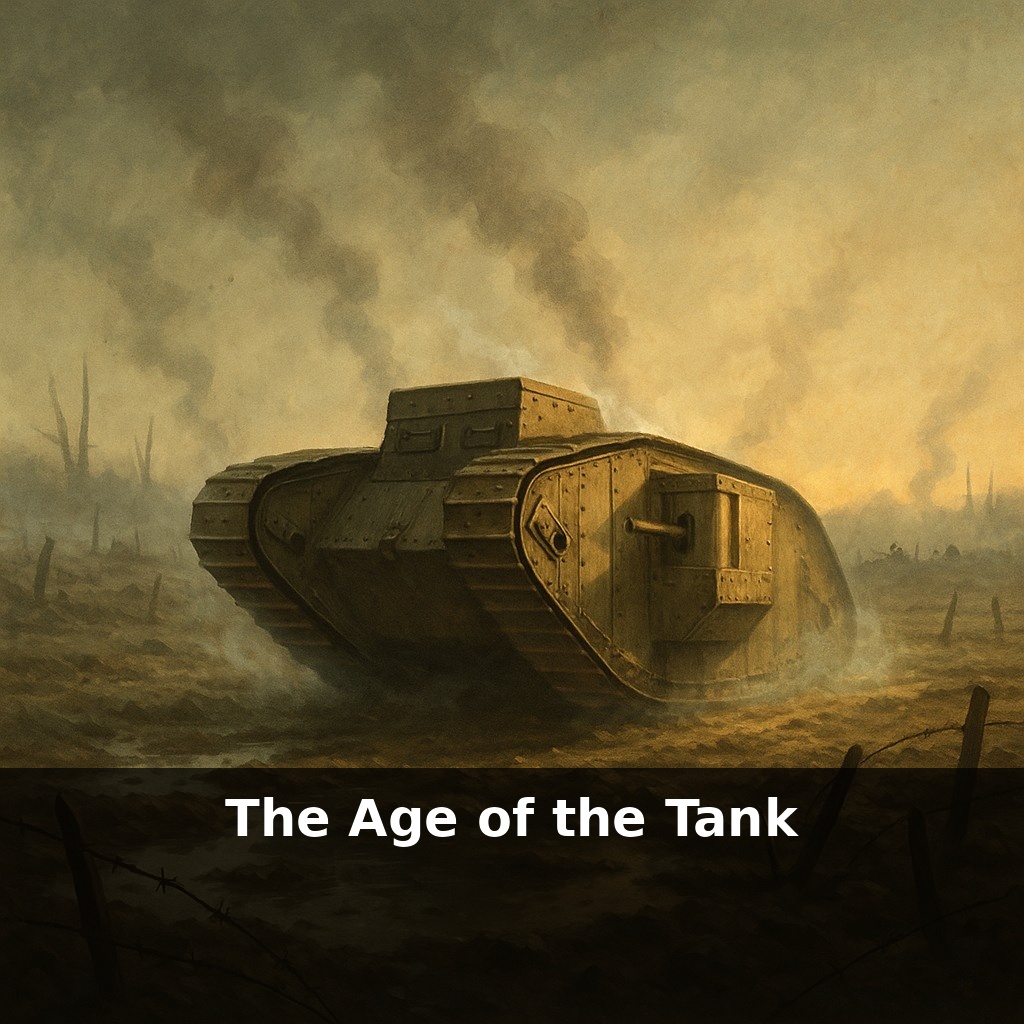
A machine rolled onto a World War One battlefield so strange that some soldiers thought it was a secret weapon from science fiction. It was slow, clumsy, and broke down a lot—yet within a few decades, armies would bet their entire battle plans on its success.
At first, the new vehicle didn’t look like the future of war. It crawled forward at walking speed, its engine overheated, and crews inside choked on fumes. Yet commanders quickly realized something unsettling: wherever this armored shape moved, the rules on the ground changed. Barbed wire that had stopped thousands became irrelevant. Trenches that acted like stone walls turned into shallow ditches to be stepped over. Defensive lines, once reliable as a locked front door, suddenly felt more like a curtain someone could simply brush aside. In the years that followed, engineers and tacticians would treat this awkward newcomer like a puzzle piece that didn’t quite fit—reshaping not just the piece, but the entire board it was placed on. The lesson was simple and unnerving: if you could move protected firepower across almost any terrain, you could redraw maps in motion.
Commanders didn’t just see a new vehicle; they saw a way to rewrite timing and distance. Suddenly, ground that used to take exhausted soldiers hours to cross could be covered in minutes, with guns and armor moving together as a single package. That forced planners to rethink everything from how far supplies had to travel, to how fast reinforcements could arrive, to where it was even safe to stand. Like a storm front sweeping across a map, this new kind of movement turned “fixed” positions into temporary guesses—and made flexibility, not thickness of walls, the real measure of security.
What made this new vehicle so disruptive wasn’t any single feature, but the way several ideas were fused into one moving system.
First, there was firepower that didn’t have to stay put. Artillery could hit hard, but it was usually anchored in place. Infantry could move, but carried only light weapons. This machine welded the two together: guns strong enough to punch through solid cover, carried fast enough to appear where defenders least expected them. That meant commanders could stop thinking only in terms of “front lines” and start thinking in terms of “windows of opportunity” that opened and closed as the vehicle advanced.
Second, it changed how protection worked. Before, you protected soldiers either by putting them underground or behind massive structures. Now, protection itself moved. A crew could advance under layers of metal, later composite armor, and eventually reactive bricks that exploded outward to blunt incoming jets of metal. Over time, sensors and computers joined the armor, so danger could be detected and countered before it ever hit the hull. Systems like Israel’s Trophy went even further, swatting away many incoming rockets and missiles—turning survival into a contest of detection speed as much as steel thickness.
Third, there was mobility across difficult ground. These machines spread their weight over tracks, letting them crawl over mud, rubble, and craters that would immobilize trucks. That ability to ignore damaged roads or churned-up fields gave planners a new kind of freedom: they didn’t just move along the map, they could redraw which routes existed at all.
By the Second World War, some states recognized that if you grouped these vehicles, wired them with radios, and synchronized them with aircraft and fast infantry, you could do more than poke holes in a defense—you could collapse its entire structure before it had time to adjust. Later, mass production pushed this concept to extremes: tens of thousands of T-34s and Shermans rolled out, proving that industrial scale could be converted directly into mobile force on the ground.
Today, even as drones and precision weapons stalk armored columns, the core idea persists: whoever can move protected firepower, coordinate it with others, and adapt it faster than the enemy can react still shapes what “control” on land really means.
In practice, that fusion of mobility, protection, and firepower has taken wildly different shapes. In North Africa, long armored columns tried to outmaneuver each other across open desert, treating distance like a weapon: whoever reached a weak spot first could roll up an entire flank. On the Eastern Front, vast tank clashes such as Kursk turned open ground into a kind of industrial-scale duel, where tactics and production rates were tightly linked—lose too many vehicles too fast, and your whole strategy collapsed. Later, in 1991, U.S. and coalition crews used thermal sights and high-speed maneuver to hit Iraqi units from beyond visual range, showing how sensors could matter as much as armor thickness. Recent conflicts add another layer: small teams with cheap guided weapons and quadcopters can stalk heavy vehicles, forcing designers to add active defenses and rethink how closely tanks can operate near cities without being digitally “seen” long before they arrive.
Tanks are now being designed less as isolated giants and more as the loudest instrument in a battlefield orchestra, cued by satellites, drones, and hidden sensors. That demands quieter engines, cooler signatures, and software that can digest floods of data without overwhelming a four-person crew. The risk is that costs snowball faster than threats evolve; the opportunity is a adaptable core vehicle that can swap sensors, armor, and weapons like seasonal gear as tactics and technologies shift.
Tanks may eventually shrink into crewless hulls or morph into command hubs for swarms of cheaper robots, more like conductors than soloists. Yet as long as people argue over who can safely stand on which patch of earth, something tank-shaped—rolling, tracked, or hovering—will likely be nearby, translating political decisions into pressure on the soil itself.
Before next week, ask yourself: 1) “If I were a commander at Cambrai seeing tanks for the first time, which parts of my current ‘strategy’ in life or work would suddenly look obsolete, and what would I need to stop doing right away?” 2) “Looking at how fast armies had to rethink trenches, artillery, and infantry tactics once tanks arrived, where in my own plans am I still ‘digging trenches’ instead of redesigning the whole approach for the new tools and realities I already know are here?” 3) “The first tanks were slow, unreliable, and clunky—what new capability in my life feels that way right now, and how could I experiment with it this week instead of waiting until it’s ‘perfect’ before I use it?”