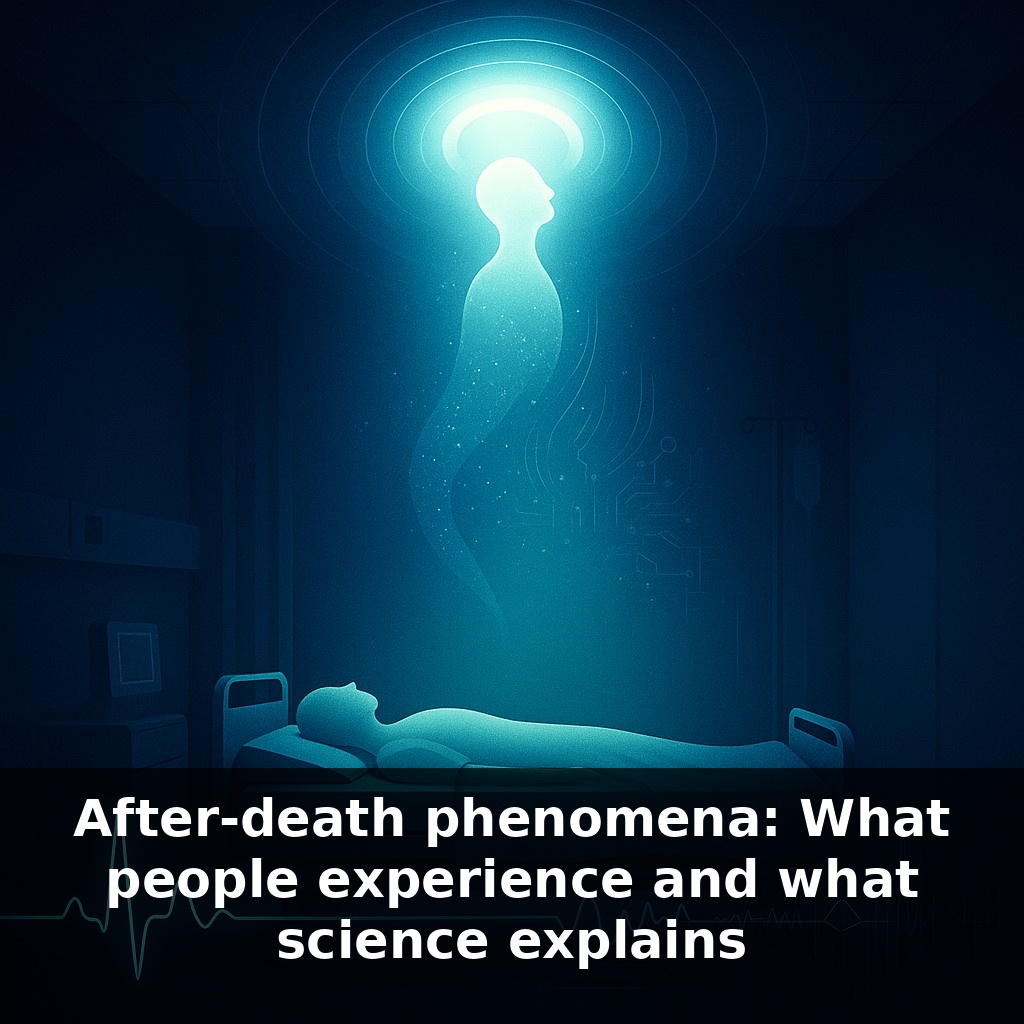
Right now, in quiet hospital rooms and busy emergency wards, some people whose hearts have stopped say they’ve never felt more alive. They talk about tunnels, brilliant light, and dead relatives—while monitors insist their brains are shutting down. So which story deserves our trust?
About one in five people revived after cardiac arrest say they’ve had some kind of profound experience—but they don’t all describe the same thing. Some talk about leaving their body and watching doctors work. Others, days or weeks before death, quietly start chatting with long‑dead parents as if they’ve just walked into the room. A few who had been deeply confused or unresponsive suddenly become sharply clearheaded in their final hours, like a radio snapping back into perfect signal right before it’s switched off for good.
These reports fall into several overlapping categories—deathbed visions, terminal lucidity, shared‑death experiences, and after‑death communications—and each raises a slightly different puzzle. Are they all products of a failing brain, or is there anything left to explain once we’ve mapped the biology? In this episode, we’ll sort the lab‑verified from the anecdotal, and see where the data actually stop.
Across cultures and centuries, these reports show the same strange rhythm: fear gives way to calm, pain fades, and meaning rushes in. Medieval monks, modern ICU patients, and children on chemotherapy often tell overlapping stories, despite never hearing each other’s words. Scientists now track not just what people say, but when they say it—comparing timing against oxygen levels, drugs, and EEG traces. That lets us ask sharper questions: Are certain experiences more likely on specific medications? Do particular brain patterns line up with feeling “out of the body,” or seeing relatives at the bedside?
About 10–20% of people brought back after cardiac arrest describe something from “the other side,” but their stories split into patterns. One cluster is highly structured: a sense of moving, encountering a boundary, hearing a message like “it’s not your time,” then returning. Another is fragmented: sound snippets from the operating room, flashes of color, a conviction that “a decision” was being made. Researchers don’t just catalog these; they score them with tools like the Greyson scale and match them to medical records.
When they do, a few clues stand out. Certain drugs, like ketamine‑like sedatives, seem to nudge people toward more elaborate narratives. Very low blood oxygen and rapid drops in blood pressure correlate with altered time perception and a feeling that events were “more real than real.” But there isn’t a neat one‑to‑one map: patients with nearly identical lab values can report nothing at all, or life‑changing encounters.
Culture adds another layer. Children in India might see Hindu figures; adults in the U.S. might meet a deceased grandparent, or simply “beings of light.” Yet underneath the costumes, the script often converges on review and relationship: people say they re‑live key moments, or suddenly grasp how their actions affected others. That moral and social focus is harder to pin on any single brain process, so some scientists frame it as the brain’s last, intense attempt to integrate autobiographical memory.
Then there are reports that don’t fit comfortably anywhere. In AWARE‑type studies, a minority describe specific, verifiable details—like the sequence of shocks, or a comment made by staff—despite being unresponsive. These “hits” are rare, and critics point out that memories can be stitched together afterward from clues and conversation. Proponents reply that timing in a few cases appears too tight for that, hinting we may be missing something about how awareness can flicker during deep coma.
Think of these final minutes less as an on/off switch and more as a hospital at night: whole departments may be dark, while a few rooms still hum, others briefly flare to life, and staff move in ways that don’t match the daytime schedule. The challenge is to decide which late‑night activities are just the building winding down—and which, if any, suggest there’s a door we haven’t yet found.
A hospice doctor might quietly track patterns the way a weather scientist watches clouds. After hundreds of deaths, they notice clusters: people who start talking about travel—“I need my passport,” “The train’s coming”—often die within hours; those who speak as if they’re already in two places at once may linger a little longer. Families, meanwhile, sometimes report “odd glitches” in ordinary life that science mostly ignores: a clock stopping at the moment of death, a pet refusing to leave the doorway of an empty room, a sibling hundreds of miles away jolting awake with a strong sense of “something’s happened” before the phone rings. None of this proves anything by itself; most episodes have mundane explanations once you dig. But taken together, they function like weak radio stations on different frequencies. Researchers are starting to ask whether some of these reports could be studied the way we study rare side effects of new drugs: not as proof of a new law of nature, but as signals that our current map may be missing a few back roads.
If these edge‑of‑death moments are brain‑made, they’re still powerful levers. Clinicians are quietly testing how scripted “guided crossings” in VR, modeled on NDE reports, might ease terror in ICU patients facing high‑risk surgery. Ethicists, meanwhile, are asking whether a person’s “final say” should be the last signed document, or the values they report if they come back changed—as if a software update arrived during a system crash and rewrote their priorities mid‑shutdown.
So for now we live with a kind of scientific “open file”: patterns without a finished theory, stories without a clear verdict. Your challenge this week: notice how you talk about loss—do you default to certainties, or admit you don’t know? Treat each claim, from vision to lab result, like a witness in court: credible, flawed, and worth hearing fully.