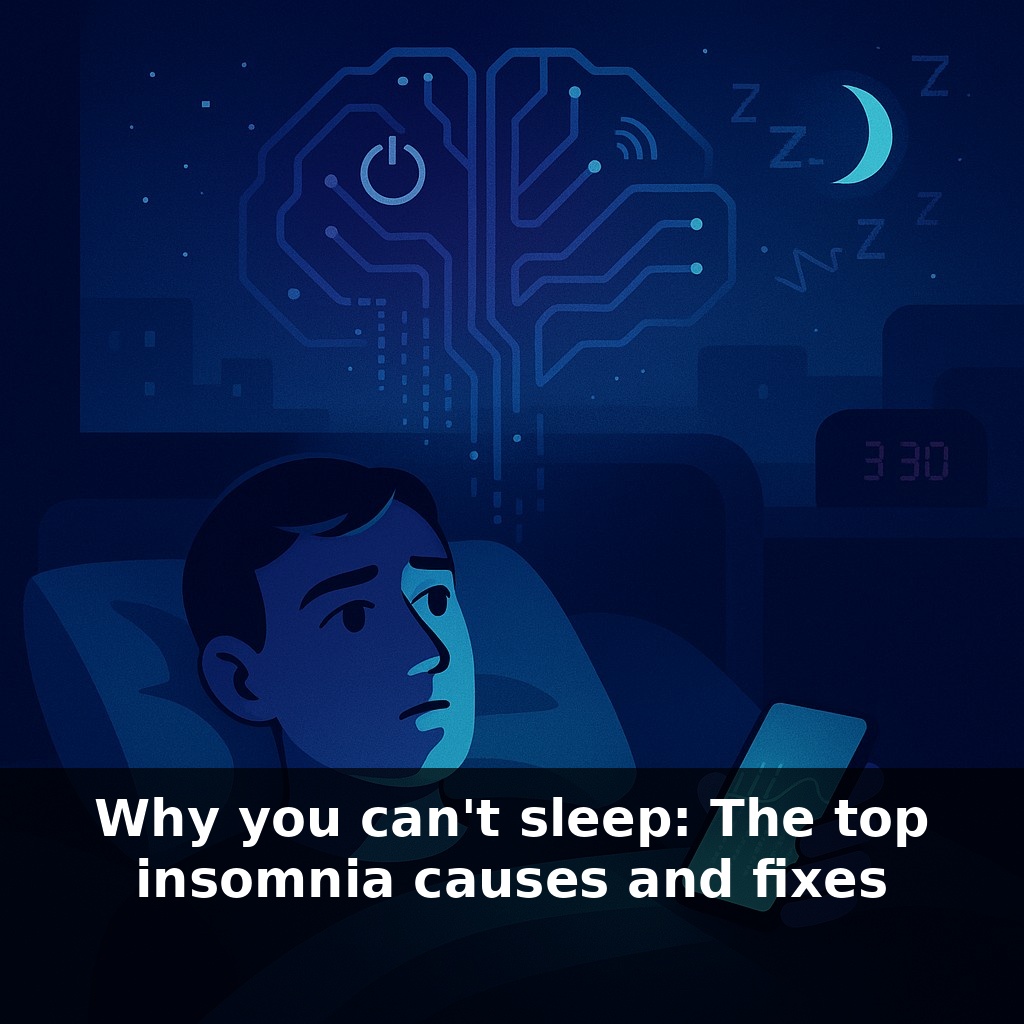
You’re likely more sleep-deprived than you think. Roughly a third of adults meet criteria for chronic insomnia, yet many blame “being a night owl” or a busy mind. Tonight, as you lie awake, ask: is this really my personality—or a fixable glitch in how my brain handles sleep?
Maybe your “bad sleep” isn’t one problem at all, but three or four smaller ones stacked on top of each other. You wake up at 3 a.m. wired, blame stress… but skip the late‑day coffee you forgot about, the extra hour of scrolling in bed, or the 5 a.m. alarm that only fits your weekday life. Insomnia usually isn’t a single villain; it’s a crowded cast of tiny saboteurs that add up.
What makes this tricky is how quickly your nights start training your days. After a few rough weeks, you might start going to bed earlier “just in case,” napping more, or working in bed. Each of those seems logical in the moment, but can quietly reinforce the very sleeplessness you’re trying to escape.
In this episode, we’ll unpack the most common culprits—stress, habits, body clock glitches, health issues—and show how to untangle which ones are actually yours.
So instead of asking, “Why can’t I sleep?” a better question is, “Which part of my sleep system is misfiring tonight?” For some people, the problem shows up at the very start of the night: they dread bedtime, replay conversations, or feel a burst of mental energy as soon as the lights go off. Others fall asleep quickly but wake at 2 or 4 a.m. with a racing pulse, vivid dreams, or a sudden urge to check email. And some feel like they sleep “through” the night, yet wake up as if they’ve pulled an all‑nighter—foggy, sore, and strangely jet‑lagged.
Think of your nights in terms of *where* the breakdown happens: input, processing, or output.
**1. Input problems: what you’re feeding your sleep**
These are the things you do (or consume) in the 6–8 hours before bed that quietly push sleep further away. Caffeine is the classic example, but it isn’t just about how much—you also have a personal sensitivity and timing window. The same dose at 10 a.m. and 3 p.m. can feel totally different at midnight. Nicotine, late heavy meals, intense evening workouts, and scrolling in bright light all count as inputs your system has to fight through.
There’s also “social input”: late‑night arguments, work emails, or even binge‑watching a riveting show keep your brain in “next episode” mode instead of “power down” mode. None of this is about willpower; it’s about not asking your nervous system to slam on the brakes at 11 p.m. after flooring the gas all evening.
**2. Processing problems: how your brain handles the night**
Some nights, you do many things “right” and still feel like your brain mismanages the night. Here, patterns matter more than any single bad sleep. Do you consistently wake at the same time? Feel wired right after you finally fall asleep? Notice that a small disruption—like a neighbor’s door closing—sets off a full wake-up?
This is where learned associations sneak in. If you’ve spent weeks checking the clock, worrying about tomorrow, or working from bed, your brain can start treating bed as a place for monitoring and planning rather than resting. Over time, the brain gets better at whatever you repeatedly ask it to do in a given context—even if what you’re rehearsing is “stay alert in bed.”
**3. Output problems: how sleep shows up the next day**
Finally, look at what your “finished product” feels like. Do you log eight hours on a tracker but wake unrefreshed? Drag most mornings regardless of bedtime? That mismatch can hint at fragmented or shallow sleep, breathing issues, or mismatched timing between when you sleep and when your internal clock expects sleep. It’s like landing in a new time zone but never fully adjusting; you’re technically sleeping, just not when your biology is best set up for it.
Most people have a blend of these: a few unhelpful inputs, some unhelpful learned processing, and an output pattern that keeps reinforcing the cycle.
Think about a week where your evenings look totally different: Monday you’re at a late concert, Tuesday you’re answering work messages until midnight, Wednesday you’re out for a heavy dinner at 9, Thursday you crash on the couch at 7:30, Friday you push through with energy drinks. By Sunday, lying in the dark, it’s hard to tell which nights “caused” the rough sleep—because they all tug your nights in slightly different directions.
To make this less abstract, picture three people. Sam falls asleep fine on weekdays but stays up until 2 a.m. on weekends; by Monday, his 6 a.m. alarm feels like flying back from a different time zone. Lina keeps a perfect schedule but does intense brainstorming in bed with her laptop; after a few weeks, her brain automatically snaps into “work mode” when she hits the pillow. Devon logs seven hours yet wakes up with a dry mouth and morning headaches; his partner notices he sometimes stops breathing briefly, hinting at a hidden breathing disorder that fragments his nights without waking him fully.
Your nights might soon be guided less by guesswork and more by data. As wearables quietly log patterns, they could flag when your schedule subtly drifts or when late messages keep nudging bedtimes later, like a train gradually missing its timetable. AI tools might then suggest tiny course‑corrections—shift this meeting, dim lights earlier, move that intense task—turning your evenings into a series of small, personalized experiments instead of one-size-fits-all rules.
Treat the next few weeks like a low‑stakes lab, not a pass/fail test. Small tweaks—shifting light, timing food, rethinking where you park your worries—are like adjusting knobs on a mixing board to find a signal that feels naturally sleepy. As tools get smarter, the real skill will be noticing which quiet adjustments actually change how your nights feel.
Before next week, ask yourself: 1) “If I replay my last 60 minutes before bed like a movie, which 2–3 things (scrolling my phone in bright light, late caffeine, stressful emails, intense workouts) are most likely keeping my brain in ‘daytime mode’?” 2) “On the nights I sleep best, what’s different about my evening rhythm—timing of my last meal, light exposure, worries I’ve already ‘parked’ somewhere, or how consistent my bedtime is?” 3) “If I experimented for just seven nights, what is one specific change from the episode (e.g., no screens after 10 pm, a fixed wake-up time, dimming lights after 9 pm, or a 10‑minute wind-down ritual) that I’m genuinely willing to try and track how my body and mind respond?”