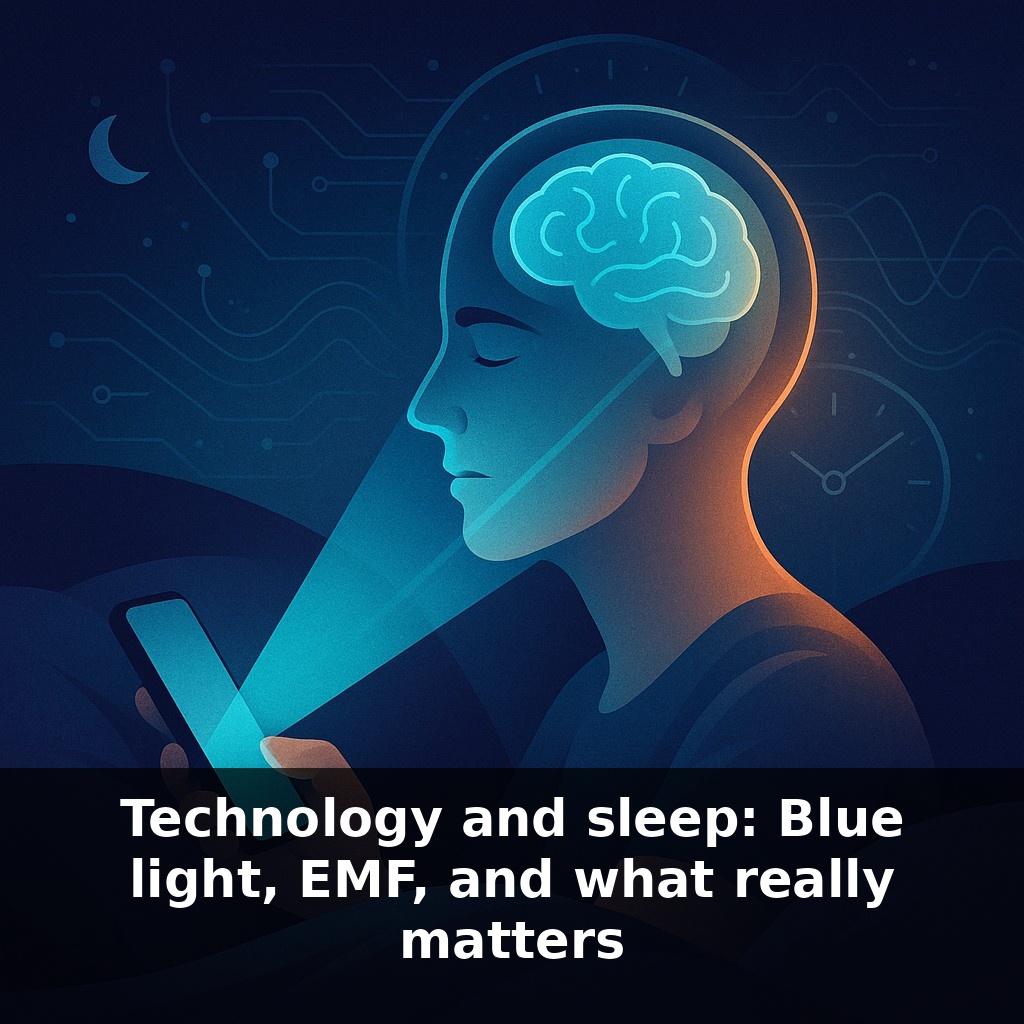
Right now, as you listen, your phone could be quietly shifting your body clock later—without you feeling it. One kind of light from screens tells your brain, “stay awake,” even when it’s midnight. So why do some people sleep fine with tech… and others spiral into insomnia?
Here’s the twist most people miss: your tech isn’t just “keeping you up” — it’s quietly training your brain *when* to feel sleepy and *how* to feel in the morning. The same device you blame for late nights can, used differently, become a tool that protects your sleep instead of wrecking it.
We tend to obsess over the wrong villains: is it the phone model, the laptop brand, the TV size? In reality, **when** and **how** you use them usually matters far more than **what** you use. A dim phone in your hand at 11:30 p.m. can be more disruptive than a bright monitor at 3 p.m.
Meanwhile, there’s a whole industry selling blue-blockers, EMF stickers, and router cages—while the biggest lever is still your behavior. In this episode, we’ll separate signal from noise: which tech risks are real, which are exaggerated, and how to turn your devices into sleep allies instead of enemies.
Some of the most feared “sleep destroyers” are also the least proven. Blue light gets blamed for everything, yet your late‑night group chat, doomscrolling news, or one “urgent” email can jolt your nervous system more than the light itself. At the same time, people worry about Wi‑Fi signals while falling asleep three hours late under bright ceiling LEDs. This gap between what feels scary and what’s actually powerful is where confusion thrives. In this episode, we’ll zoom in on three levers—light, EMF, and intentional tech—to see which are worth changing, and which you can stop stressing about.
Think of three overlapping dials you can actually control: **how much light hits your eyes**, **what your brain is doing while you’re using tech**, and **whether the surrounding “signal soup” is worth worrying about**.
First dial: **light dose.** Your circadian system cares about *dose over time*, not whether the photons came from a phone, TV, or tablet. A bright screen for 5 minutes at 7 p.m. is very different from a medium‑bright screen for 90 minutes at 11:30 p.m. Distance matters too: the closer the screen, the more light reaches the retina. That’s why a phone 20 cm from your face can nudge your clock more than a TV across the room, even if they “feel” similarly bright.
Second dial: **mental load.** The content on your device shapes how aroused your brain is. Competitive games, rapid‑fire social feeds, and late‑night email threads spin up alertness and emotional intensity, which linger after you put the device down. Calmer inputs—long‑form reading, soothing audio, or a boring show you’ve already seen—tend to produce less of that residual “wired but tired” feeling. Two people can stare at the same brightness level and have totally different sleep outcomes because one is stressed and the other is barely engaged.
Third dial: **background tech fears.** EMF is where anxiety often outruns data. At everyday levels from home routers and phones, the best‑controlled studies so far mostly fail to show large, reliable changes in sleep quality or hormone levels. That doesn’t mean research is “finished,” but it does suggest you’ll get more return from changing light exposure and habits than from, say, turning your apartment into a Faraday cage.
Here’s where intentional tech comes in. Most phones now let you schedule warmer color temperatures, auto‑dim at set times, or enforce app limits. Wearables can nudge you toward a consistent wake time instead of endlessly grading your sleep. Even smart bulbs can shift from bright, cool morning settings to dimmer, warmer evening scenes with no extra thought once configured.
The practical question isn’t “Is tech good or bad for sleep?” but “Does this particular use, at this particular time, push my physiology toward wake or toward rest—and by how much compared with my other choices tonight?”
That Harvard iPad study is a good reference point: five nights of late tablet use didn’t just push back hormones—it carried over into the next morning with measurably worse alertness. Now zoom into everyday life. One person scrolls a bright phone in bed for 45 minutes, another keeps the same phone but docks it across the room at 10 p.m. and switches to a paper book. Same device, radically different physiological nudge.
The content layer matters too. A tense Slack exchange at 10:45 p.m. can spike heart rate the way a late espresso would, while a gentle breathing app or an offline playlist does the opposite. Many people find that simply setting a “no new decisions after 10 p.m.” rule—no shopping carts, no big emails—reduces that wired, ruminative state.
On EMF, contrast the fear with what’s known: household routers operate well below the exposure levels used in lab studies that still struggled to show reliable sleep disruption. If curiosity persists, experiment pragmatically—move your phone off the pillow, not out of your life.
As displays shift toward micro‑LED and color e‑paper, late‑night scrolling may feel less like staring into a car’s headlights. Wearables could quietly learn when *your* physiology drifts toward sleepiness and time prompts, alerts, even lighting scenes around that personal pattern. Think less “one bedtime for everyone,” more “dynamic soundtrack” that adapts to your daily rhythm. The open question is how much control you’ll keep as platforms start optimizing for engagement *and* rest.
Instead of chasing one perfect rule, treat tonight as a small rehearsal: adjust brightness, shift one notification, swap one late feed for a calmer cue. Notice how your mornings respond. Over time, these tiny edits stack like quiet software updates—less drama, fewer gadgets, and a sleep system that increasingly runs on your terms, not your timeline.
Before next week, ask yourself: “What’s one screen I can realistically stop using 60–90 minutes before bed (phone, laptop, TV), and what will I do instead in that time that actually feels appealing?” Notice: “Tonight, when I look at my phone after dark, what exactly am I using it for—and how much of that truly can’t wait until morning?” Finally, as you plug in your devices, ask: “If I moved my Wi‑Fi router and phone chargers just a few feet farther from my bed and switched my phone to airplane mode at night, what worries come up for me—and are they actually true or just habit talking?”