You can cut the time it takes to fall asleep by about half without touching a pill bottle. Picture this instead: your room is cool and quiet, lights are warm and low, your phone is out of reach. In this episode, we’ll turn that scene into a repeatable, science-backed system.
Sleep quality is a *system outcome*, not a willpower badge. People who sleep well don’t usually “try harder” at night—they’ve quietly designed their 24 hours so their brain has no choice but to shut down on time.
In this episode, we’ll turn that into something you can copy.
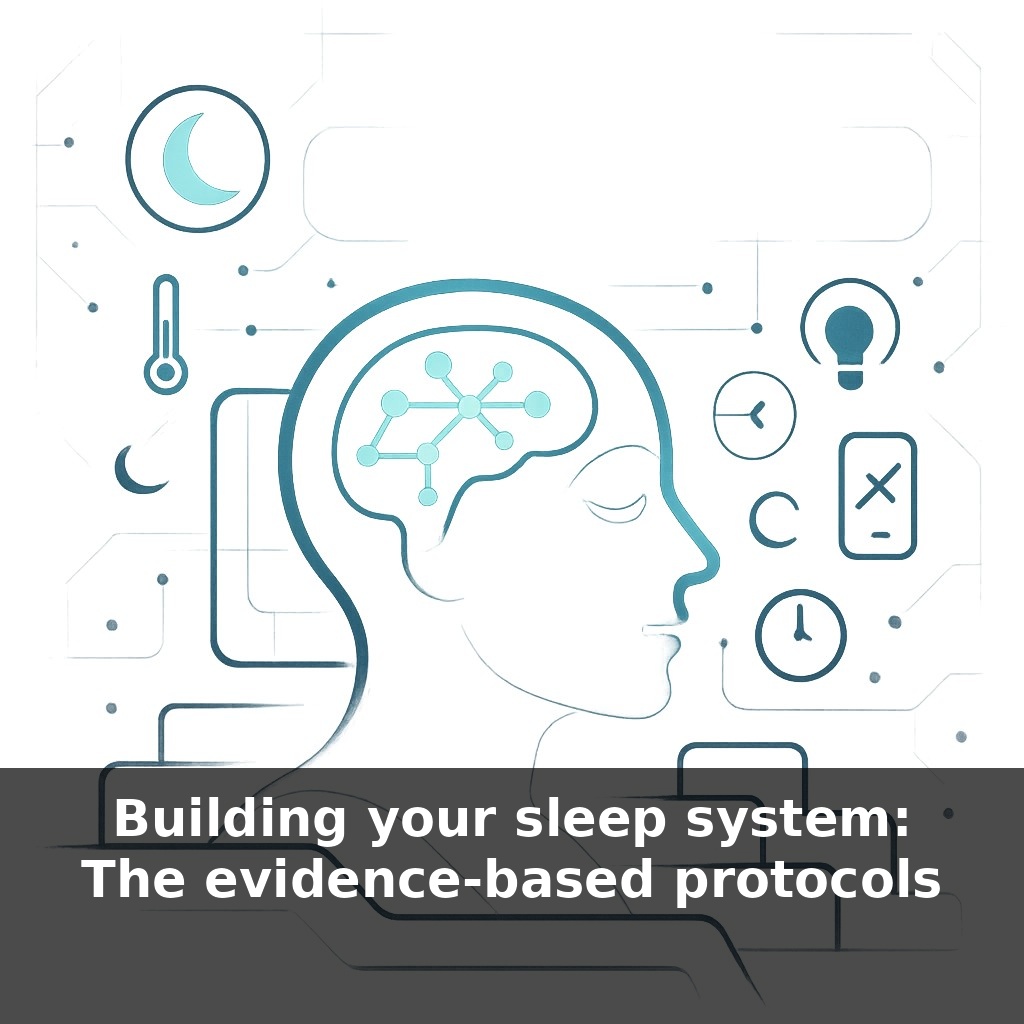
We’ll map four levers you can actually control: 1) Environment: how a 2–3 °C drop in bedroom temperature can add slow-wave sleep. 2) Light: why 10,000+ lux in the morning and <50 lux at night can shift your body clock by nearly an hour. 3) Substances: how a single 200 mg caffeine dose at 4 p.m. still affects you at 10 p.m. 4) Routine and tools: how structured wind-down rituals, CBT-I apps, and wearables create feedback you can adjust week by week.
By the end, you’ll have a concrete checklist to build and test your own sleep system, starting tonight.
Here’s the catch: a “better bedroom” or a single breathing drill won’t rescue a day that’s been misaligned since morning. The data you heard—30–60 extra minutes of deep and REM sleep, 20–30 % less next-day fatigue—only show up when the pieces run in sequence over 24 hours. That means shaping your inputs on a schedule: light within 60 minutes of waking, caffeine cutoff anchored to your target bedtime, exercise placed in the first two-thirds of your day, and a repeatable 30–60 minute shutdown sequence at night. We’ll now turn those into specific, testable protocols you can plug into your own calendar.
Most people try to “fix sleep” at night. The data say you start building tonight’s sleep in the first 60 minutes after you wake up.
Think in three blocks: **morning**, **day**, **evening**, each with non‑negotiables you can actually measure.
**Morning (first 60–90 minutes)** Anchor your clock early. Within 60 minutes of waking, get outside for at least **10–20 minutes**. On a bright day you’ll hit **10,000+ lux** easily; on overcast days, aim for **30 minutes** or more. If you must stay indoors, sit by the brightest window you have and keep overhead lights on; a typical indoor office is only **300–500 lux**, so you may need **30–45 minutes** to approximate the same circadian signal. Pair this with movement: a **10–15 minute** brisk walk raises core temperature and helps set the “countdown” to evening sleepiness.
**Daytime (middle 10–12 hours)** Here you’re protecting the system. Set a hard caffeine cutoff: count back **8–10 hours** from your planned bedtime and treat that as your last dose. If bed is 11 p.m., finish caffeine by **1–3 p.m.** Max total intake: roughly **2–3 mg/kg** body weight per day (about **200–300 mg** for a 70 kg person). Schedule exercise in the first **two-thirds** of your waking window. For a 7 a.m.–11 p.m. day, that means finishing vigorous workouts by **9 p.m. at the latest**, preferably before **7 p.m.** Heavy late-night sessions raise core temperature and can delay your natural wind-down.
**Evening (last 2–3 hours before bed)** You’re now sending “it’s safe to power down” signals. In the **90 minutes** before bed, aim for screens and lamps under **50 lux** total brightness, and shift to warmer color settings or bulbs labeled **2700 K or lower**. If you use blue-light-filtering glasses, wear them for at least **60 minutes** pre-bed. Keep your bedroom **2–3 °C** cooler than your daytime living space and minimize unpredictable noise; if you can’t get below **30 dB**, use a steady fan or white-noise track.
Layer one structured wind-down: choose **2–3 low-arousal activities** (reading paper pages, light stretching, journaling), and run them in the same order for **30–45 minutes**. Think of it like a pre-flight checklist: same sequence, same timing, so your nervous system learns the pattern and starts “descending” on cue.
Your challenge this week: pick **one block**—morning, day, or evening—and implement **exactly two** of these numbers-based rules every single day for 7 days. No skipping, no adding extras. At the end of the week, rate your sleepiness in the last hour before bed on a 0–10 scale and note any change of **2 points or more**.
Think of this like scoring a piece of music: each instrument has a volume and timing, and small shifts change the whole sound. Take a real example. “Alex,” a 34‑year‑old product manager, didn’t change bedtime at all. For 14 days, he kept a simple log with three daily numbers: total caffeine in mg, minutes of outdoor light before 9 a.m., and bedroom thermostat setting at lights‑out. On baseline days, he averaged **350 mg** caffeine, **4 minutes** outside early, and a **22 °C** room.
For the next 14 days, he capped caffeine at **200 mg** before noon, hit **18 minutes** outside by **8:30 a.m.**, and set the room to **18.5 °C**. That’s it—three dials. By the second week, his subjective “mental sharpness” at 10 a.m. (0–10 scale) rose from **5–6** to **7–8**, and afternoon “energy crashes” dropped from **4 days** per week to **1–2**. He also reported waking **0–1 times** nightly instead of **2–3**.
You can copy this structure: pick **three controllable numbers**, hold everything else constant for **2 weeks**, then shift only those numbers for the next **2 weeks** and compare.
In the next 5–10 years, treat your sleep setup like a testable “prescription.” Expect wearables to auto‑log latency, time in bed, HRV and wake episodes, then adjust your lamp from 300 to 30 lux at 9:45 p.m., drop room temperature by 2 °C at 10, and shift sound from 40 dB TV to 25 dB pink noise by 10:30—all without you touching a dial. Your job: choose the target (e.g., in bed 7.5 hours, 5 nights/week); your system will run the protocol.
Treat this like training, not a makeover. For 30 days, run one “sleep block” at a time and log just 3 numbers nightly: time in bed, wake-time variance, and energy at 10 a.m. on a 0–10 scale. If you see a ≥2‑point gain on 5 of 7 days, lock that setup in. Then advance to the next block. In 3 months, you’ll have a personalized protocol, not a guess.
Start with this tiny habit: When you first touch your pillow at night, immediately exhale slowly through your nose for just **two long breaths**, making each exhale slightly longer than the inhale. As you do it, quietly say in your mind, “Off-duty now” on each exhale. That’s it—no full protocol, no app, just two deliberate, longer exhales to start signaling your nervous system that it’s time for sleep. If it feels easy after a few nights, you can stretch it to four breaths, but only if it still feels almost effortless.