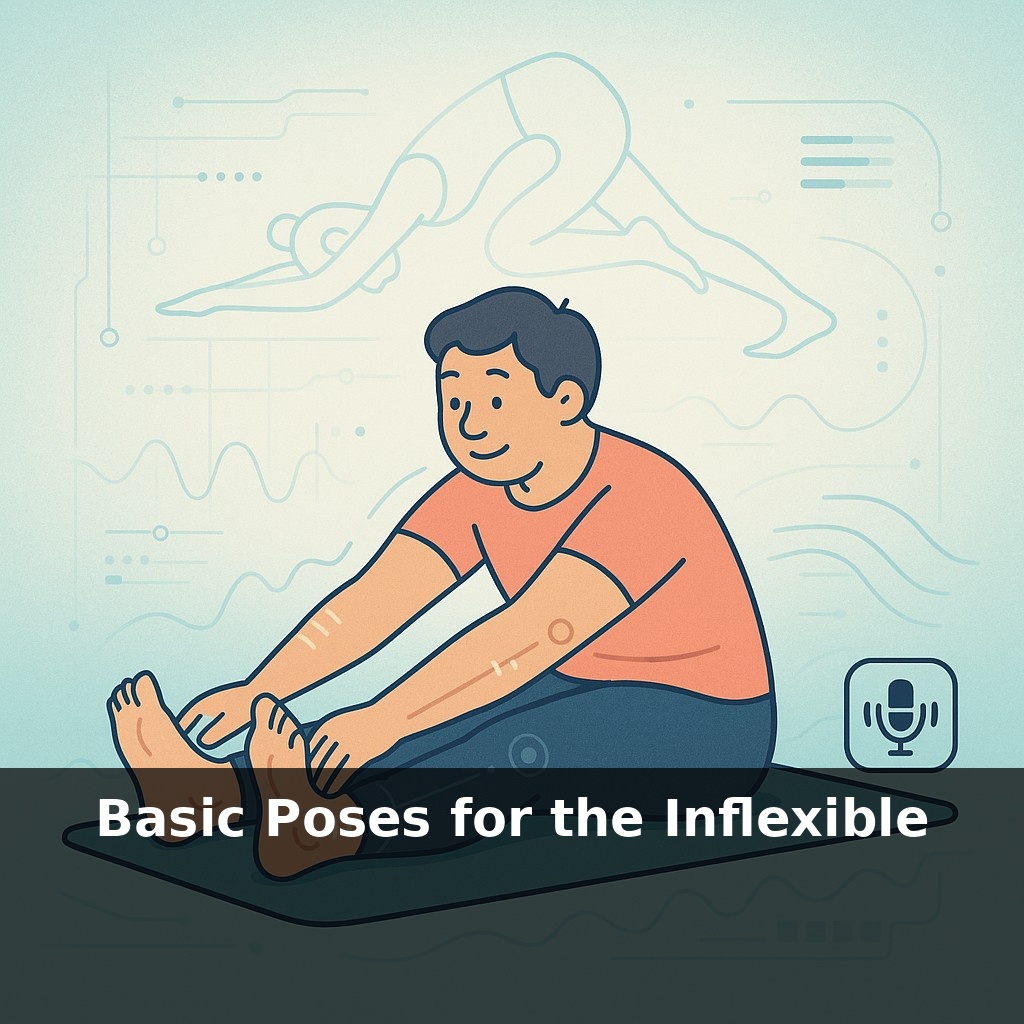
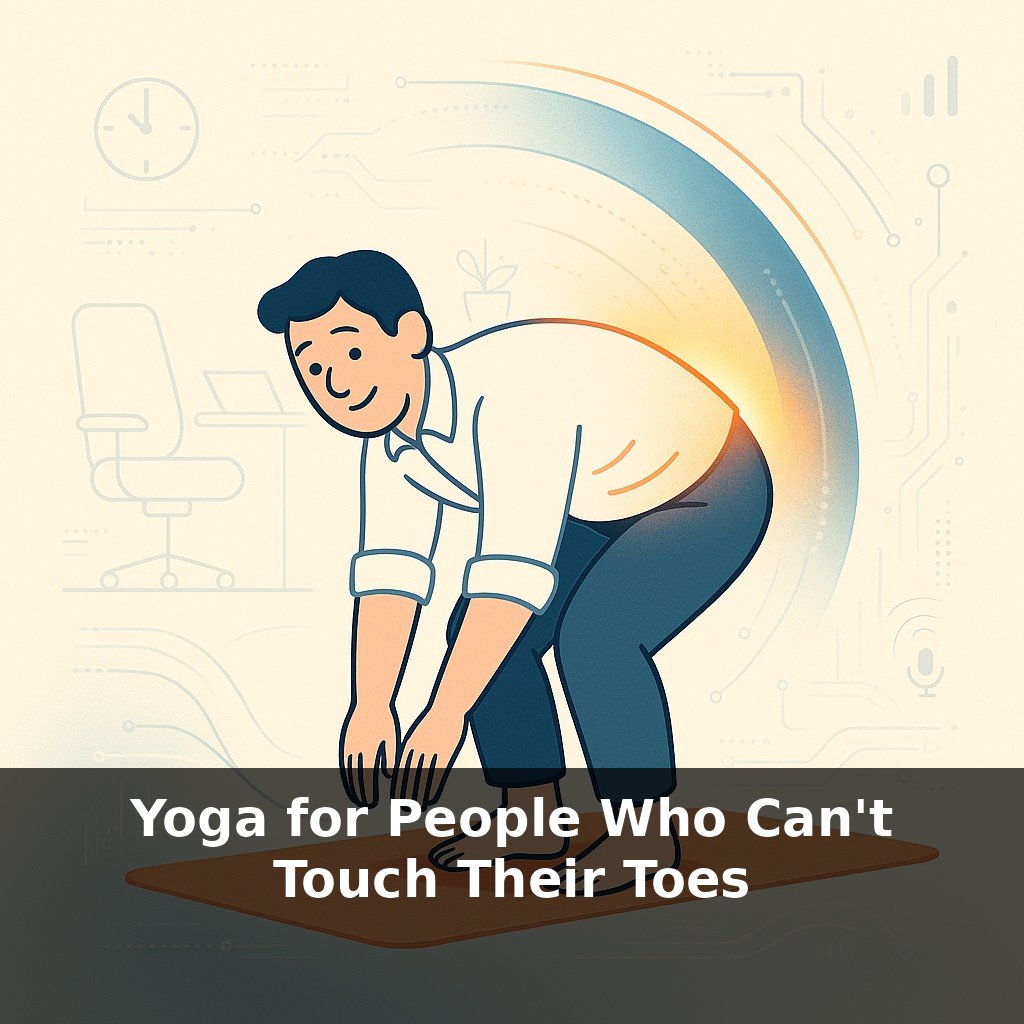
About a third of people who try yoga quit because they “aren’t flexible enough.” Yet the people who struggle to touch their toes are often the ones who gain the most. You, frozen in place on a stiff morning, might actually be the ideal beginner for today’s episode.
Nearly 35 million American adults did yoga in 2022—but most photos you see are of human pretzels, not people who wince when they sit on the floor. That mismatch quietly convinces a lot of stiff bodies to stay on the couch. Yet the research keeps saying the opposite: those who start out the tightest often see the clearest, most measurable changes in how they move, balance, and feel.
Today we’re zooming in on “Day 1 bodies”: the desk workers with cement shoulders, runners whose hamstrings feel like guitar strings, parents who groan every time they get off the sofa. Instead of chasing big, fancy shapes, we’ll look at a handful of basic positions that act more like friendly resets than heroic feats—stances you can slip between emails, or while waiting for the kettle to boil, to quietly renegotiate what your joints are willing to do.
So where do you actually start when your hamstrings complain about tying your shoes? Research points to a few quiet “support poses” that meet you where you are instead of demanding circus-level mobility. Think of them as calibration points rather than stretches: places where your joints, breath, and balance can compare notes. Mountain pose, for example, looks like “just standing there,” but when you stack your heels, hips, ribs, and skull with care, you’re teaching your whole system a new default. From that neutral home base, even tiny shifts become meaningful data instead of painful surprises.
If Mountain is your quiet “systems check,” the next step is to explore how your body behaves when you actually move or tip off center a little. That’s where a few deceptively simple shapes start doing real behind‑the‑scenes work for your joints and nervous system.
First up: Supported Half‑Forward Fold at the wall. Instead of asking your back to dangle in space, you hinge at the hips with your hands on the wall or a countertop. Your spine stays long, your knees can stay bent, and your hamstrings get a clear, negotiable request instead of an ultimatum. Research on low‑load stretching suggests that these gentler angles—held for 20–30 seconds at a time—can coax a 5–6° improvement in range over a month without the soreness you’d get from forcing a deep stretch.
Cat‑Cow on hands and knees adds motion without drama. The floor takes a lot of the load, so your back can explore flexing and extending in a way that feels more like joint lubrication than “stretching.” This rhythmic movement does more than wake up the spine; it also starts to sync up breath and motion, which helps down‑regulate the muscle guarding that often shows up as “tightness.” When the brain feels safer, it lets muscles loosen their grip.
Then there’s Reclined Figure‑Four, done on your back. Because gravity isn’t dragging your hip forward, your deep glute muscles get to lengthen and engage with surprisingly little protest. You can stay far from your end range and still get measurable change: studies on sedentary adults show that consistent, sub‑maximal holds can bump hip mobility and reduce stiffness scores in under three months.
Balance sneaks into all of this. Even with hands on a wall or knees on the floor, the small stabilizing muscles around your ankles, hips, and core are paying attention. Those proprioceptors—tiny sensors telling your brain where you are in space—get sharper every time you line up, shift weight, or notice your wobble. That’s part of why meta‑analyses find lower fall risk in beginners who never once stand on one leg with their foot behind their head.
Think of these poses less as “workouts” and more as practice conversations with your joints: frequent, calm, and specific. Bones stack, muscles engage just enough, breath stays smooth. Over weeks, your body updates its internal map of what’s normal, and things like tying your shoes or stepping off a curb start to feel less like negotiations and more like routine.
Think of this mini‑sequence as a set of “access codes” you can sneak into everyday life. Waiting for your coffee to brew? Stand in your version of Mountain, but experiment: shift your weight slightly toward your toes, then your heels, until you find the spot where your feet feel equally heavy. That’s not just posture; it’s your nervous system updating how “standing” is supposed to feel.
At a counter or wall, slide into that Half‑Fold shape while you read an email, and play with micro‑bends and straightening in your knees. Notice which tiny adjustment lets your neck soften. On the floor, Cat‑Cow can become a quick “status report” before a walk: maybe your upper back wants more movement than your lower back today. In Reclined Figure‑Four, try placing your supporting foot in three different spots—farther away, closer in, a little to the side—and watch how each subtly shifts the stretch. You’re not chasing depth; you’re collecting data about what makes your body say “yes” right now.
As these basics meet technology, the floor of what’s “accessible” rises. A phone camera could flag when your knees lock in Mountain or your spine rounds in a half‑fold, nudging you to adjust in real time. Workplaces might sprinkle in 3‑minute alignment breaks the way they once added water coolers—small, frequent tune‑ups instead of rare repairs. On a larger scale, simple mobility checks could join blood pressure and BMI as early warning lights on your health dashboard.
The next step is experimenting: notice how your breath, mood, or focus shift after a single, low‑effort round of these shapes. Treat them like quiet bookmarks you can slip between tasks—opening a laptop, ending a call, brushing your teeth. Over time, these tiny, repeated signals can redraw the outline of what “normal” movement feels like in your body.
Before next week, ask yourself: 1) “When I try the basic poses from the episode (like seated forward fold, cat–cow, or supported lunge), exactly where do I feel the most resistance, and what happens if I stay there for five slow breaths instead of backing off immediately?” 2) “If I treated my inflexibility as useful feedback instead of a flaw, what would I change about how long I hold each pose, how I use props (like cushions or blocks), or how far I push toward ‘the full expression’?” 3) “On a day when I feel too stiff or tired to do the full sequence, what is the absolute minimum I’m willing to commit to—such as 3 minutes of cat–cow on my mat—and how does my body feel before and after that tiny practice?”