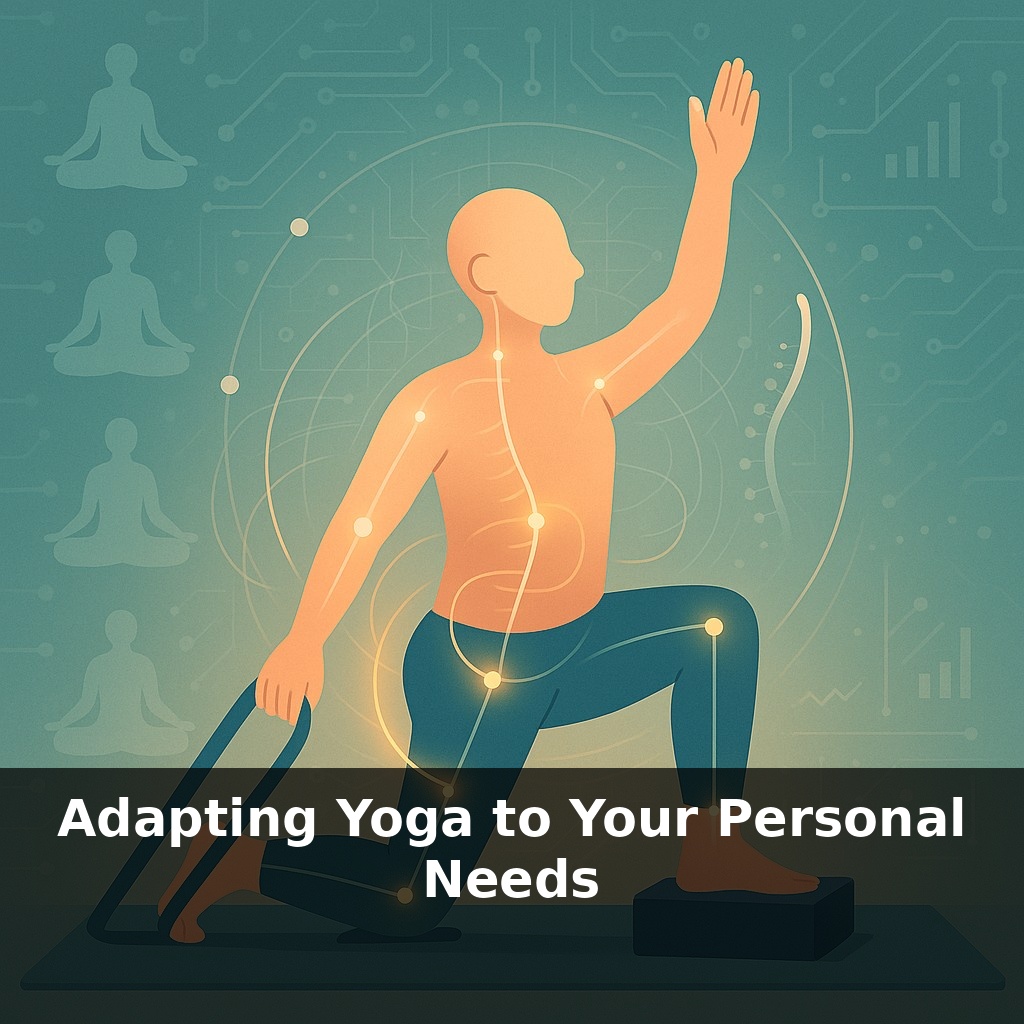
Modern yoga research shows a simple twist: personalized routines can ease chronic pain almost twice as well as standard classes. Yet most people still copy poses from the person next to them. Today we dive into this quiet paradox: one tradition, thousands of individual blueprints.
Modern studies now get very specific about *how* to adapt yoga, not just *whether* it works. Instead of asking “Which pose is best for back pain?” they ask “Which version of this pose works for *this* spine, *this* nervous system, *this* schedule?” One person might bend deep into a lunge, another keeps their hands on a chair, a third stays upright and focuses only on breath rhythm—and all three can be doing the “right” practice for their body.
This is where yoga starts to feel less like learning choreography and more like learning a language. You’re not just repeating shapes; you’re forming sentences that say, “Less pain today,” or “More focus before work,” or “Nervous system, you can stand down now.” In this episode, we’ll look at how to translate big, generic yoga ideas into small, precise tweaks that actually fit your daily life.
Once you stop copying the person on the neighboring mat, a different question appears: *What exactly are you adapting for?* Traditional texts quietly point to three big dials—body, breath, and mind-state—but modern research adds resolution, like switching from a blurry map to GPS. Your history of injuries, sleep patterns, stress load, even work setup all become “settings” you can tune. One day, the nervous system needs downshifting; another, your joints need decompression; another, focus before a high-stakes call. In this episode, we’ll treat those shifting needs as data and design around them.
Most people who try to “personalize” yoga start by asking, “Which poses are good for X?” That sounds logical—but it skips a step. Before choosing *what* to do, you need to clarify *what you’re trying to change*, and *what your current limits are*.
Researchers and yoga therapists increasingly talk in terms of **functional goals** rather than poses:
- “Get through a workday with less back fatigue” - “Fall asleep faster without medication” - “Walk upstairs without knee pain” - “Feel less wired before presentations”
Once the goal is clear, you reverse‑engineer your practice. Instead of “I should do more hip openers,” you ask:
- Which movements currently *aggravate* my symptoms? - Which positions reliably *soothe* them? - How much load, how much time, and at what time of day can my system handle?
That’s where small details—angle, support, duration, breath pattern, pacing—start to matter more than the pose name.
Take knees as a concrete example. Two people both say, “My knees hurt in lunges.” A generic class might offer one alternative and move on. An adaptive approach gets curious:
- Do the knees hurt more when bent deeply, or when straightening? - Is pain worse with weight on the front leg or the back? - Does support from a chair or wall change anything? - What happens if you shorten the stance by half?
Answering those questions gives you a map. The University of Miami data on props isn’t just academic; it implies very practical options: adding blocks under the hands, elevating the front thigh on a bolster, or practicing the same mechanics lying down can all cut joint load dramatically while still training strength and alignment.
The same precision applies to nervous‑system goals. Someone whose mind races at night may actually need *less* intense stretching and more rhythmic, predictable movement plus structured breath. Another person stuck in a low‑energy fog might respond better to shorter holds, slightly faster transitions, and a brighter gaze.
Think of yourself as a coach making mid‑season adjustments: you don’t replace the entire playbook; you tweak angles, timing, and effort so your current body can still “play the game” of your life with less strain and more clarity.
A useful way to experiment is to pick one everyday situation and quietly redesign your practice around it. Say your shoulders tense up after video calls. Instead of hunting for “best pose for shoulder tension,” you might test three small variations across a week: one day you slide your forearms up a wall and lean gently in; another day you loop a strap between your hands and widen it overhead; a third day you lie on the floor with a folded blanket along your spine, arms relaxed out. Same general region, completely different inputs. Notice which one you can still breathe calmly in after a minute, and which one your body subtly resists after 10 seconds.
Or consider afternoons when focus drops. You could compare a short standing sequence with brisk transitions versus a slower, mostly‑seated mini‑routine. Neither is “right” in the abstract; the useful question is, “Which one leaves me clearer for the next hour?” Over time, these tiny A/B tests become your personal reference library.
In a few years, your mat may “listen” as much as you do. Sensors could flag when your twist compresses more on one side, then quietly suggest a smaller range, like a skilled coach tapping your elbow to refine a throw. Apps might learn your flare‑ups and pre‑emptively swap in gentler sequences on high‑stress days. As these tools mature, the experiment shifts from “Can I follow this routine?” to “How precisely can practice respond to *today’s* version of me?”
As you keep tweaking, your mat can become less like a workout station and more like a quiet lab bench. Instead of chasing “perfect form,” you’re collecting tiny data points: which tweaks help you stand up from your chair easier, focus longer, or wake up less sore. Over months, those notes turn into a kind of owner’s manual for the way *you* move through tech‑heavy days.
Before next week, ask yourself: “In my current practice, which poses consistently feel ‘off’ in my body (for example, downward dog on my wrists or deep twists in my lower back), and how could I experiment with props, bent knees, or wall support to make them feel more nourishing instead of draining?” “If I treated my breath as the teacher rather than the poses, what would I change about the pace, intensity, or length of my next home practice—would I shorten standing sequences, add more restorative shapes, or pause in child’s pose more often?” “Looking at my real life this week (energy levels, work stress, sleep), what would a truly supportive practice look like today: 10 minutes of gentle supine stretches, a slow chair-based sequence, or simply a long savasana with guided breathing?”