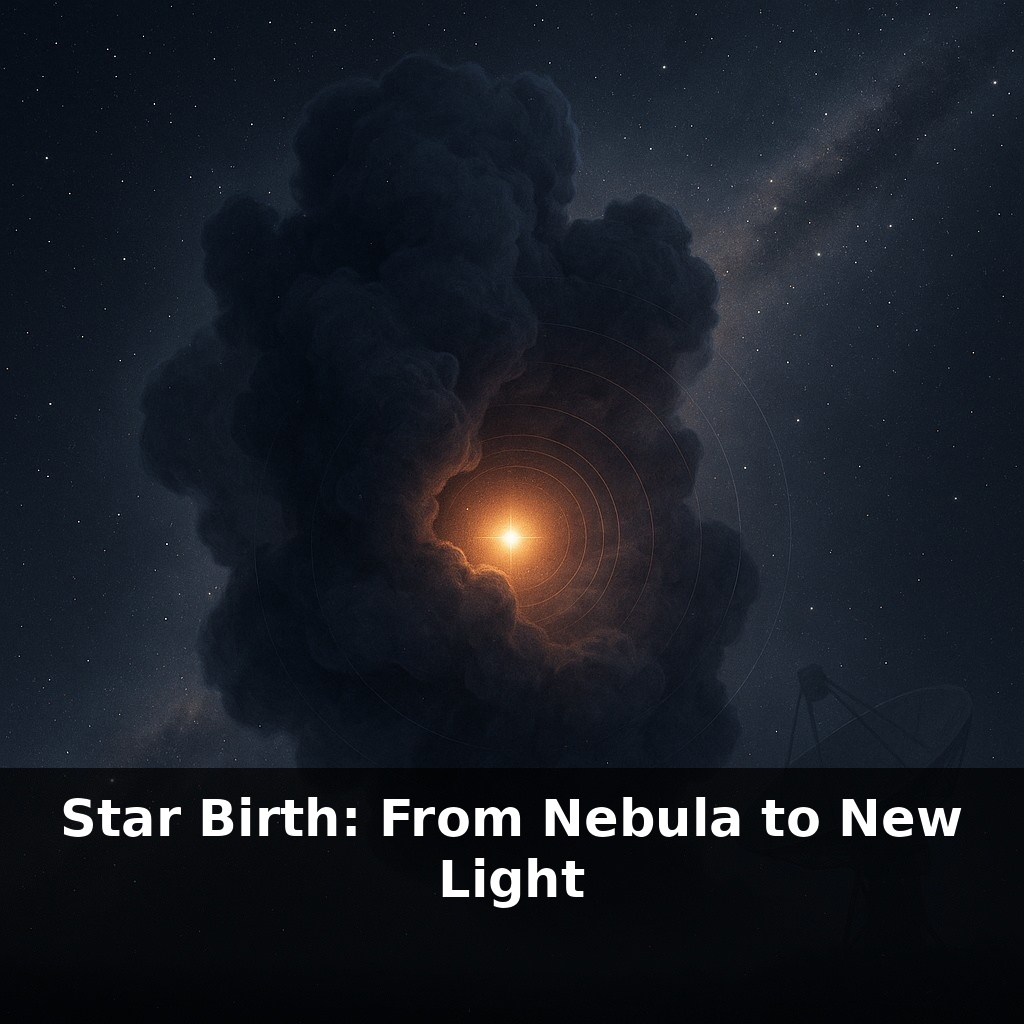
Star Birth: From Nebula to New Light
📝 Transcript
Right now, in our galaxy, stars are being born inside clouds so dark that, with human eyes, you’d swear there was nothing there at all. Yet inside, gravity is quietly lighting new suns. In this episode, we’ll step into that darkness and follow one newborn star’s first breath.
Most of what we know about this hidden process comes from light our eyes can’t see. Radio telescopes trace wisps of cold hydrogen across spiral arms. Infrared observatories like the James Webb Space Telescope peer through dust that blocks visible light, revealing clusters of still-forming suns wrapped in dusty cocoons. X-ray telescopes pick up the fierce tantrums of young stars flaring as their magnetic fields crack and reconnect. Astronomers then stitch these wavelengths together, like layering tracks in a music-editing app, to reconstruct a star’s life story from scattered signals. The result is a surprisingly detailed timeline: from the quiet clump deep inside a cloud, to a disk bright with heated dust, to the first clear, sharp light of a stable star joining its galaxy’s larger pattern.
Astronomers don’t just watch one forming star; they survey whole star‑forming regions, then compare thousands of objects caught at different stages. It’s less like reading a single biography and more like reconstructing a family history from scattered photos and receipts. In places like the Orion Nebula, young stars crowd together, some still shrouded, others already blazing. By measuring their ages, motions, and chemical fingerprints, researchers can see how fresh elements from past stellar explosions are recycled, and how only a small fraction of the original cloud ever makes it into long‑lived suns.
At the very start of this journey, there’s not much to see—just a slightly denser knot inside a larger cloud, colder than the deepest winter night. The real action is in the delicate balance of pushes and pulls. Gas particles jostle and collide, creating pressure that resists collapse, while the combined attraction of all that mass tries to squeeze it inward. Slight differences in density tip the balance: one region cools a bit better, radiates away more heat, loses some pressure support, and begins to give in. Once that happens, the collapse feeds on itself.
As material falls inward, it can’t drop straight to the center. Even a tiny initial spin gets amplified, and conservation of angular momentum forces infalling gas to spread into a flat, rotating structure. In this disk, collisions act like friction in a complex piece of software shuffling data: orbits gradually spiral inward, sending mass toward the core while some material is flung outward or ejected entirely.
Magnetic fields, frozen into the moving gas, twist as the disk spins. They act like rails, channeling some material away from the center in narrow, oppositely directed streams. These bipolar jets punch out through the surrounding cloud, carving holes through which radiation can finally escape. Shockwaves where the jets slam into ambient gas heat it to glowing, producing some of the most striking structures in modern astronomy images.
Inside the growing core, conditions change from gentle to extreme. Density climbs, temperature rises, and the gas transitions through regimes where different physical processes dominate how it transports energy. Turbulence, radiation, and convection all take turns shuttling heat outward. The object’s brightness doesn’t just increase smoothly; it can surge and dim as fresh clumps from the disk suddenly dump material onto the surface in rapid bursts.
During this phase, fierce magnetic activity powers flares and high‑energy outbursts that can strip or reshape the disks around neighboring embryos of planets. At the same time, larger‑scale events—like nearby massive stars blowing powerful winds or ending in explosions—can either choke off the supply of fresh gas or compress it further, setting off new rounds of collapse. Each star’s path through this environment ends up slightly different, sculpted by both its initial mass and the neighborhood chaos.
In the kitchen of a professional bakery, not every gram of flour ends up as perfect loaves; much is lost as dust, scraps, or experimental batches. Molecular clouds are similarly “wasteful”: only a small fraction of their mass turns into lasting stellar “products,” while turbulence, radiation, and feedback from massive neighbors stir and disperse much of the rest. Observations show that in some galaxies, this cosmic “bakery” runs hot—high-pressure regions and dense filaments push efficiency upward, briefly flooding spiral arms with newborn suns before feedback slams on the brakes. In more quiescent systems, clouds loiter along, forming only a trickle of new light. The Sun’s own birthplace was likely part of a modest burst enriched by earlier explosions, seeding it with the heavier elements later built into planets, oceans, and life. Across the sky, bipolar jets mark where this process is currently most intense: signposts of where gravity is still winning, for now, against the forces that try to shut star birth down.
Some of the most radical implications sit close to home. As instruments sharpen, they can map how often disks like our own once was give rise to Earth‑scale worlds and temperate orbits. That, in turn, reshapes odds for life elsewhere from guesswork to statistics. On grander scales, birth‑rates of stars act like a galactic budget report, revealing when galaxies splurged on rapid growth or shifted into quiet “retirement,” changing how often heavy elements—and potential habitats—appear.
Each time instruments sharpen, we catch earlier whispers of this process: ripples in gas that foreshadow which regions will “win” the race to shine. Your challenge this week: when you see city lights at night, pick one and trace its story backward—materials, people, power—like rewinding a star’s origin through layers of cosmic cause.

Unlock all episodes
Full access to 5 episodes and everything on OwlUp.
Subscribe — $1.99/monthLess than a coffee ☕ · Cancel anytime