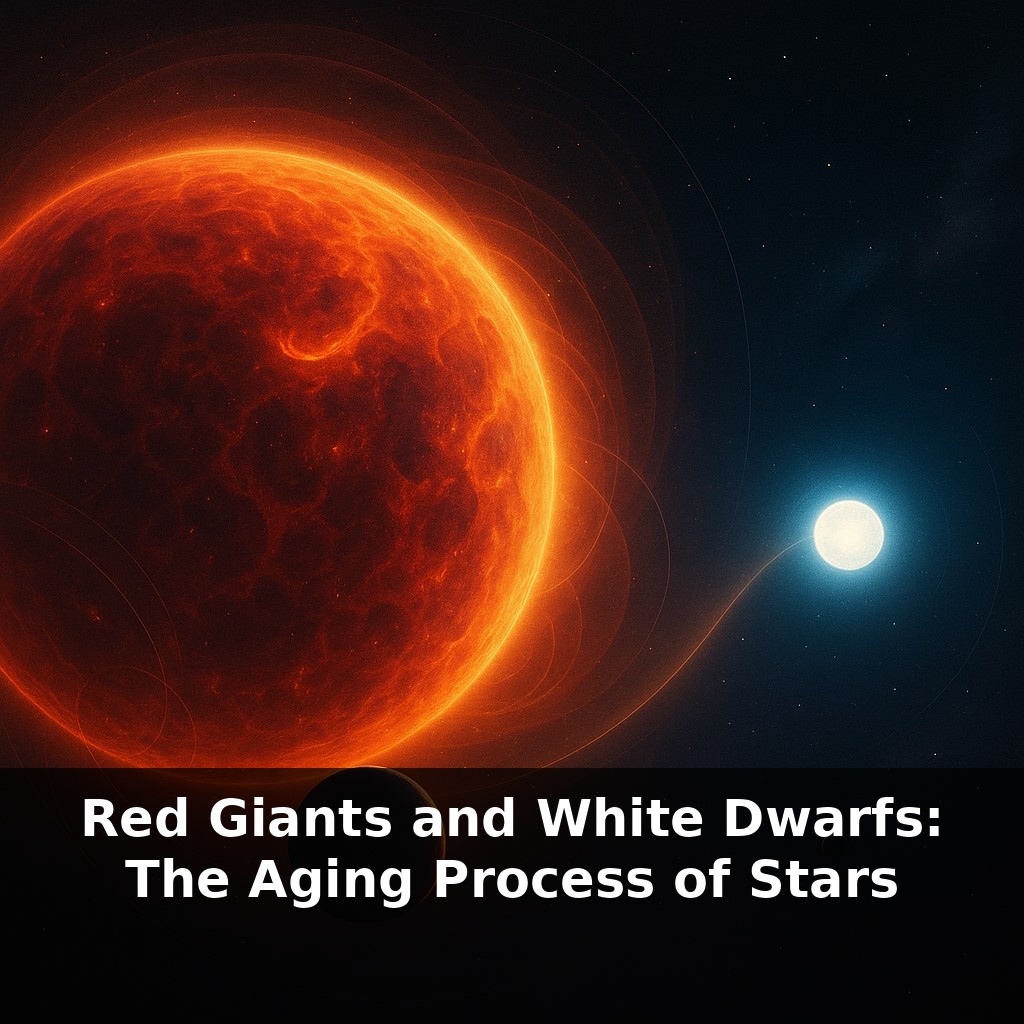
Our Sun is quietly counting down to a phase where it will swell so large it could swallow entire planets. Right now, somewhere in our galaxy, stars like it are puffing up into red giants, shedding their skins, and leaving behind dense, fading stellar ghosts.
The strange part is this: stars don’t just “get old” and fade—they radically reinvent themselves. A star that once looked steady and ordinary can, late in life, pulse in brightness, shed rings of gas, and then shrink into something so compact a spoonful would outweigh a mountain range. Our Sun is on that path, but it’s only one example in a vast catalog of stellar destinies.
Astronomers read these endings the way geologists read layers in rock. By measuring color, brightness, and motion, they can tell which stars are only beginning to bloat and which have already collapsed into dense remnants. Some nearby examples—like the red giant Aldebaran or the white dwarf Sirius B—act as time-lapse snapshots of our Sun’s eventual future.
In this episode, we’ll trace that transformation step by step, and see how it reshapes not just stars, but the planetary systems that orbit them.
To follow that story properly, we need a kind of “stellar family album” for low- and intermediate-mass stars like the Sun. Not all stars share this fate—only those born within a certain mass range will pass through the swollen, unstable late-life phases and end up as compact leftovers. Astronomers sort these stars by mass the way an engineer sorts engines by horsepower: it tells you how hard they can run, how long the fuel will last, and what finally breaks. That single number—mass—sets the timetable for swelling, shedding, and collapse. Our Sun sits in the quiet middle of that spectrum.
As hydrogen in a star’s core runs low, the balance that kept it stable starts to slip. Gravity pulls inward more effectively than the dwindling pressure from fusion pushing outward. The core contracts and heats, while the outer layers respond in almost the opposite way: they expand and cool. That expansion can be surprisingly dynamic—many aging stars don’t simply swell smoothly, they pulsate. Their brightness can change over days to months as their outer layers rhythmically thicken and thin.
Astronomers track this behavior with exquisite precision. Variable red giants—like Mira in Cetus—serve as living graphs of internal changes. Each cycle of brightening and dimming reflects sound waves and convection rolling through their interiors. By timing those cycles, we can infer sizes and masses of stars we’ll never visit.
As the core contracts further, fusion shifts into a surrounding shell. The extra energy from that shell boosts the outflow of radiation, which helps drive stellar winds. These winds aren’t gentle breezes; they can blow away substantial fractions of the star’s outer layers. For Sun-like stars, that gradual peeling ultimately exposes the hot interior. The ejected gas glows under intense ultraviolet light, becoming what we call a planetary nebula—often a complex, symmetric pattern seen in telescopes.
The core that remains is extraordinarily dense. Spectra of objects like Sirius B reveal not only high temperatures, but clues to extreme surface gravity. Light leaving such a compact star is measurably redshifted by gravity alone, a phenomenon predicted by general relativity and confirmed in white dwarf observations. That gravity also broadens spectral lines, letting astronomers weigh these objects from afar.
Cooling proceeds slowly. At first, a newly exposed remnant can be tens of thousands of degrees. Over billions of years, it radiates away stored heat, sliding from blue-white to amber to near invisibility. Some well-studied examples show evidence of crystallization in their interiors, their ions locking into ordered lattices as temperatures fall—more like a slowly freezing ocean than a burning ember.
Your challenge this week: look up real images of three specific objects—Mira (a pulsating giant), the Ring Nebula (a planetary nebula), and Sirius B (a compact remnant). For each, note one detail that surprised you about its shape, color, or behavior, and what that suggests about its stage in this long stellar aging process.
Astronomers don’t have the luxury of watching a single star grow old in real time, so they “splice together” lives from thousands of snapshots. It’s a bit like editing a movie from security-camera stills: one frame shows a swollen cool star, another a glowing gas shell, another a compact blue point. Surveys like Gaia and SDSS catalog these frames by the billions, letting researchers trace typical life paths and also spot odd outliers—objects that seem to have skipped or stretched a phase.
In star clusters, this becomes especially powerful. Every star there formed at roughly the same time, so differences mainly reflect mass and aging, not birthplace. The main sequence “turnoff” in a cluster’s color–magnitude diagram marks the point where stars have just left their stable youth, letting us estimate the cluster’s age. White dwarfs in the same cluster then act as a second clock: the dimmest, coolest ones set a lower limit on how long cooling has been underway, cross-checking the story told by brighter, earlier-stage neighbors.
Instruments like Gaia are turning these late-life stars into tools. By mapping their motions, we can trace how the Milky Way assembled over time, like following faded footprints across a dusty floor. Cooling rates of dense remnants reveal how well we understand exotic physics, from particle interactions to crystallizing interiors. And as future telescopes watch worlds near swollen stars, they may catch brief second chances for life where frozen planets drift into newly warmed orbits.
Seen across the galaxy, these elderly suns become more than curiosities; they’re practical tools. Their cooling rates refine the age of star clusters, their motions trace past galactic mergers, and their nebulae enrich space with heavier elements—like a cosmic compost system that quietly seeds raw material for the next round of stellar births.
To go deeper, here are 3 next steps: (1) Pull up the free interactive HR diagram at astro.unl.edu and plot the evolution of a 1-solar-mass star from main sequence to red giant to white dwarf, then compare that track with a 5–10 solar-mass star to see how the lifetimes differ in gigayears. (2) Open NASA’s “Eyes on Exoplanets” or the ESA Gaia archive viewer and filter for red giant stars within 500 light-years, then pick one and look up its parallax, radius, and luminosity to connect the episode’s concepts to a real object in the sky. (3) Grab *The Life and Death of Stars* by Kenneth R. Lang or watch the free MIT OpenCourseWare lecture series on stellar evolution, and specifically work through the section on shell burning and planetary nebulae to understand exactly how a white dwarf gets “revealed” at the end.