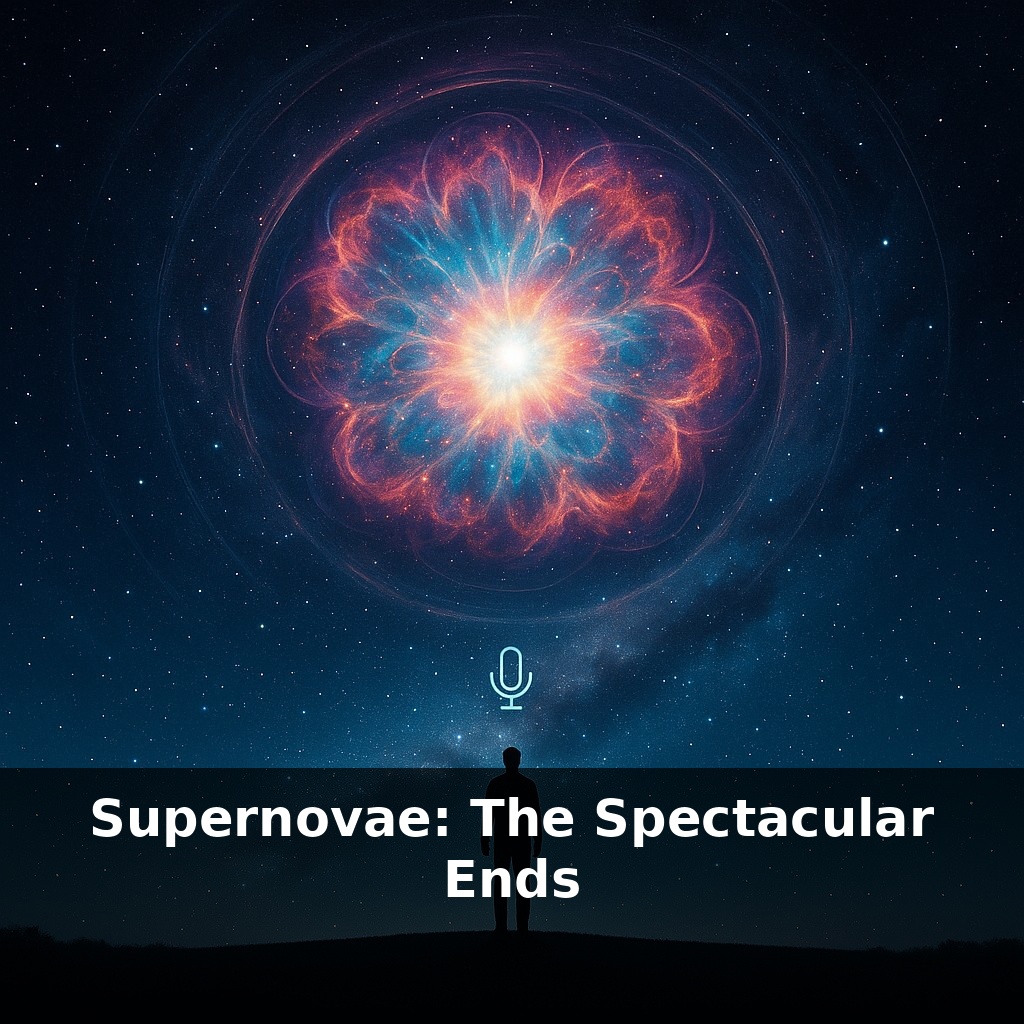
Somewhere in our galaxy, right now, a single dying star is briefly shining brighter than hundreds of billions of suns. You’re walking under a calm night sky, but overhead, entire worlds are being unmade so that future planets—and maybe future life—can exist at all.
In the time it takes you to read this sentence, roughly a hundred supernovae have already detonated somewhere in the observable universe. They are surprisingly common, yet in our own sky they are so rare that no human has ever watched one in the Milky Way with modern telescopes from start to finish. When they do appear, they don’t just flare and fade; they leave behind exotic relics—neutron stars spinning faster than a blender blade, or black holes that carve silent absences into space-time itself. Astronomers scour the heavens for these brief beacons, triggering global alerts within seconds of detection so telescopes, detectors, and even underground neutrino observatories can pivot toward the blast, racing to capture the first clues from a star’s final heartbeat.
While those cosmic deaths flicker on and off across the universe, each follows a story that began quietly: a star spending millions of years steadily fusing lighter elements into heavier ones, layering its interior like a complex spreadsheet of “energy accounts.” As iron builds up in the core, the calculations no longer balance—fusion can’t pay the energy “interest” needed to hold up the star’s own weight. In massive stars, this invisible accounting failure happens in less than a second, triggering a runaway collapse whose outcome—neutron star or black hole—depends on just how overdrawn that final core has become.
When that inner “energy account” fails, gravity doesn’t just win—it overcorrects. The star’s core rushes inward at a significant fraction of light speed, squeezing atoms so violently that protons and electrons are crushed together into neutrons, releasing a flood of neutrinos in the process. Almost all the energy of this event leaves as those ghostly particles, streaming straight through the star as if its bulk were fog.
For a moment, it looks like gravity will simply swallow everything. The outer layers are still plunging inward, unaware that deep inside, the collapse has slammed into something essentially incompressible: nuclear-density matter. The infalling material “hits the wall,” rebounds, and launches a shock wave outward. That shock should be the start of the visible explosion—but in most simulations, it stalls, quenched by the very matter it’s trying to plow through.
To get from stalled shock to blazing supernova, the neutrinos that just escaped the core have to do something they almost never do: interact. A tiny fraction dump energy back into the collapsing layers, reheating and reviving the shock. It’s like a failed software deployment that is salvaged by a last‑second patch—small changes, applied in exactly the right region, determine whether the system recovers or crashes entirely.
The outcome hinges on subtle details: the mass of the core, how fast the star was rotating, how tangled its magnetic fields are. Slightly lighter cores can be successfully blasted apart, leaving behind a compact remnant that may later reveal itself as a pulsar. Slightly heavier ones let gravity keep tightening its grip until no known force can counter it, and a black hole forms in the aftermath.
Meanwhile, the outward‑surging shock wave forges and flings out the universe’s heavier elements. Oxygen, silicon, calcium, much of the iron in your blood and the gold in your electronics—these are minted or liberated in that expanding debris. Within a few days, radioactive freshly-made nuclei in the ejecta start to decay, powering the rise to peak brightness that telescopes can catch from millions of light-years away.
Astronomers don’t just wait around hoping a nearby star obliges them with a perfect explosion. They turn distant events into laboratories. When a supernova appears in another galaxy, its light is split into a spectrum that acts like a barcode, revealing which new elements are racing outward and how fast. Different types of explosions leave distinct fingerprints: some strip‑bare, showing almost pure oxygen or calcium, others wrapped in hydrogen and helium from still‑intact outer layers. Time is encoded too. Watching the same object night after night, researchers see velocities slow, temperatures drop, and radioactive elements fade, letting them back‑calculate how much mass was ejected and how compact the remnant must be. A single well‑observed event can recalibrate distance measurements to its entire host galaxy, tightening our map of cosmic expansion and feeding directly into debates about dark energy and the ultimate fate of the universe itself.
Within a decade, “supernova weather reports” may guide astronomy the way stock tickers guide finance: a live stream of sudden events reshaping our models in real time. JWST, Rubin, and new neutrino observatories will catch blasts hours apart, letting us watch newborn compact objects settle, merge, and feed. Each detection subtly tweaks estimates of cosmic age, dark energy, even how fast heavy elements accumulate in galaxies like our own. Your night sky becomes a dashboard of stellar risk and renewal.
As detectors sharpen and surveys deepen, we’ll catch more of these stellar finales in real time, like tuning into fireworks you once only saw as smoke. The pattern that emerges won’t just chart where stars die; it will outline where chemistry becomes biology, hinting which galactic neighborhoods might someday host skies with their own questions.
Before next week, ask yourself: How does knowing that our heaviest elements—like the iron in your blood or the gold in a ring—were forged in supernova explosions change the way you look at everyday objects you use today? When you hear about a star living for billions of years and then ending in a few spectacular seconds, what does that make you rethink about your own “endings” and big life changes—are there places in your life where something ending might actually be creating space for something new? If you stepped outside tonight and tried to spot a star that could *one day* go supernova (like a bright, massive star in Orion), how would it feel to consciously connect that distant future cosmic event with the tiny choices you’re making in your life right now?