Somewhere above you right now, an official star map is quietly dividing the sky into exactly 88 pieces. Yet no two cultures tell the same stories about those stars. Tonight, we’re stepping into the dark and asking: who got to decide what the sky is supposed to mean?
So here’s the twist: those tidy boundaries in the sky are less like ancient law and more like a recent international agreement—finalized only in the 20th century. For most of human history, people didn’t talk about “constellations” as fixed real estate; they talked about heroes, animals, warnings, seasons—stories that shifted just enough to fit local needs. A farmer in ancient China, a navigator in Polynesia, and a merchant in Mesopotamia could all look at overlapping patches of stars and “see” completely different, yet equally practical, pictures—like three chefs using the same ingredients to cook entirely different meals. Modern astronomy now pins down these regions with precise coordinates, but underneath the math, those older sky-stories still shape identity, calendars, even flags and mission patches.
Tonight we’ll zoom in on a few specific patches of that agreed‑upon sky and see how uneven they really are. One tiny region, Crux in the south, is barely a celestial postage stamp, while Hydra sprawls across space like a continent. Some areas are packed with bright guide stars; others are mostly faint pinpricks that only show up far from city lights. And then there’s the oddity that the Sun’s yearly path quietly slices through a “bonus” pattern—Ophiuchus—that most horoscopes skip, even though the sky itself doesn’t.
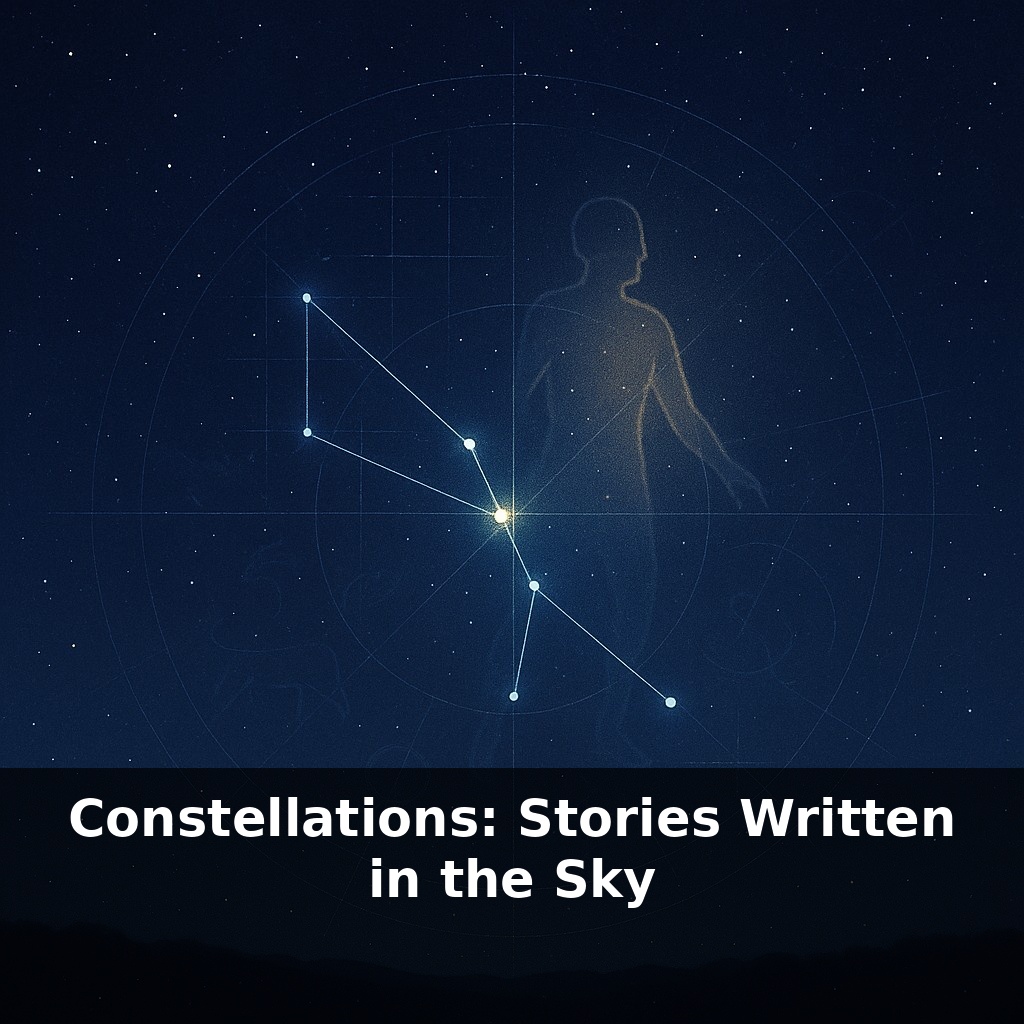
Stand under a dark sky long enough and you’ll notice something subtle: the patterns people talk about rarely match how the stars are actually arranged in space. A bright “line” you trace from one star to another might link a neighbor 25 light‑years away with another star hundreds of light‑years behind it. From Earth they look side‑by‑side; in 3D they’re nowhere near each other. That’s why constellations are really about where we’re looking from, not how the universe is built.
Modern astronomers take that Earth‑centered view and turn it into a working grid. Hydra and Crux aren’t just pictures; they’re labels on sectors of the sky that help you say, “Point the telescope here.” When someone reports a new supernova in Hydra, nobody thinks it’s physically tied to Hydra’s other stars—it just means “in that direction.” In that sense, constellations are like file folders on your computer desktop: the contents inside each one may have nothing to do with each other, but the folder name tells you where to click.
This directional system hides a few surprises. Take Polaris. It’s famous not because it outshines everything else—it doesn’t—but because it happens to sit almost exactly above Earth’s north rotation axis right now. If you could watch the northern sky in time‑lapse, most stars would trace big circles; Polaris would barely move. Sailors, hikers, and spacecraft navigators all exploit that cosmic convenience. Yet even this “fixed” point is temporary. Earth’s axis slowly wobbles, like a spinning top, over about 26,000 years. A few millennia ago, Polaris wasn’t the “north star,” and a few millennia from now, another star will take the job.
Then there’s the Sun’s path. As Earth orbits, the Sun gradually drifts through a narrow band of constellations along the ecliptic. That band includes a quiet troublemaker: Ophiuchus, the serpent bearer. Astronomers see the Sun move through 13 of these constellations, but popular zodiac traditions stick with 12. On top of that, the dates when the Sun actually sits in each constellation no longer match the traditional horoscope ranges, because that same axial wobble has slowly slid the sky under our calendar over thousands of years.
Your challenge this week: on a clear evening, try to find just one well‑known pattern—Orion, the Big Dipper, or Crux if you’re in the south. Then use a sky app to tap on a few of those stars and check their distances. Let that 3D spread sink in. You’re looking at a human outline draped across a depth of space your eyes can’t see—yet your brain still turns it into a story.
Think of how different groups “use” those sky regions today. Astronomers treat them a bit like tagged datasets in a giant shared database: exoplanet surveys might trawl a slice in Cygnus, while galaxy hunters mine Fornax. When a new black hole candidate pops up, its constellation tag acts like a project label, helping teams coordinate observations from radio to X‑ray without ambiguity.
Meanwhile, space agencies quietly lean on these same patches for navigation and symbolism. Star trackers on satellites lock onto fixed patterns to keep telescopes aimed with absurd precision. Mission planners sometimes choose targets in visually rich regions—not because the myth matters, but because dense star fields make pointing and tracking more reliable. Yet the old names still slip into call‑signs, mission logos, and outreach campaigns, turning dry coordinates into something people feel invited to care about, from classroom planetariums to deep‑space probes.
Soon, the “fixed” patterns overhead may become negotiable. Mega‑constellation satellites could smear bright trails through classic outlines, forcing regulators to treat dark skies like a protected coastline. At the same time, AR star‑maps may turn your phone—or glasses—into a multilingual tour guide, layering Indigenous asterisms beside Greek figures. As exoplanet catalogs swell, expect naming debates to feel less like trivia and more like deciding who gets to write the chapter titles for our shared cosmic atlas.
In the end, those old names become launchpads: astronomers file discoveries under them, artists steal their patterns, and coders turn them into overlays for phones and planetariums. The next “line” someone draws up there might be a climate sensor’s orbit or a student’s first telescope sketch—each a fresh margin note on a sky already full of revisions.
To go deeper, here are 3 next steps: 1) Open Stellarium (free desktop app) or SkySafari (mobile) tonight, turn on constellation labels, and trace the exact shapes of Orion, Cassiopeia, and the Big Dipper while replaying the episode’s stories in your head. 2) Grab a copy of H.A. Rey’s *The Stars: A New Way to See Them* and compare his redrawn constellation outlines with the more abstract stick figures discussed in the episode—pick one constellation and decide which version tells the better story for you. 3) Visit the International Astronomical Union’s constellations page and the Native Skywatchers or Navajo Skies projects, then choose one Western constellation from the episode and look up at least one non‑Western story attached to that same patch of sky to expand your personal “story map” of the heavens.