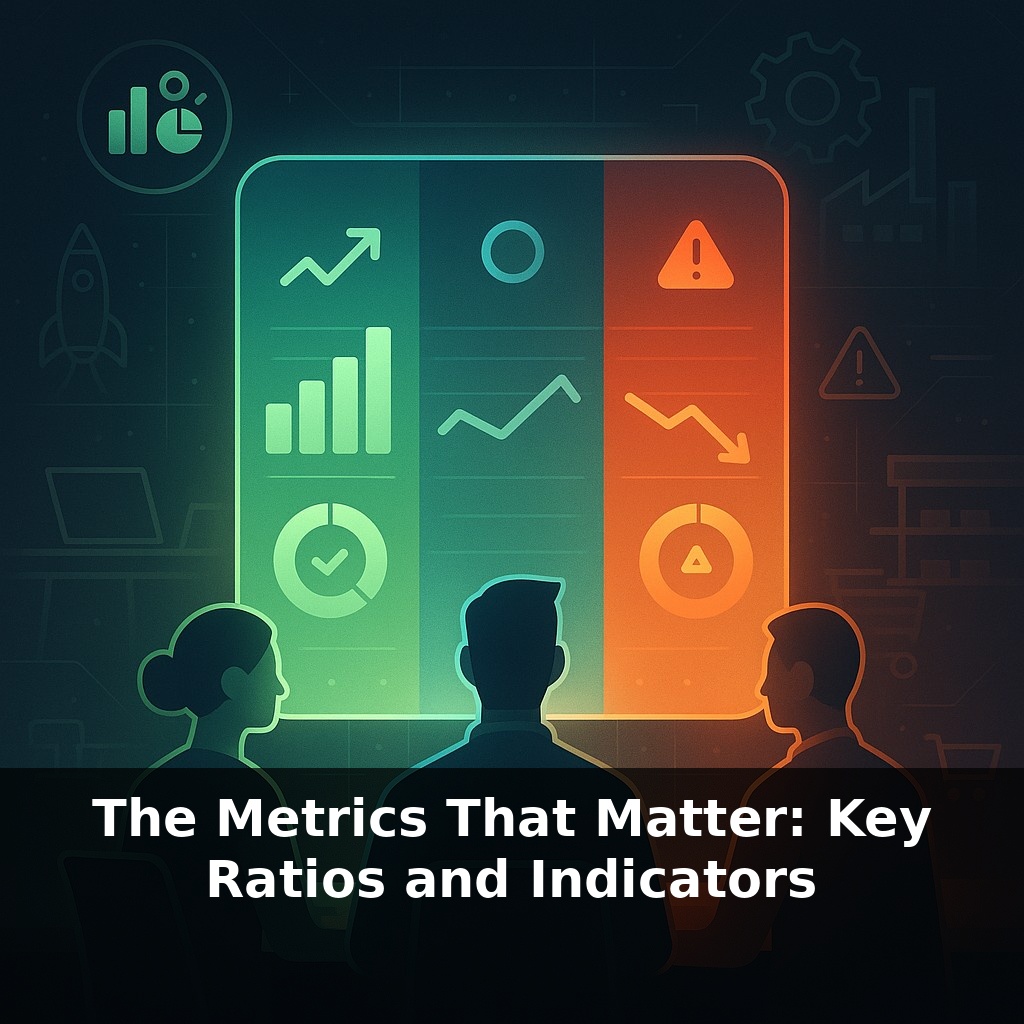
A supermarket can look “cash-poor” on paper and still be one of the healthiest businesses in town. In this episode, we drop into three boardrooms—a fast‑growing startup, a struggling factory, and a calm supermarket—to ask: which one is actually winning, and why?
The twist is that all three boardrooms are staring at the **same** financial statements—and drawing very different conclusions. One investor sees danger, another sees a bargain, a third sees “business as usual.” The difference isn’t the numbers; it’s which **signals** they’re trained to notice.
That’s where ratios and indicators come in. Instead of reading every line of a 40‑page report, you zoom in on a handful of sharp metrics: how quickly cash comes back after it goes out, how much profit each dollar of sales really keeps, how hard each machine or store shelf is working.
These aren’t just for Wall Street. Owners deciding whether to hire, managers arguing over a price cut, even lenders setting your interest rate are quietly using the same set of indicators to judge who gets the next dollar—and who doesn’t.
Some signals talk about survival, others whisper about momentum, and a few quietly predict who’ll dominate the next decade. Liquidity ratios answer “Can we make payroll next month?” Profitability tells you whether each sale is actually worth the effort. Efficiency reveals if your team and assets are working smart or just working late. Leverage gauges how much risk you’ve layered on top. Then market indicators reflect what outsiders really believe about your future. Put together, they form a dashboard that can contradict the story your revenue line seems to tell.
Start with the “can we sleep at night?” set: **short‑term safety**. Beyond the current ratio, many operators watch the **quick ratio** (cash + receivables ÷ current liabilities). It strips out inventory entirely. That’s why a fashion brand with slow‑moving stock might look fine on a current ratio, but a razor‑thin quick ratio warns, “You can’t pay bills by staring at boxes in the warehouse.”
Then move to **return on effort**, not just return on sales. Net margin says how much of each dollar you keep. **Return on assets (ROA)** asks: “For every dollar tied up in buildings, software, trucks, and IP, how much profit comes back?” **Return on equity (ROE)** narrows it to owners’ money. DuPont Analysis breaks ROE into three levers: margin, asset turnover, and leverage. The surprise for many managers: nudging margin from 9% to 10% can beat years of squeezing more volume out of the same asset base—if debt stays steady.
Next, **how hard your balance sheet works**. The **cash conversion cycle (CCC)** knits together receivables days, inventory days, and payables days. McKinsey finds companies with top‑quartile CCC tend to deliver meaningfully higher shareholder returns, because every day shaved off the cycle is a day less funding customers and suppliers. That’s why some firms obsess over collecting invoices a week faster; it compounds.
On the **risk side**, debt ratios translate strategy into fragility. **Debt‑to‑equity** shows how much of your growth rides on creditors. **Debt‑to‑EBITDA** compares obligations to earning power. When Netflix cut its debt‑to‑EBITDA from around 5× to near 3× while cash flow flipped positive, the story wasn’t “less bold,” it was “more self‑funding and resilient.”
Finally, the **market view**: **P/E**, **price‑to‑sales**, and **EV/EBITDA** don’t tell you what a business is worth; they tell you what investors *believe* about its future. A high multiple can mean “great prospects,” or “priced for perfection.” A low one can mean “cheap opportunity,” or “risk we haven’t spotted yet.”
One useful way to think about this dashboard: each ratio answers a different question—“Can we pay?”, “Is this effort worth it?”, “Are we quick or clumsy with cash?”, “How fragile is our balance sheet?”, “Do outsiders buy our story?” You need all five answers before you bet your next dollar.
Think in stories, not just formulas. Take two online retailers with similar sales. One extends ultra-generous returns and pays influencers upfront; the other negotiates 60‑day terms with suppliers and nudges customers toward prepaid subscriptions. On the surface, both “grow fast,” but their indicators will diverge: one’s cash cycle stretches, the other’s shrinks, long before revenue lines separate.
Or look at two software firms with identical net income. One burns cash on custom projects and long implementations; the other sells self‑serve tools with annual billing. Their return metrics might rhyme, but ratios tied to recurring revenue, churn, and customer lifetime value will quietly reveal who’s building an annuity and who’s running a treadmill.
A single quarter’s numbers can flatter almost anyone. Patterns across several periods—margin trends, small shifts in leverage, tiny improvements in working capital days—often reveal the true story of discipline, luck, or strain that the headline figures leave out.
Soon, “closing the books” monthly will feel as slow as mailing letters. Always‑on data feeds and AI will flag odd movements in key ratios before humans notice patterns. Think of a chef whose stove now whispers when a pan is overheating, long before anything burns. Boards may review live dashboards instead of slide decks, while small firms tap plug‑and‑play KPI copilots once reserved for giants. The real edge won’t be access to indicators, but choosing which ones to trust—and when to ignore them.
Treat this like tuning an instrument: slight adjustments can change the whole song. As you track these indicators over time, pair them with on‑the‑ground stories—why a client paid late, why a launch slipped. Patterns in the numbers plus context from the floor will show where a tiny tweak today prevents a crisis, or unlocks your next quiet breakthrough.
Start with this tiny habit: When you open your email in the morning, glance at yesterday’s revenue and immediately say out loud, “My revenue-to-cost ratio yesterday was roughly [revenue ÷ 2] if my margins held.” Then, pick just ONE number you already see daily—like Shopify sales, Stripe payouts, or client invoices—and add a 10‑second mental check: “Is this going up, flat, or down compared to last week?” Over the next few days, hook one more key ratio onto that same moment—like quickly estimating your customer acquisition cost by thinking, “New customers yesterday vs. what I spent on ads.”