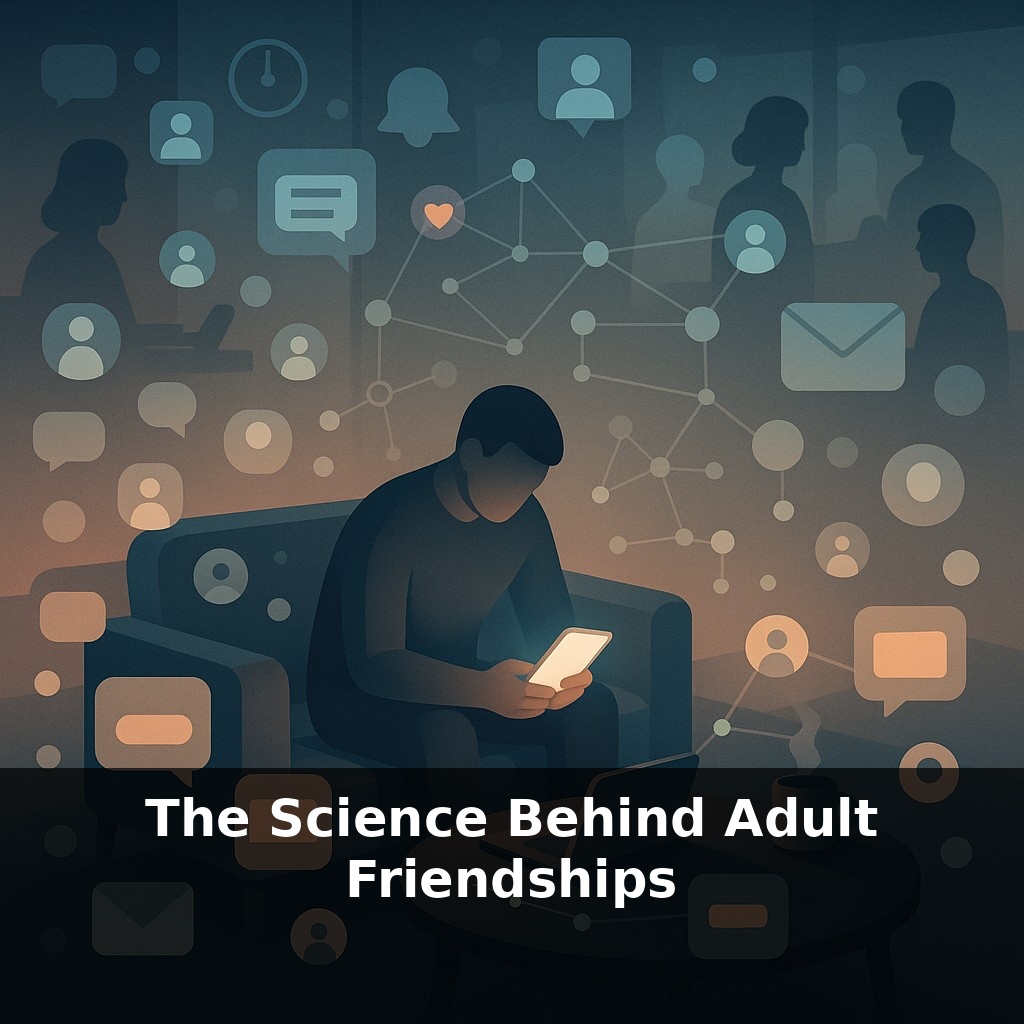
The Science Behind Adult Friendships
📝 Transcript
On an average weekday, adults spend more time with their inbox than with their closest friends. You walk into a party, open a group chat, or scroll past a friend’s update—and feel oddly alone. How can we be so connected and yet feel friendship slipping through our fingers?
Adults aged 25–44 now average about two hours a week with friends. That’s less time than many of us spend commuting, doom-scrolling, or in meetings that could have been emails. Yet when researchers zoom out across thousands of lives, strong friendships still show up as one of the most powerful predictors of health and happiness—on par with quitting smoking or exercising regularly.
So what’s going on between those shrinking hours and those huge benefits?
Across adulthood, the number of people we call friends usually contracts, even as the emotional “weight” of the remaining ones grows. Workplaces quietly become our main friendship factories. Childhood attachment patterns nudge us toward certain people and away from others. And the digital spaces that keep us in touch can also flatten nuance, making it harder to tell who’s really in our corner—and who’s just passing through.
Psychologists point out that our adult friendship “settings” aren’t neutral—they’re shaped by the small, daily choices we barely notice. Who you text back first, whose invite you say yes to when you’re tired, whether you stay in the group chat or peel off for a one‑to‑one call: each is like a brushstroke that, over years, turns into a recognizable picture. Layer onto that the frictions of adult life—partners, kids, careers, moves—and it’s no surprise that some lines fade while others get traced over. This episode looks under the hood at those quiet forces, and how to nudge them in your favor.
Strong social ties are linked with a 50% jump in survival odds, yet adults in their prime spend about two hours a week with friends. That gap isn’t just inconvenient; it tells you something about how friendship works in adulthood: the benefits compound slowly, while the costs of inattention pile up quietly.
Psychologically, adult friendship is largely about three needs playing tug-of-war: belonging (“I’m part of a ‘we’”), affirmation (“They see and value me”), and autonomy (“I’m still myself here”). When a friendship feels off, it’s usually because one of those is out of balance. The friend you never disagree with may feed belonging but starve autonomy. The friend who only calls in crisis might give you affirmation but erode any sense of mutuality.
Attachment style adds another layer, but it doesn’t seal your fate. Studies like Fraley & Davis’s find securely attached adults rating their friendships as warmer and more stable, yet all styles can build strong bonds when they understand their patterns. Anxiously attached people often overinterpret delays as rejection; avoidantly attached people may underinvest until it’s almost too late. The crucial shift in adulthood is moving from “How do they make me feel secure?” to “What do I do when I feel insecure with them?”
Sociologically, your life structure keeps redrawing the map of who is even available to be close to you. New city, new job, new relationship, caregiving, parenthood—each transition quietly reshuffles who you see often enough for closeness to be possible. That’s one reason the workplace has become an outsized source of adult friendships: it’s one of the last places where repetition, shared goals, and informal conversation still happen by default.
Online spaces complicate this but also widen the field. A group chat that’s mostly memes can still be the scaffolding that lets two people peel off into deeper one-on-one conversations. The medium matters less than whether there’s movement over time: Do interactions broaden (more topics), deepen (more vulnerability), and steady out (more reciprocity)?
Your challenge this week: run a live “micro‑experiment” on one friendship you’d like to strengthen. First, pick a specific person—not your whole social circle. Next, for seven days, change one concrete variable that research shows friendships respond to: frequency, vulnerability, or collaboration. That means either: (a) increase contact from “occasionally” to “almost daily” with brief, low‑pressure touchpoints; or (b) share one notch more honestly than usual about something real in your life; or (c) propose doing one small, shared project—co‑work, a weekly walk, a game, planning a trip. At the end of the week, don’t ask “Are we closer?” Ask three sharper questions: Did our topics expand? Did we both disclose, not just one of us? Did we make or adjust any future plan together? The answers will tell you whether that friendship is ready to grow with you—or simply travel alongside for a while.
You might notice this most clearly in the “in‑between” friends. Think of the person you only see at the quarterly off‑site, or the acquaintance who always likes your posts but never DMs. They sit on the edge of your life like books left half‑read—full of potential, but easy to ignore when you’re busy rereading the same familiar chapters with long‑time friends or family.
One pattern researchers see is that these edge‑friends often become central after a life jolt: a move, a breakup, a new job. The shared context (same industry, same city, same niche interest) suddenly matters more, and the relationship jumps a level with surprisingly little effort. In that sense, your “real” social world is bigger than it feels on a bad day; it’s just that many ties are dormant rather than dead.
The practical question becomes less “Do I have enough friends?” and more “Which of my half‑read friendships might be worth picking back up—and what’s the smallest next page I could turn with them?”
Algorithms may soon flag “almost-friends” you’d actually click with: the colleague you message at odd hours, the neighbor on your dog-walking route. Cities might treat casual encounters like infrastructure, designing benches and wi-fi courtyards the way they once laid rail lines—betting that chance overlap scales into real support. Even healthcare could prescribe social “rehab,” pairing people for low‑stakes, repeat contact the way physio pairs you with specific exercises.
So the question quietly shifts from “Do I have enough people?” to “Where do I want to place my limited attention?” Think of your week like a playlist: some tracks stay on repeat, some you skip, a few you promote to favorites. Curating those rhythms on purpose—rather than by habit—turns acquaintances into allies and ordinary days into shared history.
Try this experiment: For the next 7 days, intentionally “dose” yourself with 10 minutes of high-quality social connection each day, the way the episode described—aim for one emotionally honest text, voice note, or short call where you share something real (a worry, a win, or a vulnerable thought) instead of small talk. Before you start, rate your mood and stress level from 1–10, then rate them again right after each connection. At the end of the week, look at which type of interaction (in-person, call, text, group chat, etc.) created the biggest positive shift and commit to repeating that specific form of connection twice next week.
Unlock all episodes
Full access to 8 episodes and everything on OwlUp.
Subscribe — $1.99/monthLess than a coffee ☕ · Cancel anytime

