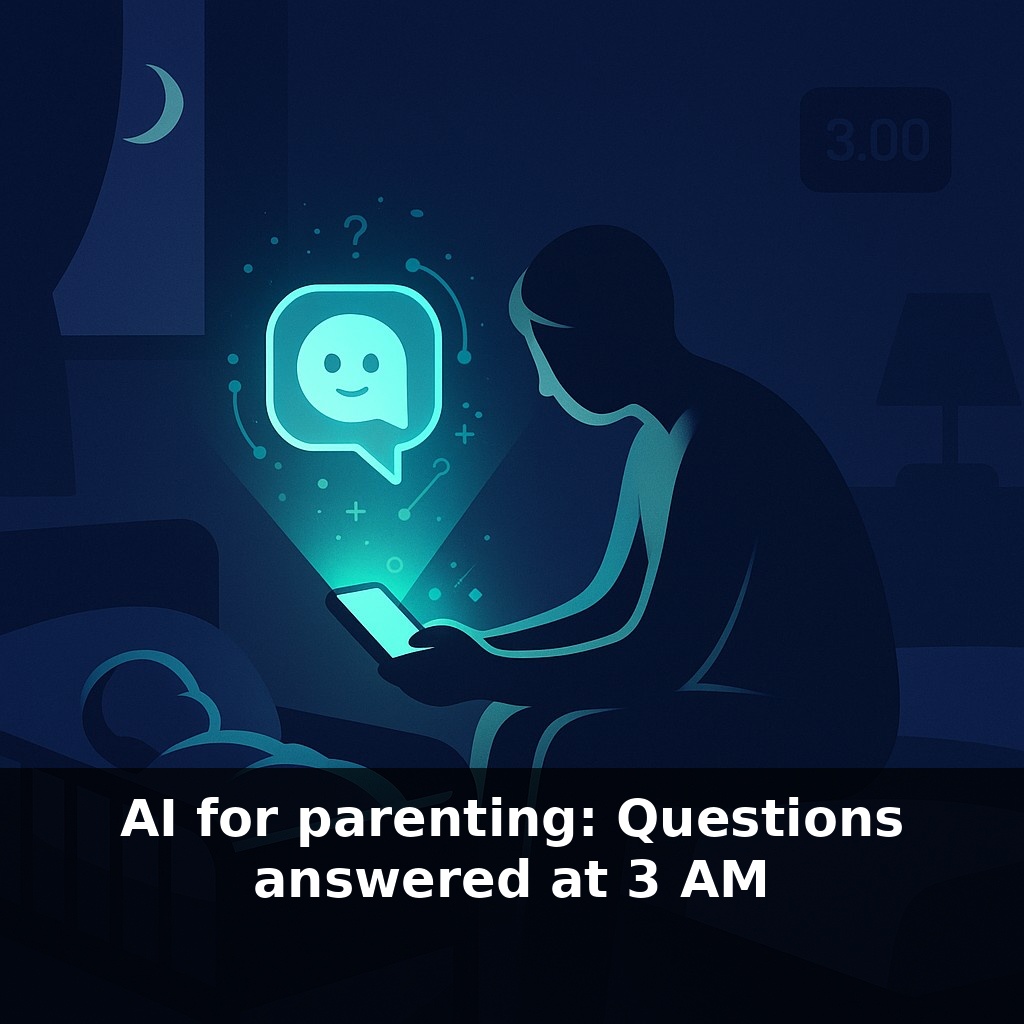
About three out of four parents admit they’re secretly googling parenting questions in the middle of the night. Now, swap that search bar for an AI that talks back—softly, instantly, at three in the morning. Is that comforting…or a little unsettling? Let’s step into that moment.
By 3 a.m., most pediatric offices are closed, friends are asleep, and even the good parenting books feel too dense to crack open. That’s exactly the gap a new wave of AI tools is racing to fill. Some apps now watch your baby’s breathing and sleep patterns through computer vision, others log feeding schedules and developmental milestones, and some combine it all into one chat window that claims to “know” your child’s routine better than your group text does. Pew data shows late‑night parenting questions are the norm, not an exception, and companies are quietly building around that reality—tuning models on millions of anonymized questions, layering in medical guidelines, and learning from products like smart socks and AI baby monitors that stream vital signs from tiny feet to massive cloud servers in real time.
But midnight reassurance is only half the story. Behind that calm chat bubble sits a tangle of trade‑offs most parents never see. Who decided which sleep-training method the bot prefers? How does it weigh a cautious “call your doctor” against a reassuring “wait and watch”? Some tools quietly learn from millions of parent interactions, nudging advice toward what keeps users engaged. Others plug into wearables or nursery cameras, turning your living room into a stream of data points. Helpful, yes—but also creating digital baby books you never explicitly agreed to write.
A lot of these systems now promise something bigger than basic tips: pattern-spotting across the chaos of early parenting. An app might notice that every time your toddler skips an afternoon nap, you end up asking about tantrums by bedtime, and start nudging you about “sleep pressure” before the meltdown hits. Another might see a steady cluster of questions about feeding, weight, and diapers and suggest a growth check—not because one data point is alarming, but because the cluster looks like concern brewing.
Underneath that, designers are quietly making value choices that can feel invisible in the middle of the night. Does the chatbot lean toward “responsive” parenting styles or stricter routines? When you ask about sleep training, does it show you multiple approaches or subtly favor the one that keeps most users from churning? These are not neutral decisions; they shape what “normal” looks like on your screen. For parents who already feel unsure, that default “normal” can be powerful.
Then there’s the question of whose baby data these tools have learned from. Most models are trained on broad internet text and whatever proprietary datasets a company can access. That means advice may reflect the norms, medical systems, and family structures that are most represented online: often Western, often middle‑class, often nuclear families. Cultural practices around co‑sleeping, extended family caregiving, or traditional remedies can end up treated as edge cases—or risks—rather than valid baselines.
Accuracy isn’t just about getting facts right; it’s also about clarity on what the AI doesn’t know. Some tools are starting to label their confidence level, surface multiple viewpoints, or explicitly flag, “This is a debated topic; here’s the range of guidance.” That transparency matters when you’re deciding whether to wait until morning or wake someone up now.
Think of an AI parenting chatbot like a GPS for parenting: it suggests a route based on vast maps and live traffic, but it can’t see the pothole only you notice, or know that your kid always gets carsick on winding roads. You still choose when to follow its turn‑by‑turn, when to detour, and when to pull over and call a professional.
And looming over everything is privacy: every cry log, diaper photo, or “is this rash normal?” upload can become part of a long digital trail. Some companies pledge local processing or strict deletion timelines; others reserve the right to use de‑identified data to “improve services,” which often means training future models. The trade‑off is stark: the more your tools “know” you, the more helpful they can be—and the more you need to decide where your comfort line sits.
One parent might use an AI assistant the way some people use a late‑night radio doctor: not as a diagnosis, but as a calm voice that helps them decide whether to try one more soothing trick or start packing for urgent care. Another leans on pattern‑spotting: after a week of logging fussy evenings, the app notices they almost always follow daycare days with skipped outdoor play, and suggests experimenting with a short walk before dinner instead of more screen time.
You can also see the trade‑offs when co‑parents use the same tool differently. One saves every chat, treating it like a searchable diary; the other deletes logs weekly to limit the trail. Grandparents might join a shared account, adding their own questions—suddenly the system is mediating three generations’ beliefs about “spoiling” a baby.
These tools can also surface blind spots: for a single parent working nights, the assistant might suggest scheduling questions for their actual awake hours, not the default nine‑to‑five, shifting the center of gravity toward their reality instead of a hypothetical “average” family.
Three a.m. coaching could also quietly reshape who we think of as a “good” parent. If future systems translate lullabies across languages, suggest locally affordable resources, or spot early signs of caregiver burnout, they might serve as a bridge between overextended families and real‑world help. But as these tools plug into clinics, insurers, and schools, the same patterns that feel supportive could be used to judge, score, or even penalize parents who don’t match the data.
In the end, those 3 a.m. questions aren’t really about data; they’re about feeling less alone while you’re learning a new human. As these systems grow up beside your kids, the real opportunity is to shape them like a trusted babysitter: close enough to notice when something’s off, but never so in charge that you stop checking in with your own judgment.
Before next week, ask yourself: 1) “If I opened my AI chat right in the middle of a 3 AM meltdown, what’s one very specific thing I’d ask it—‘help me rephrase this boundary without yelling,’ ‘give me three calm bedtime scripts,’ or ‘explain this tween behavior in age-appropriate language I can share with my kid’?” 2) “Looking at the biggest stress point in our day (bedtime, homework, screens), how could I safely ‘co-parent’ with AI there—like drafting a new bedtime routine, testing two versions of a family screen rule, or role‑playing a hard conversation with my teen?” 3) “What’s one guardrail I want to set for myself so AI stays a helper, not a crutch—such as ‘I’ll always add my own values to any script it suggests’ or ‘I’ll never use AI to secretly monitor my kid, only to understand and support them better’?”