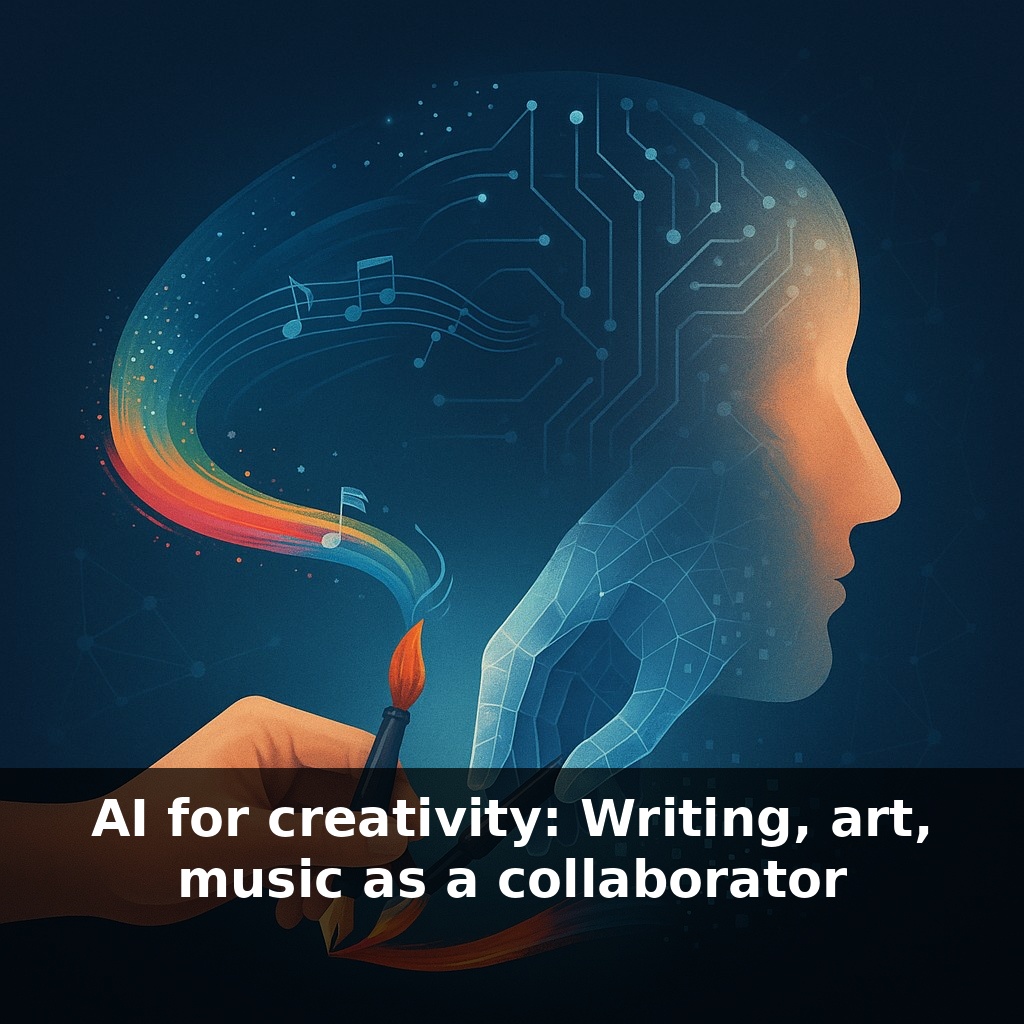
A.I. has co‑written hit songs, painted on museum walls, and helped authors draft novels—yet it can’t feel a single spark of inspiration. Today, we’re stepping into that tension: when a tool that has no imagination starts reshaping how humans write, paint, and compose.
You might already be using AI creatively without calling it that. Autocorrect quietly reshapes your sentences. Photo filters nudge your snapshots toward a mood. Music apps finish your playlists with eerily on‑point recommendations. Those are tiny hints of what happens when much more capable systems move from the background to the center of the creative process.
Today, we’re looking at AI not as a replacement for the writer, painter, or producer, but as the collaborator who never gets tired, never runs out of variations, and never complains when you hit undo for the 50th time. We’ll explore how people are using language models to break writer’s block, image generators to prototype visual ideas in minutes instead of days, and AI music tools to sketch harmonies the way you might hum into a voice memo—only far more flexible.
So where does this actually show up in real projects, beyond novelty demos? Novelists are using models as “roomfuls of beta readers,” stress‑testing dialogue for different tones before deciding what feels true. Designers are roughing out ten directions for a logo in an afternoon, then spending their real effort finessing the one that fits. Producers are feeding stems into neural tools that suggest alternate grooves, like a bandmate pitching wild takes at 2 a.m. The through‑line isn’t outsourcing vision; it’s reserving your limited focus for the moments only you can judge.
When people talk about “using AI” in writing or art, it can sound like a single button you press. In practice, the most interesting work comes from building a *workflow* around it—deciding where in your process you want explosion and where you want control.
For writers, one pattern is alternating passes. First, you ask for quantity: 20 alternate headlines, 5 ways a scene could go wrong, 3 radically different structures for a chapter. Then you switch to judgment: you cut 90%, merge the survivors, and only then invite the model back in to fill gaps or smooth transitions. Instead of asking for a finished article, you’re using it as a pressure‑test for your own taste: “Show me what I don’t want so I can see what I do.”
Visual artists are finding similar rhythms. Rather than prompting endlessly for a “perfect” image, they start from something already theirs—a sketch, a photo, a color script—and use tools like Stable Diffusion as transformation engines. You nudge: “more brutalist,” “softer light,” “1970s printmaking feel,” then pull the results back into your usual tools and paint over them. That loop—human mark, machine mutation, human edit—keeps authorship anchored in your decisions, not your prompts.
Musicians are discovering that neural tools shine in the “messy middle” stages. Maybe you import a rough vocal and ask for harmonies in three genres, or feed in a bassline and explore drum patterns at different swing levels. The point isn’t to accept any one suggestion wholesale; it’s to surf through a space of possibilities faster than you could play or program them, stopping only when something hits that nerve of “that’s *me*, just… more.”
All of this raises thorny questions about ownership and identity. When Grimes invites people to use an AI version of her voice for a revenue share, she’s treating her vocal tone almost like an API others can build on. Refik Anadol’s MoMA piece leans into the opposite extreme: authorship as curation of a 200‑terabyte river of images, where the “art” is choosing the data, rules, and limits.
Your challenge this week: pick one project—a song, a story, a visual—and deliberately design *one* step where an AI system is allowed to go wild, followed by *one* step where you ruthlessly impose your taste. Notice not just what the model makes, but how your sense of “this is mine” sharpens when you push back.
Think of a novelist using a model not for plot, but for *negative space*: asking it to list what a character absolutely would never say, then writing a key scene that tiptoes right up to those edges without crossing them. Or a poet who feeds in yesterday’s news headlines and asks for ten surreal misreadings, then steals only a single unexpected verb as the seed for a new piece.
A painter might capture quick phone photos while walking through a city at night, then batch‑process them with different “weather” prompts—acid rain, frozen fog, desert dust—just to study how light bends in each scenario before returning to canvas.
Producers are trying the same stance with rhythm: generating outlandish percussion grids, then muting almost everything and keeping only the off‑kilter hi‑hat that shifts the groove. In all these cases, the real work isn’t pressing generate; it’s knowing what tiny fragment to rescue from the chaos and carry forward.
Soon, your “creative setup” may matter as much as your skill. Think less about one tool and more about an ecosystem: a style-aware assistant that remembers your quirks, a version-control trail of your prompts, and contracts that spell out who owns outputs, credits, and royalties. As synthetic voices and visuals flood feeds, the value of traceable process will rise—screenshots, drafts, stems—so audiences can tell not just what you made, but *how* and *with whom* you made it.
As these tools mature, your “voice” becomes less about rejecting technology and more about how deliberately you bend it. Treat every prompt like a camera angle, every output like a rehearsal take. The risk isn’t sounding synthetic; it’s sounding generic. The opportunity is turning an infinite buffet of options into a sharply personal signature.
Before next week, ask yourself: “Where in my current project (a scene I’m stuck on, a melody that feels flat, a visual concept that’s fuzzy) could I invite an AI tool in as a ‘first draft’ partner, and what very specific prompt would I try today to explore that?” “When AI gives me something that feels ‘almost right but not quite’, how will I mark up, remix, or deliberately ‘break’ its output so that my own taste and voice are clearly leading the final result?” “If I treated AI like a writer’s room partner or studio musician instead of a magic box, what recurring ‘roles’ could it play for me this week—such as brainstorming 20 alternative metaphors, generating reference images for a mood I can’t yet draw, or reharmonizing a basic chord progression?”