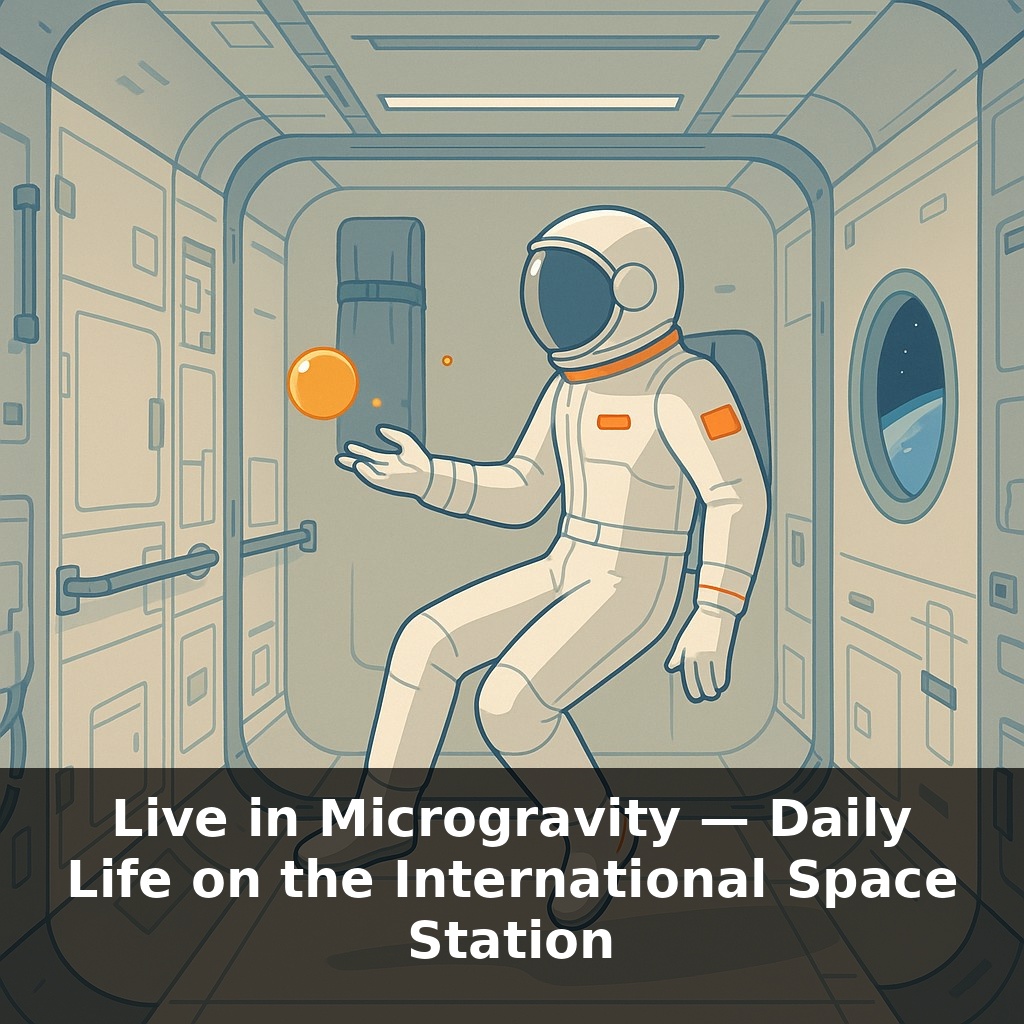
“Up here, even a single breadcrumb is a hazard,” an astronaut once joked. Now, drop into a cramped metal hallway where your water floats, your bed is a sleeping bag on the wall, and every movement matters—because for months, falling never actually ends.
On Earth, you can ignore gravity most of the time; on the ISS, you negotiate with it every second. That floating droplet of orange juice? Beautiful in a photo, but it can seep into electronics or a crewmate’s eye. So life is organized like a high-stakes camping trip where everything has a labeled pocket and nothing is truly “set down”—only Velcroed, clipped, or tied. Astronauts learn new “habits of motion”: nudging off handrails instead of walking, rotating their whole body to turn, bracing their feet so a simple task doesn’t launch them sideways. Even rest is redesigned. A sleeping astronaut zips into a bag on the wall or ceiling, not to keep from “falling,” but to keep from drifting into equipment. Meanwhile, the station hums like a mechanical rainforest—fans, pumps, scrubbers—all working constantly to keep air, water, temperature, and noise within a narrow band where humans can safely stay for months.
Days on the ISS are ruled by a clock that has nothing to do with sunrise in your hometown. The crew runs on Greenwich Mean Time, so when mission control in Houston or Moscow says it’s time to work, everyone aligns—no matter which country they launched from. Out the window, “morning” happens every 90 minutes as the station swings from darkness into blazing sunlight. To keep bodies from getting confused, lights inside follow a careful schedule: cooler, blue‑rich light to wake the brain, warmer tones to wind it down, like tuning the color of an office and a bedroom without ever changing rooms.
Every task on the station is a small engineering problem, starting with something as simple as breakfast. Food arrives in labeled packets, stowed in every spare nook. Astronauts choose their meals weeks before launch, balancing calories, nutrition, and cultural comfort foods—Japanese curry, Italian pasta, Russian soups—all redesigned so they won’t crumble or slosh. Spoons and forks are tethered; drinks live in sealed pouches with straws that clamp shut. A stray droplet of coffee is both a mess and a potential short‑circuit.
The menu is more than morale. Dietitians on the ground tweak sodium to control fluid shifts in the body, add extra calcium and vitamin D to help bones cope, and track every bite in shared databases. Your lunch is literally part of the experiment.
Workdays are packed: maintenance, science, training, outreach. A typical day might start with checking experiment racks, then swapping out samples in a furnace that can melt metals cleaner than any lab on Earth, precisely because convection behaves differently here. Another task may be tending to protein crystals growing in clear boxes—crystals that, in microgravity, form larger and more perfect structures scientists use to design new medicines.
The body always demands attention. Every astronaut spends about two hours a day exercising on equipment that looks familiar but behaves differently. A cycle ergometer keeps you “seated” with straps instead of weight. A treadmill uses bungee cords to pull you toward the belt. The station’s advanced resistive exercise device mimics free weights using vacuum cylinders for up to hundreds of pounds of “load,” crucial to slow muscle and bone loss. Each session is logged, compared with preflight baselines, and adjusted like a personalized training plan for a marathon that never leaves the stadium.
Even the air is an experiment. Sensors quietly sample carbon dioxide, trace contaminants, humidity. Filters, reactors, and molecular sieves scrub and recycle; water from breath, sweat, and urine is reclaimed until, as astronauts like to say, “today’s coffee is tomorrow’s coffee.” Engineers test upgraded systems here before trusting them on longer, more isolated missions deeper into space.
In many ways, the ISS is run like a hospital ward in orbit: strict checklists, constant monitoring, and rapid consultations with experts on the ground, all focused on keeping a small, isolated population stable in a place humans were never meant to live.
A crew day can feel like living inside a carefully choreographed experiment. A toothbrush isn’t just personal hygiene; its worn bristles are saved and later studied for microbial life. When a laptop fails, it’s not tossed—it’s dissected as a data point on how electronics age in constant radiation. Even casual “looking out the window” becomes work: astronauts use high‑resolution cameras to document wildfires, algal blooms, and storm systems in ways weather satellites can’t, sending images to disaster‑response teams on Earth. Tools are tagged and bar‑coded so precisely that misplacing a wrench is as unlikely as a surgeon misplacing a scalpel mid‑operation. Off‑duty time is its own human‑factors lab. Crews test how group dinners, shared music, or live calls with family affect mood across long missions. A simple movie night—laptops bungeed to a rack, snacks floating nearby—feeds into ongoing research on isolation, teamwork, and how to keep future Mars crews emotionally steady when home is no longer just below the window.
The station’s routines are rehearsal more than routine. Each maintenance log, mood survey, and failed gadget becomes a data point for future outposts—Gateway near the Moon, then months‑long journeys to Mars. 3‑D‑printed organs, fiber‑optic cables, and drug crystals grown in orbit hint at factories that might someday ring Earth like ports on a trade route. And as partners plan the ISS’s retirement, its playbook quietly hardens into something like a building code for the rest of the Solar System.
In the end, life on the ISS is less about conquering space and more about learning to be gently reshaped by it. Crews carry habits home like invisible souvenirs—new ways of sleeping, eating, cooperating. One day, those quiet lessons will guide students in lunar dorms or Martian labs, swapping stories the way neighbors now trade recipes across a backyard fence.
Here’s your challenge this week: For one full day, run your home like a mini–space station. Pick three daily tasks (e.g., eating a meal, brushing your teeth, and doing a short workout) and adapt them as if you were in microgravity: secure or “tether” every object you use, keep every droplet and crumb contained, and use only bodyweight, resistance bands, or isometric holds for exercise. Time how long each task takes compared to normal and jot down at least three specific design changes you’d make to your home to make “microgravity living” easier.