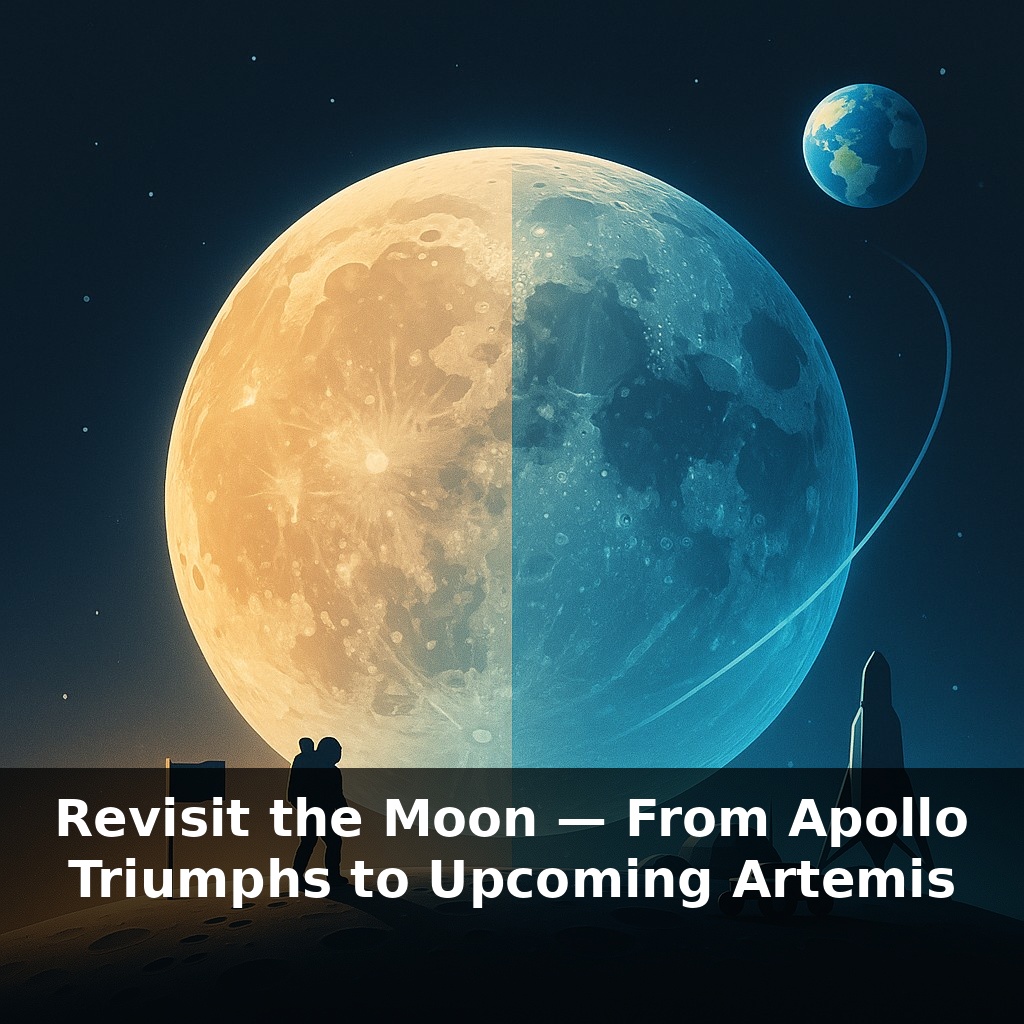
For one brief stretch in the early seventies, humans walked on another world—and then we just…stopped. No return trips for decades. In this episode, we dive into why we left the Moon, and why the next journeys back will be nothing like Apollo.
In earlier episodes, we focused on how to get off Earth and live in orbit; now we’re zooming back out to ask a bigger question: what do we actually *do* with a whole other world next door?
This time, the story isn’t a single flag, a few footsteps, and a quick ride home. Artemis is about turning short visits into a durable presence: orbital waystations, reusable landers, and crews who rotate through the lunar environment the way scientists rotate through remote field camps. The goal isn’t just “go back,” it’s “stay smart.”
New players are in the mix—international partners, private launch companies, robotic scouts mapping resources like water ice in shadowed craters. Those frozen reserves could become air to breathe and fuel to burn, reshaping the Moon from distant destination into a working outpost for the rest of the Solar System.
Apollo treated the Moon like a finish line; the new era treats it like the opening of a long, unfinished book. The big shift isn’t just technology—it’s *purpose*. Governments once raced mainly to prove they could; now space agencies and companies are treating the Moon as a place to test ideas that Earth can’t easily host: ultra-clean telescopes, deep-space habitats, even “off-world” mining prototypes. Think less victory lap, more remote test range where every experiment teaches us how to survive farther out, from multi-year Mars journeys to supporting industries that don’t rely on Earth for every screw and oxygen tank.
The leap from Apollo to Artemis starts with hardware. Saturn V remains the heavyweight champion, but its spiritual successors—NASA’s Space Launch System and SpaceX’s Starship—are being built to lift not just short-stay crews, but the bulky pieces of habitats, power systems, and cargo needed for month‑scale expeditions. Where Apollo launched a complete stack in one go, future campaigns will look more like assembling a modular building: multiple rockets ferry parts that plug into each other in lunar orbit and on the surface.
Computers may be the most invisible revolution. Apollo’s guidance computer squeezed its job into a few dozen kilobytes. Artemis-era spacecraft will fly with computing power closer to a small data center, hardened against radiation. That unlocks onboard navigation, autonomous docking, and real‑time hazard detection during landing—key when you’re touching down near shadowed craters laced with rocks and slopes. It also means crews can run sophisticated science and engineering software locally instead of waiting on every instruction from Earth.
Partnerships are another major shift. Apollo drew from a national network of contractors; Artemis layers in international agencies and commercial providers that own and operate their own vehicles. Think of how airlines, cargo companies, and airports intertwine: different organizations, shared standards, and interoperable systems. Gateway modules, landers, surface rovers, and communications relays may all have different flags and logos, yet must mesh into a coherent transportation and logistics web.
Science goals are evolving too. Seismometers and rock samples are still vital, but they’re joined by experiments in extracting oxygen from lunar soil, building roads or landing pads from local materials, and testing long‑duration life‑support in reduced gravity. Each experiment is a rehearsal for Mars, where resupply is rare and rescue is slow.
Finally, expect the timeline to feel less like a sprint and more like a series of overlapping “seasons.” Cargo missions lay groundwork, uncrewed test flights vet new systems, and crewed sorties gradually stretch from days to weeks to months, turning the Moon from a distant objective into a practiced destination.
Artemis-era hardware will also reshape who can *participate* in lunar science. Instead of a handful of specialists training for years, you could see “guest investigators” on Earth patching into instruments through high‑bandwidth links, tweaking experiments on dust behavior, radiation shielding, or how 3D‑printed structures hold up after repeated thermal cycles. Think of a medical team spread across continents, where surgeons, radiologists, and lab techs all consult on the same patient in real time; here, the “patient” is a harsh, airless landscape testing every system we send.
We’re likely to see odd, unglamorous jobs emerge: software “farmers” tending swarms of autonomous rovers; power managers balancing nuclear, solar, and battery reserves through two‑week nights; archivists curating a continuous environmental record for future engineers. Even art and culture will creep in—musicians sampling radio noise from the plasma environment, writers using live mission data as narrative prompts. As capabilities grow, the Moon stops being just an engineering target and becomes a place a wide range of people can *work with*, even from Earth.
Moon-focused industries could sprout in odd directions: architects learning to design for low‑gravity dust storms, chefs inventing menus around ultra‑compact crops, lawyers drafting “neighborhood rules” for shared craters. As off‑Earth supply chains mature, companies might treat cislunar space the way startups treat coastal cities: risky, expensive, but full of first‑mover advantage for energy, data relays, and elite training grounds for deep‑space crews.
If we treat the next lunar era less like a race and more like open‑ended fieldwork, the real payoff may be unexpected: new alloys born from low‑gravity casting, climate insights from untouched dust layers, even fresh art shaped by a sky where Earth is the “evening star.” Your lifetime might span the shift from visiting the Moon to having history *rooted* there.
Try this experiment: Tonight, recreate an “Artemis-style” mission plan at home using just a flashlight, a ball, and a lamp to model the Sun–Earth–Moon system. First, darken the room, set the lamp as the Sun, and move the ball (Moon) around your head (Earth) to see where shadows fall and where a lunar south pole base would get near-constant light. Then, pick one real Artemis goal you heard about—like building the Lunar Gateway or testing new landers—and design a 3-step “mission” you could run on your kitchen table using simple materials (paper for solar panels, coins for modules, etc.). Notice what surprised you about lighting, communication angles, or lander positioning, and tweak your mini-mission to solve one problem you discovered.