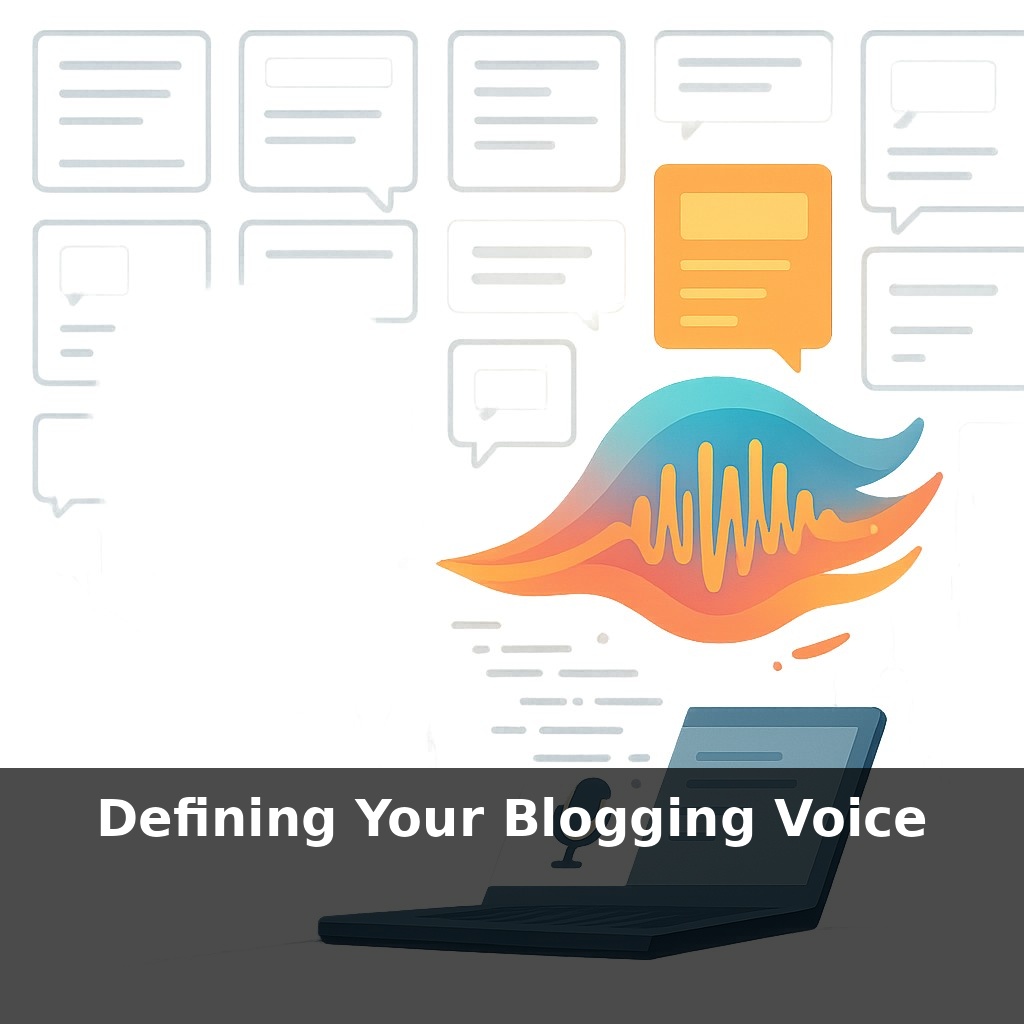
Defining Your Blogging Voice
📝 Transcript
Most blogs don’t fail because of weak ideas—they fail because they all sound the same. A marketer in Chicago, a designer in Berlin, a coach in Sydney… different lives, identical voice. Today we’ll explore why “sounding like yourself” might be the most strategic move you make.
Most creators assume their voice will “just show up” once they start publishing. Then they hit publish 20, 50, 100 times—and everything still feels like a cleaned-up version of a corporate memo. The problem isn’t that they’re faking it; it’s that their real patterns—how they think, joke, rant, question—never make it onto the page.
Research backs this up: the bloggers getting the best results are the ones whose readers say, “I can hear you in my head when I read this.” That’s not an accident; it’s the result of deliberate choices about language, rhythm, and what you refuse to compromise on. In this episode, we’ll treat your voice less like a mood and more like a system: something you can observe, codify, and then use as a filter for every post, guest article, and newsletter you publish online.
So where does that “I can hear you in my head” effect actually come from? Not from copying your favorite blogger’s quirks, and not from forcing jokes into every paragraph. It usually emerges at the intersection of three things: what you obsess over, what you’ll argue about, and what you’re unwilling to pretend you don’t believe. That mix quietly shapes whether you write like a generous teacher, a playful skeptic, a tough-love coach, or a meticulous analyst—and each of those attracts (and repels) different readers, just like a specific investment style attracts a specific kind of client.
If you strip away the buzzwords, what you’re really trying to design is: “What is it like to be inside my head for five minutes?” That experience is your blogging voice in practice. To make it usable, you need to stop treating it as a vibe and start treating it as a set of repeatable patterns you can actually see on the page.
Start with your default *stance* toward the reader. Are you writing *with* them, *to* them, or *at* them?
- Writing *with* sounds like: “Let’s walk through this together,” “Here’s where I’d probably mess this up.” - Writing *to* sounds like: “Here’s what you need to know,” “You’ll want to avoid this.” - Writing *at* sounds like: “You’re doing this wrong,” “No serious professional would…”
None of these are automatically better or worse; they just create different expectations. The danger is slipping between them unconsciously, which makes you feel trustworthy in one paragraph and weirdly condescending in the next. Pick the stance that fits your personality and goals, then stick to it unless you intentionally shift for effect.
Next, look at *how you handle uncertainty*. Do you admit when the data is thin? Do you flag your guesses as guesses? A lot of “authentic” voices quietly die here, because the writer starts sanding off their doubts to sound more authoritative. Paradoxically, clearly labeling your confidence level (“Here’s the evidence; here’s where I’m speculating”) tends to make people trust you more, not less.
Then there’s your *emotional range*. Some writers live between mild curiosity and calm explanation. Others swing from rant to delight to dry aside. Neither is right or wrong—but readers feel it when you flatten out. If you’re the kind of person who gets genuinely excited, or annoyed, or amused, a durable voice gives those reactions a consistent outlet instead of letting them leak out as random mood swings.
Think of this as building a tiny “style API” for yourself: specific, callable behaviors you can rely on—how you open, how you disagree, how you admit you were wrong—so every post feels like it came from the same mind, even as your topics and formats evolve.
Consider how this looks in practice. A product designer might default to “with” by narrating tiny failures: “I shipped this feature and watched 82% of users ignore it. Here’s the autopsy.” The same case study, told by a no-nonsense consultant, might lean “to”: “If 80% of users miss your feature, your discovery process is broken. Fix it like this.” A third writer, wired for sharp takes, might go “at”: “If your users can’t find core features, you’re not doing product design. You’re decorating interfaces.”
Notice what shifts: sentence length, tolerance for fluff, even how often they use “you” versus “we.” Those are the surface traces of the deeper patterns you’re designing. Over time, you can turn them into simple rules: “Short sentences when I’m making a point,” “Stories before frameworks,” “One clear admission of doubt per article.” Like configuring an app with a few key preferences, those rules quietly standardise how you show up, so readers know exactly what kind of mental environment they’re stepping into each time.
Your voice choices don’t just shape posts; they quietly shape your career. Editors, clients, and collaborators start to recognise your “signature” the way fans recognise a producer’s tag on a track. Over time, that signature becomes a filter for opportunities: certain gigs stop showing up, others find you faster. Treat drafts like prototypes in a lab—tweak one variable (heat, sharpness, vulnerability), then watch which readers lean in, reply, or hit subscribe.
Treat each post as a field test: which lines friends quote back, which sections strangers screenshot, which tangents people say “felt like you talking.” Those are breadcrumbs. Over time, patterns emerge—favourite phrases, recurring angles, default moods. Don’t chase consistency first; chase recognisability, then refine the rough edges.
Start with this tiny habit: When you open a blog post (yours or someone else’s), underline just one sentence that sounds the most like a real person talking. Then, in your notes app or a sticky note, rewrite that one sentence using the way you’d actually say it out loud to a friend (same idea, just in your own words). If you’re about to hit publish on a post, scroll to the first paragraph and swap just one stiff phrase for how you’d naturally say it in conversation. Do this once per day, and let those tiny tweaks slowly shape your true blogging voice.
From this course

Blogging with Authority
7 episodesUnlock all episodes
Full access to 7 episodes and everything on OwlUp.
Subscribe — $1.99/monthLess than a coffee ☕ · Cancel anytime