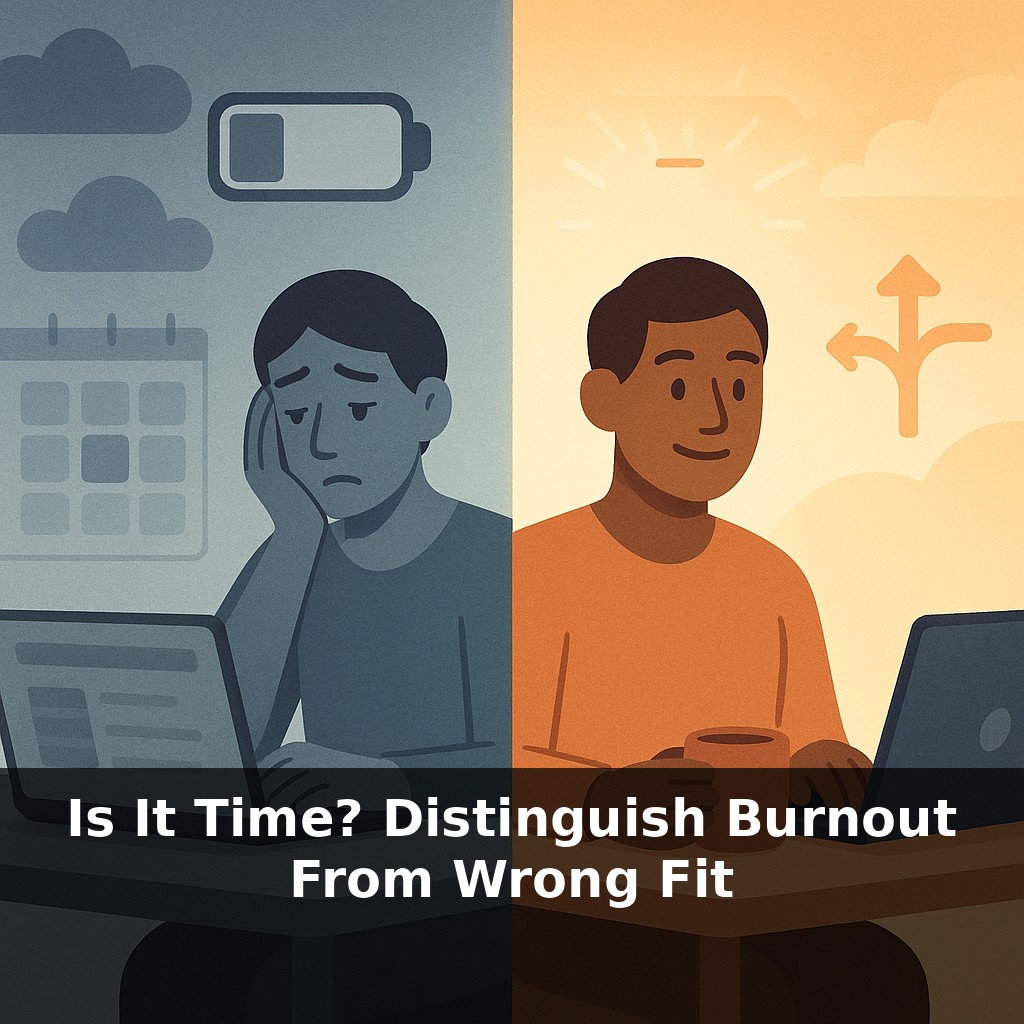
Is It Time? Distinguish Burnout From Wrong Fit
📝 Transcript
About half the people who quit their jobs don’t actually need a new career—they need their old one to stop draining the life out of them. You’re exhausted, dreading Mondays, scrolling job boards at midnight… but here’s the twist: burnout and wrong‑fit can feel exactly the same.
Burnout and wrong-fit blur together most on the hardest days. You’re staring at your calendar, every meeting feels heavy, and your brain whispers the same line on repeat: “Something has to change.” But *what* exactly? A different boss? A lighter load? Or a totally different path?
Here’s where it gets tricky: both problems can produce the same signals—fatigue, cynicism, that quiet grief of knowing you’re not bringing your best. But beneath those shared symptoms, the “engine” of the problem is different. One is about how your current job is run; the other is about whether this kind of job should be yours at all.
The real risk isn’t feeling this way—it’s reacting blindly. If you misread the source, you can spend years fixing the wrong thing and calling it “being responsible.”
Here’s the twist most careers never prepare you for: both burnout and wrong‑fit can coexist, or trade places over time. Early on, you might love the field but be buried under impossible expectations. Years later, the workload eases, but your interests or values quietly drift away from the role. That’s why “Should I stay or go?” is rarely a one‑time decision; it’s more like a recurring review cycle. The goal isn’t to label yourself once and for all, but to keep asking a sharper question: “Is this still *my* work, and is it set up in a way that lets me do it sustainably?”
Here’s where the paths quietly start to diverge: look less at how you *feel* and more at *when* and *where* those feelings show up.
Start with **patterns across your week**. With burnout, your energy often dips in proportion to demands: brutal call days, stacked deadlines, constant paging. When the load briefly lightens—protected time, a cancelled meeting block, a no‑call weekend—you may notice flickers of your old self. You still care about the work; you’re just depleted by how it’s set up.
Wrong‑fit feels different in the details. Notice **which tasks give you even a tiny spark** versus which feel like pulling teeth no matter the conditions. For a physician, maybe patient counseling lights you up, but documentation and RVU targets feel soul‑sucking even on a light clinic day. For an engineer, deep problem‑solving might feel great, while endless stakeholder meetings feel like acting in someone else’s life. When the core, non‑negotiable tasks of the role consistently deaden you, that’s a wrong‑fit signal.
Next, pay attention to **how you talk about the future**. Under burnout, you might say, “If I could just get better staffing / reasonable hours / a supportive leader, I’d stay.” Under wrong‑fit, even a fantasy version of your job feels flat: “Even if they fixed all this, I still wouldn’t want to be doing this in five years.”
Data helps here. WHO classifies burnout as an occupational phenomenon, and hospitals literally budget for it—around \$7,600 per physician per year in turnover and lost productivity. Organizations can and *do* change schedules, staffing, tooling, and policies because those levers matter. At the same time, Gallup finds people who use their strengths every day are far less likely to quit, and LinkedIn’s numbers show many career changers are happier even when their paycheck barely moves. That’s the quiet evidence for fit.
Think of this phase as **diagnostics, not verdicts**. You’re not deciding today whether to quit; you’re deciding to notice—precisely—what drains you, what sustains you, and what never seems to change no matter how much rest you get or how hard you try to “push through.”
Think in terms of **test cases**, not life sentences. For a week or two, treat your days like experiments. For instance, say yes to covering one extra shift but negotiate control over *how* you run it—who you work with, how you structure the day, what tools you use. If more autonomy makes the same type of work feel lighter, you’re gathering evidence that the *setup* is the culprit.
Flip it: try stripping away nonessential tasks for a day—no optional meetings, fewer side projects, tighter boundaries—and do only the core of your role. If, even then, you feel that quiet “I’d rather be almost anywhere else,” you’re bumping into a fit issue.
You can also prototype tiny, adjacent roles. A teacher might take on curriculum design, a nurse might join a quality‑improvement project, an accountant might shadow someone in FP&A. Notice where time disappears in a good way—and where it drags, even when the pace is reasonable.
A few years from now, you may have dashboards quietly flagging “load vs. fit” the way wearables flag your sleep debt. Tools like Viva or Peakon will hint whether it’s your calendar or your career that’s off. Skills‑based paths could let you slide sideways into roles that match you better without resigning. Your job description may feel more like a living recipe—tweaked as AI takes the rote steps—making your unique flavor of interests and values harder, and riskier, to ignore.
Your challenge this week: Run a “fit vs. load” experiment on your own calendar. Pick three blocks of time: one you dread, one you tolerate, one you enjoy. For each, slightly change only *one* variable—either the volume (how much), the context (where/with whom), or the nature of the task (what part you do). Note which tweaks ease the dread and which don’t budge it. By next week, you’ll have concrete clues about whether you’re underwater—or in the wrong ocean.
You don’t have to decide your whole future from one bad week; this is more like adjusting a recipe than tossing out the whole dish. As you collect evidence, look for tiny “green shoots”: curiosity, focus, moments you’d gladly repeat. Those are trail markers. Follow them gradually, and let your next move be a test, not a final verdict on your career.
Here’s your challenge this week: Pick ONE typical “draining” workday and run a live experiment by timing your energy from 0–10 at four specific points: right before you start work, after your first deep-focus task, mid-afternoon, and right after you finish. At each checkpoint, quickly label what you’re doing as either “burnout trigger” (too much of what you used to like, overload, no recovery) or “wrong fit signal” (work you’ve never liked, misaligned values, wrong strengths). At the end of the day, total how many burnout triggers vs. wrong fit signals you logged, and based on which is higher, choose ONE concrete adjustment for tomorrow—either subtract 10% of your workload (burnout) or swap 10% of your time toward tasks that better match your strengths and values (wrong fit).
From this course

Career Change: Reinvent Yourself at Any Age
8 episodesUnlock all episodes
Full access to 8 episodes and everything on OwlUp.
Subscribe — $1.99/monthLess than a coffee ☕ · Cancel anytime