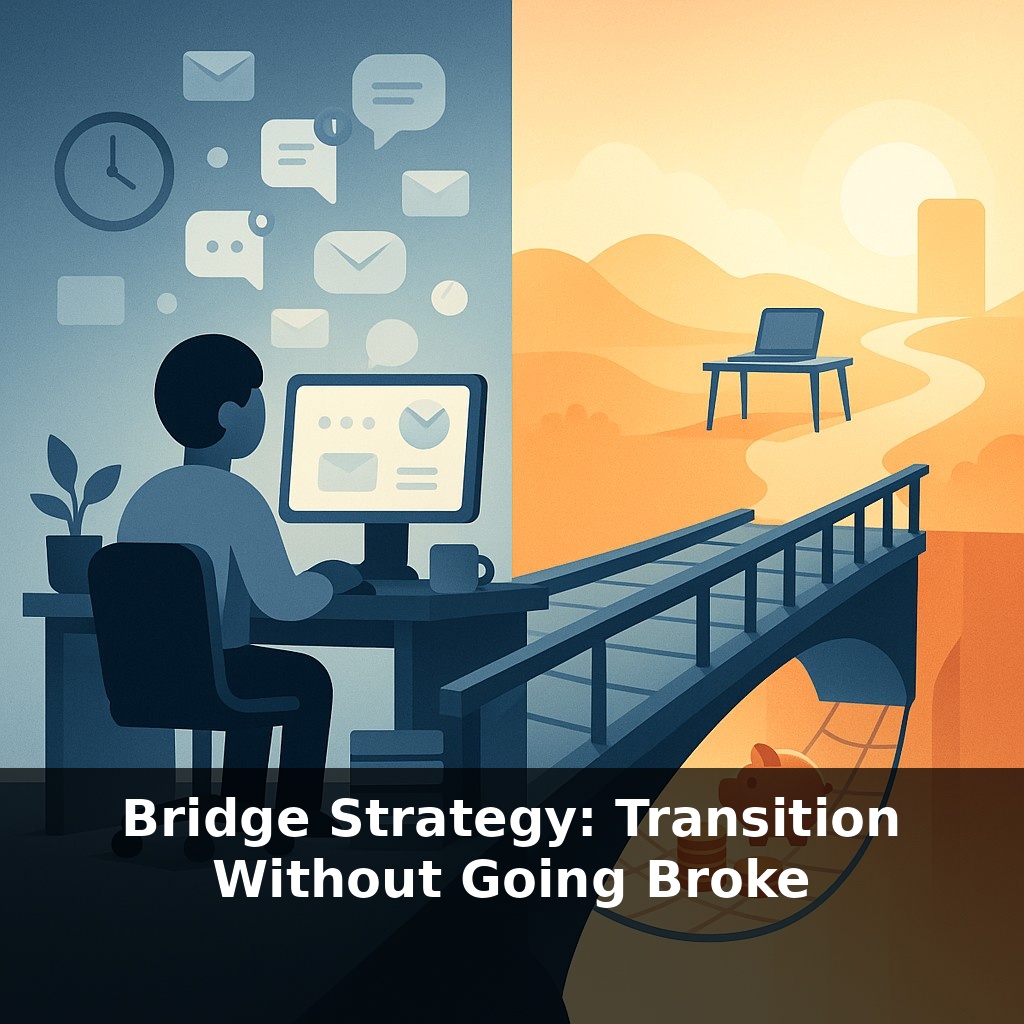
About half of workers say they want a career change—yet most still rely on a single paycheck. You’re at your desk, inbox exploding, daydreaming about your next chapter…but your rent, loans, and grocery bill all vote “stay put.” How do you move without going financially off a cliff?
Median job tenure in the U.S. is just over four years—shorter than a car loan, and often shorter than the time it takes a new business to break even. That mismatch is where many reinvention plans quietly fail. People time their leap to the end of a role…not to the reality of their bank account, skill set, or learning curve. A bridge strategy closes that gap. Instead of “I quit, then I figure it out,” you’re asking, “How do I start shifting *before* my main income changes?” That might mean picking up one freelance client, negotiating one day a week for focused work on your next path, or using your current job to fund a short, intense training. You’re not just buying time—you’re designing a softer landing and a clearer path forward.
Here’s the catch: most people plan the emotional side of a change and skip the math. They’ll map dream roles, polish LinkedIn, maybe enroll in a course—while their bank account quietly runs the show. A solid bridge strategy starts by translating “how I want to live” into numbers: rent or mortgage, food, health costs, dependents, debt, and a realistic fun budget so you don’t rebel against your own plan. Then you layer on timing: when big expenses hit, when benefits renew, when bonuses vest. You’re not just asking “Can I afford this?” but “When is the cheapest, least risky moment to move?”
Most people stop their planning at “What’s my monthly number?” and forget two quieter variables: *runway length* and *runway shape*.
Runway length is how many months you can cover essentials if your main income drops. But here’s the twist: you don’t need the same length in every phase. Early on, when you’re just exploring, a thinner cushion might be fine because your current paycheck is still doing most of the work. As you edge closer to quitting or cutting hours, you want that cushion thicker—this is when you accelerate savings, not after you’ve jumped.
Runway shape is how that money gets used over time. Instead of one flat “I need $X/month,” think in stages:
- **Stage 1 – Exploration:** your costs look almost the same, but you’re funding training, networking trips, or tools. You’re not replacing income yet; you’re buying information. The goal here: keep your fixed costs lean so you can afford smart experiments.
- **Stage 2 – Transition:** this is where intermediate income starts to matter. Maybe you drop to 80% time, pick up a consulting client, or add a weekend shift that teaches directly relevant skills. The cash from these “bridge” roles doesn’t have to match your old salary; it just needs to slow the burn of your savings so your runway stretches out.
- **Stage 3 – Build:** now you’re leaning hard into the new path. You expect uneven income and more rejection. This is where people panic if they haven’t planned. Instead, set a *minimum viable income* line: the lowest steady number that keeps you afloat without constant crisis. Anything above that is fuel for growth, not a signal to inflate your lifestyle.
One subtle advantage of using layered income—salary plus experiments plus bridge work—is psychological. You’re no longer waiting for a single yes from one employer, investor, or client to “save” your plan. You’re collecting many small proofs that this direction can work. That proof isn’t just comforting; it tells you *which* skills to double down on, where demand actually exists, and how much more runway you realistically need before you can safely let go of your current role.
A marketing manager keeps her full-time role but treats Thursday nights as “lab time.” For six months, she runs tiny paid ad experiments for a local bakery, a yoga studio, a friend’s Etsy shop. Each project is short, clearly scoped, and pre-paid. Patterns emerge: local service businesses keep asking for the same package. By the time she’s ready to reduce her day-job hours, she isn’t guessing what to sell—she has a repeatable offer and two retainer clients already waiting.
A nurse considering health coaching starts with three weekend workshops at a community center. She charges a modest fee, tracks who signs up, and notices most attendees are newly diagnosed diabetics. Instead of launching a generic coaching practice, she designs a focused 8-week program for that group, pairing her clinical experience with structured sessions and email check-ins.
Your version might be five paid “beta” projects, a micro-course, or a short contract inside your target industry—small, real-world tests that earn while they teach.
AI will quietly widen the gap between those who can pause and retool, and those who can’t. Bridge strategies are how you stay in the first group. Think less “What job replaces this one?” and more “What mix of small bets funds my next chapter?” Maybe that’s two niche contracts, a licensing deal, and a short internal rotation. Treat each like a lab sample: small, contained, informative. Over time, you’re not just changing roles—you’re building a personal safety net that moves with you.
When you treat money as a creative constraint instead of a cage, more doors appear: maybe a seasonal contract, a temporary roommate, or swapping pricey hobbies for skill-building sprints. Like tweaking a recipe, a few small substitutions can change the whole dish. You’re not just avoiding “going broke”—you’re quietly funding the person you’re becoming.
Here’s your challenge this week: By Friday, map out a 12‑month bridge strategy that covers your bare‑bones monthly “stay‑alive” number, your current income sources, and at least two temporary bridge income streams (like consulting in your current field or a part‑time role that preserves your energy). Assign real dollar amounts and timelines to each income stream and plug them into a simple spreadsheet or budgeting app so you can see exactly how many months of runway you have. Then, schedule one concrete money‑producing step for this week (e.g., emailing three specific people about contract work or applying to two targeted bridge roles) and put those actions as calendar events with dates and times.