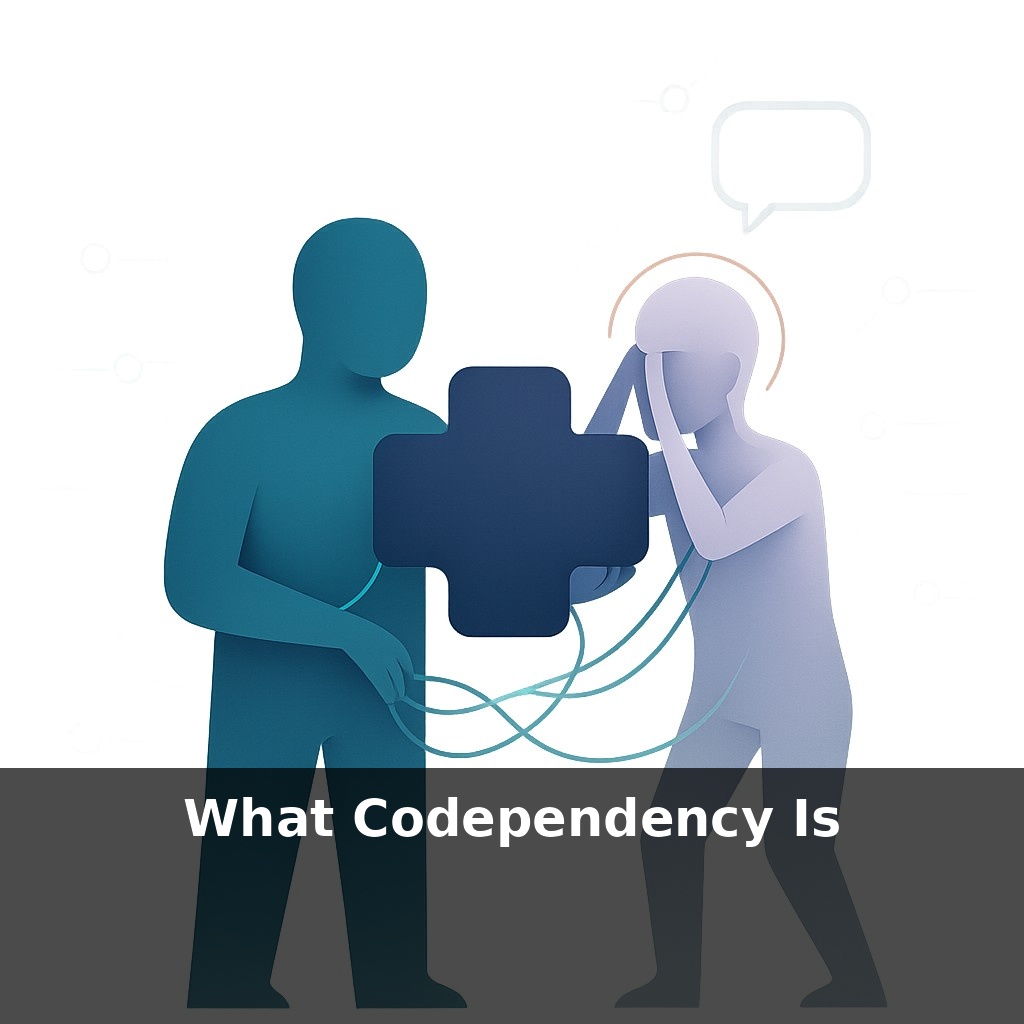
What Codependency Is
📝 Transcript
“According to one study, most partners of people with addictions quietly meet criteria for a condition they’ve never heard of. In daily life, it looks ordinary: you cancel plans, smooth over chaos, hold everything together—yet somehow feel invisible in your own story.”
You might not call it “codependency.” You might call it “being loyal,” “sticking by your person,” or “just doing what needs to be done.” On the surface, it can look like dedication: staying up late to fix their mess, rehearsing what they should say in therapy, checking their phone battery, their mood, their schedule—while your own life quietly slips into the background.
Codependency isn’t about being caring; it’s about losing the steering wheel of your own life while you keep grabbing theirs. Your choices start orbiting around their crises, their feelings, their potential. You say “it’s fine” when it isn’t, agree when you’re exhausted, and apologize when you’re the one hurt. Over time, your needs don’t exactly disappear—they just get buried under layers of “it’s not that important” and “they need me more.”
Sometimes the signs are subtle. You might notice that making a simple decision—what to eat, when to rest—quietly depends on how you predict they’ll react. Their bad day rearranges your whole week. A tense silence in the room feels like an alarm you’re responsible for turning off. Over time, your internal “thermostat” for comfort, safety, and fairness resets around what they can handle, not what you truly want. You become the unofficial project manager of their moods, choices, and consequences, while your own plans and preferences wait on permanent standby, labeled “later.”
If you zoom in on what’s actually happening inside a codependent pattern, three themes usually show up: identity, responsibility, and regulation.
First, identity quietly relocates. Instead of “Who am I? What do I want?” the brain starts asking, “Who do they need me to be so things don’t fall apart?” Your strengths—empathy, loyalty, problem‑solving—get drafted into a single mission: stabilize them. Over time, compliments you remember most aren’t about you, they’re about your usefulness: “I don’t know what I’d do without you,” “You’re the only one who understands me.” It feels like closeness, but it’s actually a narrow role: caretaker, fixer, emotional shock absorber. Your own preferences, dreams, even quirks get edited down to keep that role secure.
Then responsibility expands far beyond what one person can realistically carry. You start taking emotional and practical responsibility not just for your reactions, but for their feelings, their choices, their recovery, their reputation. If they relapse, explode, oversleep, you feel you’ve failed. Research on partners of people with addictions shows this isn’t just “being supportive”; many partners meet proposed diagnostic criteria for codependency, meaning this over-responsibility reaches clinical levels of distress and impairment. You become hyper‑vigilant to signs they might spin out, and you pre‑correct for them: calling in sick on their behalf, hiding bills, covering for missed deadlines, doing quiet damage control before anyone notices.
At the same time, regulation—how you manage your own emotions and impulses—gets compromised. Brain imaging suggests a tug‑of‑war: empathy circuits fire intensely when the other person is distressed, while self‑regulation areas quiet down. In practice, that might look like saying “yes” through clenched teeth, texting 20 times to check on them, or abandoning your own plans the moment they hint at a wobble. You may know, logically, “This isn’t sustainable,” yet feel almost physically compelled to step in. Caring stops being a choice and starts to feel like an obligation wired into your nervous system.
And there’s a deeper paradox underneath: the more you take over their responsibilities, the less opportunity they have to confront their own behavior. Your effort buys temporary calm, but it also protects the very patterns that are hurting you both.
Sarah notices she checks her partner’s location more often than her own calendar. When his dot doesn’t move, her mind does: rehearsing excuses for him, planning how to soften his landing if he’s messed up again. Meanwhile, the hobby she loved—her Thursday-night music jam—hasn’t seen her in months. No one told her to quit; it just kept losing the tug‑of‑war for her time and mental space.
Or take Daniel, who tells friends his relationship is “intense, but we’re a team.” When his boyfriend spirals, Daniel’s weekend turns into triage: researching therapists, rearranging shifts, drafting apology texts on his partner’s behalf. By Sunday night he’s wired and depleted, yet weirdly proud of how much chaos he absorbed.
In both cases, the pattern doesn’t scream “problem.” It feels like being devoted, resourceful, even uniquely needed. The quiet cost shows up elsewhere: sleep that never feels deep, friendships that thin out, a body that lives in low‑grade tension as if always on call.
Early tech may quietly amplify these patterns: read receipts, location sharing, and constant pings can turn your nervous system into a 24/7 monitoring station. The person on the other end becomes less a partner and more a fluctuating “status update” you’re always checking. As AI tools start spotting relational red flags the way fitness apps track steps, one possible future is getting a gentle “boundary alert” long before you’d ever use the word codependent about yourself.
Noticing these patterns isn’t a verdict; it’s a starting signal. You’re learning where you’ve been living on mute, so you can begin turning the volume back up on your own life. Technology may have helped you over-focus on their “status,” but it can also help you track tiny acts of self‑honoring—like calendar events for your needs that you actually keep.
Before next week, ask yourself: 1) “Where this week did I say yes when I actually meant no, and what was I afraid would happen if I’d been honest?” 2) “In my closest relationship, what emotions or needs do I routinely ignore in myself so I can ‘keep the peace’ or manage the other person’s mood?” 3) “If I pressed pause on trying to fix, rescue, or advise one specific person in my life for just one day, what uncomfortable feelings come up in me—and what might those feelings be trying to tell me about my own needs?”
From this course
Codependency: Breaking the Pattern
7 episodesUnlock all episodes
Full access to 7 episodes and everything on OwlUp.
Subscribe — $1.99/monthLess than a coffee ☕ · Cancel anytime

