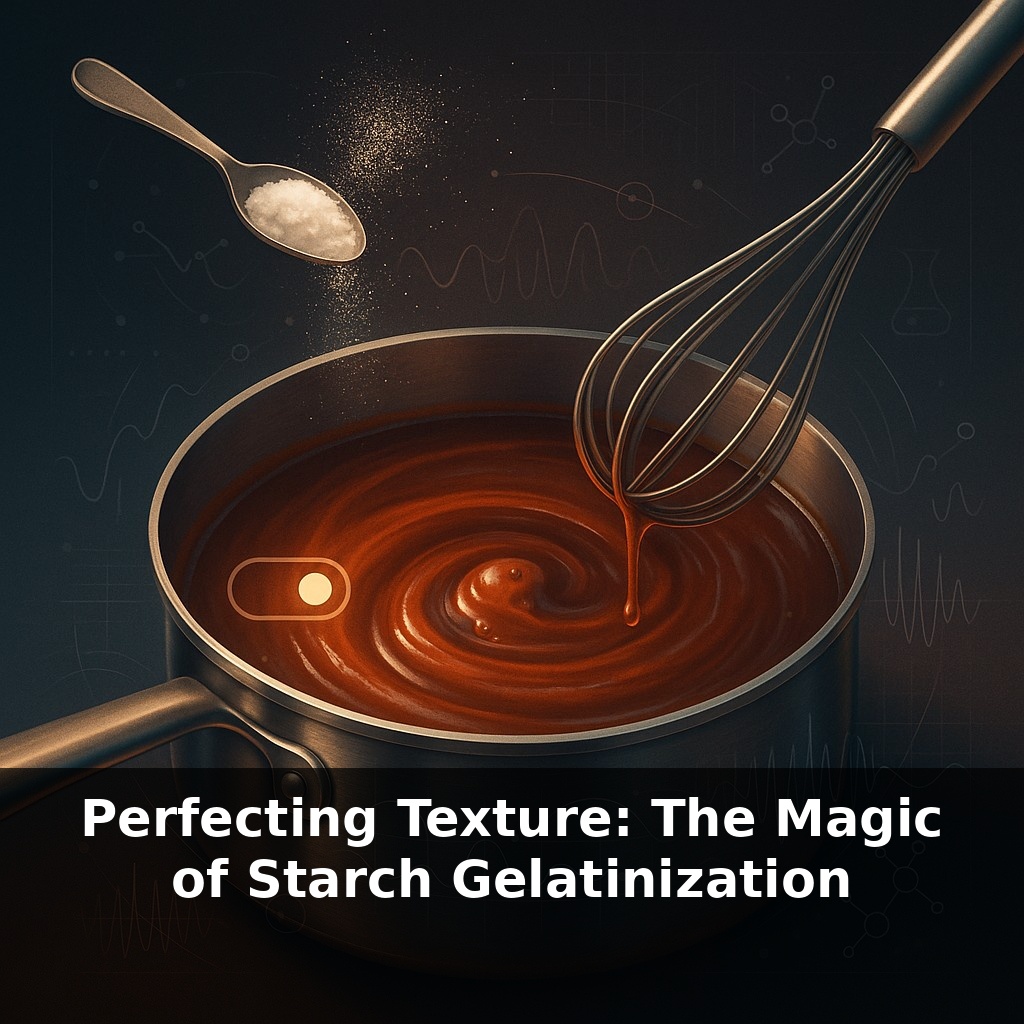
A pot of sauce can go from thin and lifeless to silky and luxurious in less than a minute—yet most cooks have no idea what actually changes. In this episode, we’ll pause that moment mid-bubble and explore the hidden switch that turns liquid into texture.
Chefs don’t just follow thickening ratios; they chase specific textures the way musicians chase a particular sound. This is where starch gelatinization stops being a chemistry term and becomes a precision tool. The same process that turns a gravy from runny to rich also decides whether your pastry cream slices cleanly, your pie holds its shape, or your sandwich bread feels cottony instead of dense. Tiny shifts in temperature, timing, and recipe design change how far gelatinization goes and how that starch network behaves as it cools, freezes, or gets reheated. Even ingredients you think of as “flavor” additions—sugar, fat, eggs—quietly push that texture dial up or down by nudging when and how starches set. In this episode, we’ll move from noticing that moment of thickening to deliberately engineering it, so you can call your shot: spoon-coating, sliceable, or melt-in-the-mouth.
Professional kitchens treat starch the way an architect treats load‑bearing walls: they decide exactly where it carries weight and where the structure must stay flexible. That’s why pastry chefs reach instinctively for cornstarch in a fruit pie, potato starch for a glossy, short‑cooked glaze, or wheat flour for a roux that can simmer all afternoon. Each choice carries trade‑offs in peak thickness, clarity, and how well the dish survives chilling, reheating, or the brutal dryness of the fridge. To cook like a technician instead of a guesser, you’ll need to learn those trade‑offs dish by dish.
Think about how differently you want a pastry cream, a ramen broth, and a sandwich loaf to behave on the plate. All three rely on starch, but they call for completely different “gelatinization profiles” in practice: how fast they thicken, how firmly they set, and how they feel as they cool and age.
The levers you actually control are simple: how much water is available, how violently you stir, what else is dissolved in the pot, and whether the mixture gets cooled or chilled later. Change any one, and you reshape the final structure.
Water first. High‑hydration systems—soups, broths—let granules swell freely, so you get a softer, more fluid body at a given starch percentage. In dense systems—pasty fillings, doughs—the same percentage yields a firmer, sliceable set because there isn’t enough free water for every granule to fully expand.
Agitation is your second lever. Gentle stirring during heating distributes granules evenly and prevents clumping. Aggressive whisking once the mixture is thick, especially at a full boil, starts tearing swollen granules apart. That’s useful when you want a smoother, shorter texture (think velouté), but disastrous if you’re chasing a bouncy, elastic glaze.
Now layer in “texture modifiers” that piggyback on your starch choice:
- Fat coats granules and competes for water. Sauces with cream or butter reach their target thickness at slightly higher starch doses but feel richer and less gluey. - Acidity (fruit fillings, tomato sauces) weakens the structure if the starch is cooked too long after acid is added. Smart move: hydrate and thicken first, then adjust with lemon juice or vinegar off the heat. - Proteins (egg yolks, dairy) create a second network as they set. In custards and pastry creams, you’re juggling two setting points: heat enough to hydrate the starch, but not so much that the proteins curdle.
Cooling and storage finish the story. As mixtures sit, particularly in the fridge, amylopectin chains realign and squeeze out water, which is why yesterday’s smooth gravy can look weepy. A brief reheat with a splash of liquid relaxes that network and restores body—unless the starch you chose was fragile under shear or prolonged heat.
Your challenge this week: cook the *same* simple starch‑thickened dish three times, changing only one lever each round—water content, agitation level, or added fat—and taste how dramatically the texture vocabulary in your kitchen expands.
Think of this section as a tasting flight of “texture case studies.” Start with a lemon curd versus a lemon bar filling. Same core flavors; one is meant to flow, the other to cut cleanly. In the curd, you stop heat as soon as it thickens and chill shallow, so it stays supple. For bars, you bake longer, in a deeper layer, and let it cool completely in the pan; that extra time and slow cooling encourage a firmer, sliceable set.
Now compare a glossy stir‑fry sauce to a ramen broth that clings lightly to noodles. The stir‑fry gets thickened at the very end, then served almost immediately so it stays shiny and bouncy. The broth is simmered longer with bones or aromatics, then only lightly thickened so it coats without feeling sticky.
Finally, consider sandwich bread versus a chewy baguette. The sandwich loaf gets more hydration and a softer set as it cools, giving you that cottony, shreddable crumb. The baguette is baked drier, cooled fully on a rack, and eaten before the crumb tightens.
Soon, you might “order” softness or chew the way you choose a roast level for coffee. Bakers could specify flour blends by crumb lifespan, not just protein. A 3‑D printer might extrude noodles at one setting, then switch to a filling that sets just firm enough to stack. Drought‑tolerant grains could be blended like an architect’s materials library—each chosen for how it behaves under heat, cold, and time, not just for flavor or nutrition. Mastering this gives cooks real control over food’s fourth dimension: how it feels.
Mastering this unlocks comfort‑food “dial settings”: silky for gravy, spoon‑standing for stew, barely thickened for bright pan jus. You can start swapping thickeners the way you swap herbs—arrowroot for shine in fruit sauces, tapioca for freeze‑thaw desserts, rice flour for gentle, cloudy broths—and sketch textures first, then write recipes to match.
Before next week, ask yourself: 1) “What’s one starch-heavy dish I already cook (like rice, pasta, or a roux-based sauce) where I could deliberately tweak gelatinization—by changing liquid ratio, temperature, or stirring—to see how the texture transforms?” 2) “If I ran a tiny ‘texture experiment’ today—such as cooking the same potatoes with cold-start vs. boiling water or testing cornstarch vs. flour in a sauce—what would I watch for in terms of gloss, thickness, and mouthfeel?” 3) “Next time something turns out gummy, gluey, or too thin, how can I pause and trace it back to a specific step in the gelatinization process (like overcooking, under-hydrating, or not letting it cool) instead of just thinking, ‘I messed up’?”