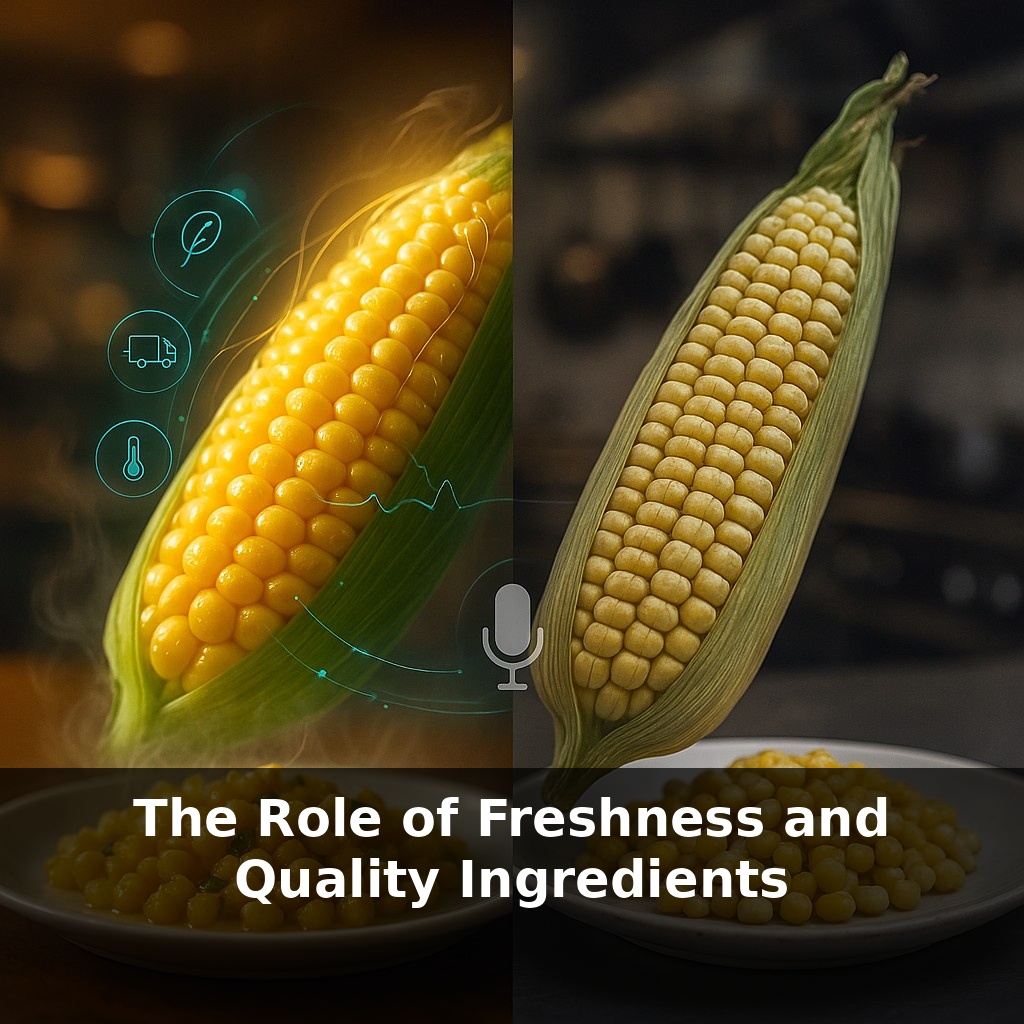
Corn bought fresh at the farmer’s market can light up a dish in ways a supermarket cob never could. In a bustling chef's kitchen, identical recipes with different sources of produce create vastly different experiences. What makes one version shine while the other falls flat?
Here’s where it gets interesting: “fresh” isn’t just about the date on the sticker or how crisp something feels in your hand. It’s a moving target shaped by biology, time, and how the ingredient has been treated since it left the field, ocean, or farm. A tomato picked green, shipped hard as a tennis ball, and blushed red in a warehouse is technically fresh on paper—yet it started losing potential flavor before you ever saw it. Meanwhile, a fully ripe tomato eaten the day it’s harvested carries a completely different “flavor budget” into your pan. The same goes for herbs harvested in the cool morning versus the afternoon, or meat that’s been properly aged versus rushed to the shelf. Chefs quietly obsess over these tiny windows of peak quality; home cooks usually never hear about them.
Chefs treat ingredient quality almost like a secret second recipe: one for the dish, one for the product itself. They’ll choose one farm for tomatoes, another for eggs, and only buy fish on days they trust the catch. Behind that pickiness is hard science—cell walls breaking down, sugars converting to starch, aromatics evaporating. A strawberry doesn’t just “sit” in your fridge; it’s quietly spending its flavor with every hour. The twist is that you don’t need restaurant suppliers to play this game. You just need to know which ingredients are most time-sensitive, and how to slow that clock once they reach your kitchen.
Chefs start by ranking ingredients by how fast they “fall off a cliff.” At the top of the urgency list are things whose flavor lives mostly in volatile compounds and delicate textures: herbs, salad greens, berries, sweet corn, fresh fish. Those are your use‑fast, treat‑gently items. Further down are hardy vegetables, roots, dry goods, and most frozen products—far more forgiving, and often indistinguishable from “fresh” in the final dish if handled well.
This is where quality and freshness separate. Quality is baked in before you ever see the ingredient: variety, how and where it was grown or raised, how ripe it was at harvest. Freshness is how much of that built‑in potential is still available when you cook it. You can’t turn a watery supermarket tomato into a concentrated, field‑grown one—but you can protect whatever it does have by how you store and use it.
Professionals constantly trade time for quality. Buy super‑fresh, eat it nearly raw: carpaccio, salads, crudo. As ingredients age, they move them into forms that rely less on peak texture and aroma: braises, confit, purees, stock. You can copy this at home. That mint you just bought? First day: use it raw in salads or drinks. Day three or four: blitz into pesto. Day five: simmer into a syrup where bruised leaves don’t matter.
Cold, air, and light are the three levers you actually control. Cold slows every reaction you don’t want: respiration, enzymatic browning, microbial growth. Air dries and oxidizes; light accelerates off‑flavors in fats and some vegetables. A chef’s walk‑in is organized to fight those three: herbs rolled in just‑damp towels in covered containers; greens spun dry, not packed soaking; meat kept cold but not smothered in airtight plastic so it doesn’t sit in its own purge.
One counterintuitive trick: sometimes “less fresh” is better. Good beef and some game actually improve after controlled aging as enzymes relax tough muscle fibers and deepen savoriness. The key is control—steady low temperature, clean handling, and clear limits—so that flavor‑boosting change happens long before safety becomes a question.
From a cook’s point of view, this is like managing a budget. You “spend” your most fragile, aromatic ingredients where they’ll be noticed, and reserve sturdy, slower‑changing ones for background roles. Over time, you start planning menus around what’s at its peak that day, not just what sounds good on paper.
Think about a simple dinner: pasta, tomato sauce, and a salad. Two versions, same recipe. In one, the basil went straight from a sunny windowsill pot to your cutting board; in the other, it’s a week-old clamshell from the back of the fridge. You’ll probably salt, taste, and tweak the “tired” version more, yet it still lands flatter. That’s not your skill; that’s ingredient momentum.
Chefs quietly game this every day. A bistro might turn today’s bright greens into a barely dressed salad, tomorrow’s into a sauté with garlic, and the day after’s into a soup garnish. Same original purchase, three different ways of hiding or showcasing what time has done.
Your pantry has tiers like this too. Top tier: eat‑now items—soft berries, cut melon, fresh bread, opened nuts. Middle tier: flexible players—yogurt, carrots, hardy herbs like rosemary. Bottom tier: true anchors—dried beans, grains, vinegar, soy sauce. The more fragile the ingredient, the more it deserves a starring role before it slips into a support act.
Soon, “fresh” might become as precisely tracked as a bank transfer. Sensors in fields, trucks, and fridges could log every hour an ingredient spends warm, shaken, or compressed. Your phone might nudge you: “Those peas are in their last 12 prime hours—make a quick soup tonight.” Restaurants could filter deliveries by freshness scores the way they now sort by price, and home cooks might swap recipes not just by cuisine, but by exactly where each ingredient sits on its timeline.
Treat your kitchen like a small R&D lab: test two versions of one dish, one with “just bought” items, one with whatever’s drifting toward the edge, and taste them side by side. Over time, you’ll start designing meals around tiny life spans the way a good DJ plans a set—riding each ingredient’s brief, peak moment before the song changes.
Before next week, ask yourself: Where in my current menu or daily cooking do I rely most on processed or long-shelf-life items, and which 1–2 of those could I swap for truly fresh, in-season ingredients starting today? When you taste a dish you make this week, can you pause and ask, “Which ingredient is actually carrying the flavor here—and how would this taste if that one ingredient were fresher, higher quality, or locally sourced?” The next time you shop, will you challenge yourself to choose one ingredient (like tomatoes, herbs, or olive oil) where you deliberately upgrade quality and then honestly compare how it changes the flavor, texture, and even how proud you feel serving the dish?