Right now, somewhere in the world, a neighborhood is deciding how to spend part of its city budget—online. No mayor’s speech, no closed-door meeting. Just residents, cheap digital tools, and a clear question: what do we fix first? That tiny process can reshape power.
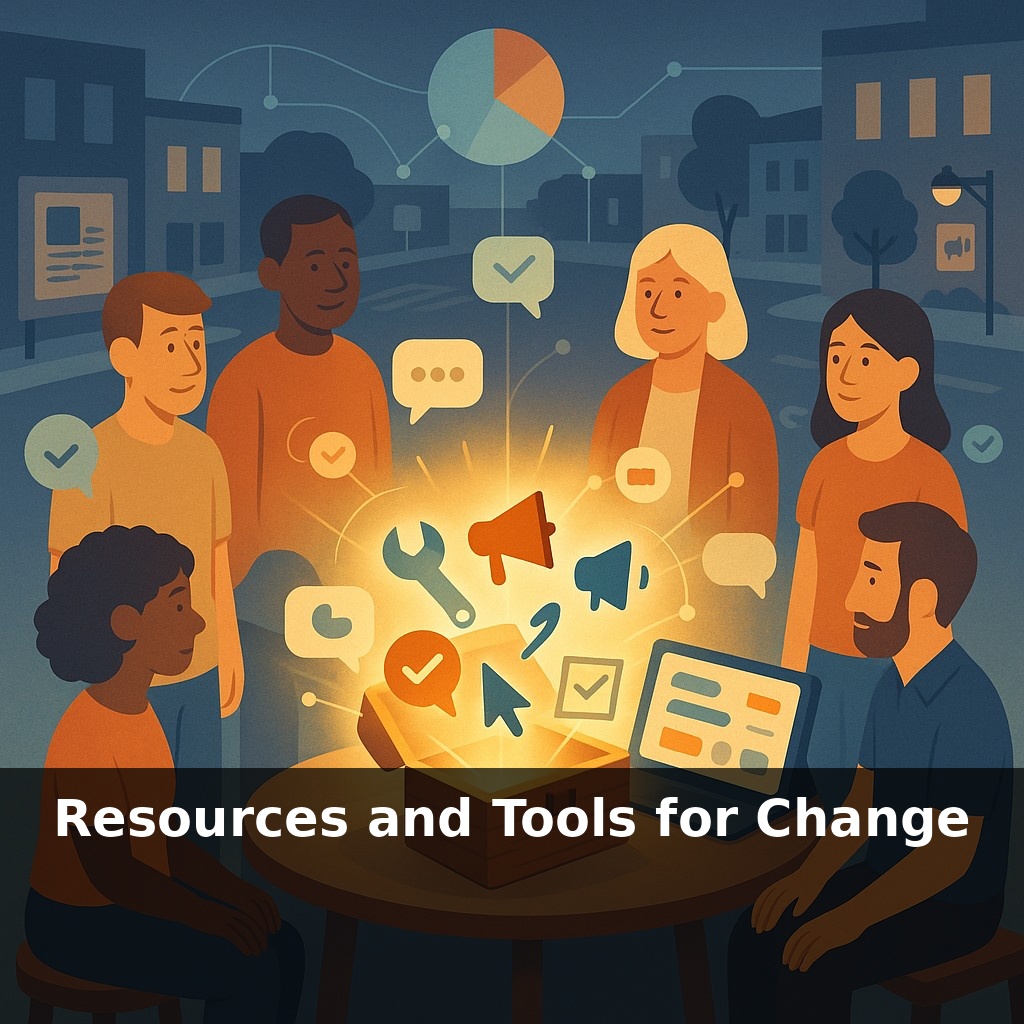
That neighborhood isn’t special because it has money on the table; it’s powerful because it has a *toolkit*. Across the world, people are stitching together low-cost tools, old-school community resources, and tested organizing methods to punch far above their weight. Some start with open maps where residents flag broken streetlights or unsafe crossings. Others use shared online documents the way past generations used kitchen tables—sorting ideas, tracking promises, and recording who will do what, by when.
But tools alone don’t create change any more than owning a drill builds a house. The real leverage comes from matching the right resource to the right moment: data when you need proof, storytelling when you need allies, co-working spaces when you need a reliable place to gather and focus. This episode is about learning what’s already within reach—and how to combine it so your next move is sharper, faster, and harder to ignore.
To get there, you need three kinds of assets working together: frameworks that help you think, tools that help you act, and community spaces that keep people involved when momentum dips. Think of it as upgrading from “one-off campaign” mode to “always-on change system.” Proven approaches like Theory of Change or Participatory Action Research keep you from guessing which step comes next. Platforms like Ushahidi or open-data portals turn scattered complaints into visible patterns—more like a heat map than a suggestion box—while mutual-aid groups, libraries, and public hubs anchor all that activity in real relationships.
Start with the *question*, not the app: what exactly needs to change, and who must be involved for it to stick? Frameworks like Theory of Change or Participatory Action Research shine here because they force you to spell out: “If we do X with Y people, using Z resources, we expect A, B, C to happen.” That clarity is what lets you choose between running a quick online poll, convening a library meeting, or digging into an open-data portal.
Next, think in layers of evidence. One layer is lived experience: stories from tenants, commuters, students, street vendors. Another is numbers: crime stats, air-quality readings, school outcomes. Open-data portals, satellite imagery, or microtasking platforms (like Mechanical Turk–style tools) help you turn raw material into patterns—fast and cheap—so you’re not arguing from hunches. Studies suggest this kind of microtasking can slash survey or coding costs for nonprofits by up to 60–80%, which means you can test more ideas with the same budget.
Then comes visibility. Tools like Ushahidi—used in more than 160 countries—let people “drop a pin” on problems or successes. Suddenly, complaints that felt isolated become clusters you can point to: “Look, this whole corridor has no safe crossings.” When residents literally see themselves on a map, participation stops feeling symbolic and starts feeling operational.
But infrastructure for collaboration matters just as much as software. Public libraries with Wi‑Fi, community centers with printers, neighborhood hubs with whiteboards—these are your low-cost “command centers.” They level the field for people without laptops or stable internet and give campaigns a physical heartbeat. The World Bank’s finding—that community-driven projects are maintained 20% more often years later—reflects this: when people co-design in spaces they trust, they’re far more likely to maintain what gets built.
Think like a systems engineer: you’re not just picking tools, you’re wiring them together. A survey funnels into a map, which feeds a public meeting, which produces priorities, which you then track in a shared workspace so promises can’t quietly evaporate. Each resource plays a position, like players on a basketball court—data setting the pick, community spaces making the pass, digital platforms finishing at the rim.
Think of an underfunded tenants’ group treating their neighborhood like a software project in beta. First, they crowdsource bug reports: residents log elevator failures, mold, heating issues using a simple form at the library. Volunteers then “debug” the data with a World Bank–style community review session: small groups verify each entry, add missing context, and prioritize what must be fixed before winter. Next, a volunteer with basic mapping skills layers those issues onto a public dashboard, color‑coded by urgency. Instead of a vague complaint—“our building is neglected”—they now walk into a meeting with a ranked backlog of issues, timestamps, and resident counts. A local law clinic “forks” this dataset to prepare legal strategies, while a youth group uses the same cases to script short videos. The result isn’t just pressure on the landlord; it’s a reusable change pipeline the group can duplicate for safety, accessibility, or rent‑increase tracking in the future.
Policy will start to feel less like a distant decree and more like a group chat you can actually reply to. As sensors, AI, and satellites sketch finer-grain pictures of inequality, the question shifts from “Can we see the problem?” to “Who gets to hold the zoom controls?” Think of neighborhood groups managing their own “control rooms,” deciding what gets tracked, when to blur sensitive details, and how findings flow into campaigns, art, or local businesses—not just official reports.
Change rarely arrives as a tidal wave; it seeps in like water through hairline cracks. When you stack small moves—one dataset checked, one neighbor trained, one public promise logged—you start carving channels that future campaigns can rush through. Over time, your “one-off” project becomes a reusable path others can sprint down faster than you did.
Start with this tiny habit: When you open your laptop or phone in the morning, spend 30 seconds bookmarking **one** new resource that supports the change you want (like a local support group page, a recommended book on change, or a short grounding meditation video). Then, copy its link into a simple “Change Toolkit” note or document you keep in one place. That’s it for today—no reading, no signing up, just collecting one helpful tool so your personal library of resources quietly grows a little every day.