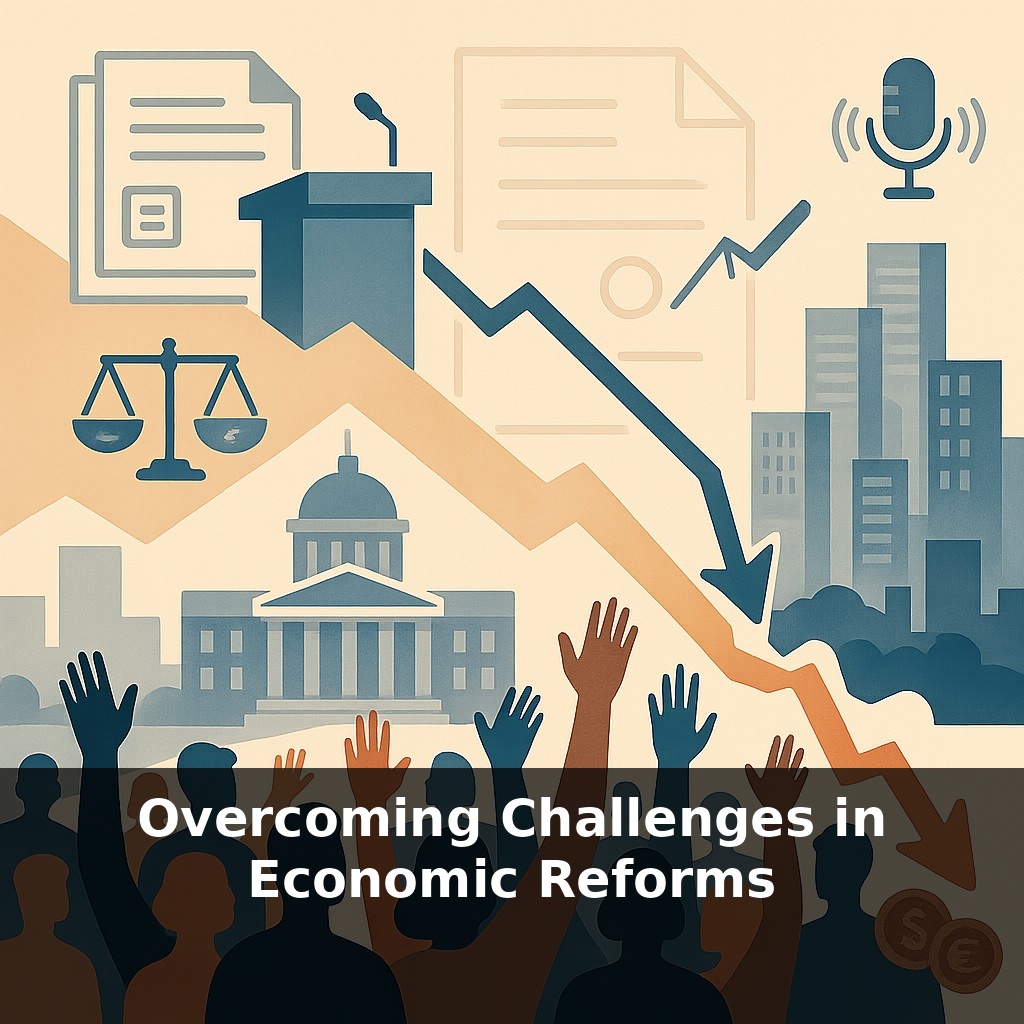
About half of major economic reform plans collapse within a year. A new tax sparks street protests. Fuel prices jump overnight. Politicians backpedal. In each case, the policy wasn’t always the problem. The real puzzle: why do good ideas die the moment they meet real people?
Nearly 50% of subsidy-removal attempts in developing countries are rolled back within a year. That’s not just a statistic; it’s a symptom of something deeper: reforms are often treated like one-off announcements instead of living processes that must survive contact with fear, anger, and uncertainty. People worry about rent next month, not GDP in ten years. Businesses look at cash flow, not abstract efficiency gains. Politicians count votes, not welfare theorems.
When reforms collide with these short-term pressures, resistance hardens and leaders retreat. Yet some countries do manage to push through: Estonia built digital systems that made change feel smoother; others tied trade opening to cash transfers that softened the blow. The difference isn’t who has the cleverest blueprint—it’s who can sequence change, win trust, and adjust quickly when the ground shifts.
So the real question isn’t just “What should we change?” but “How do we move from here to there without blowing things up on the way?” That’s where sequencing, coalitions, and feedback loops become practical tools, not academic jargon. Think of officials timing price increases with harvest seasons when food is cheaper, or phasing new rules so small firms get extra time to adapt. Unions, business groups, and local leaders can shift from opponents to co-designers when they see data, timelines, and contingency plans laid out clearly—and when early adjustments prove that leaders are willing to listen, not just announce.
Some of the most durable reform stories start not with a decree, but with a map of “who hurts, when, and how much.” Instead of asking, “Is this efficient?” reformers ask, “Whose costs are visible and immediate, and whose gains are distant and vague?” That shift in question changes design.
One reason nearly half of subsidy changes get reversed is that they front-load pain on groups that can mobilize quickly—drivers, unions, urban consumers—while benefits are dispersed and slow. Countries that learned from this pattern started pairing tough measures with highly visible cushions: time-limited cash to the poorest, electricity credits for small shops, temporary transport vouchers for workers on minimum wage. World Bank data suggest that when governments link such cushions to openness in markets, growth tends to be higher after the shock—partly because fewer people are pushed into outright crisis and can keep participating in the economy.
Timing and pacing matter just as much as who gets compensated. Instead of a single “launch day,” durable plans often have three kinds of steps: small pilots in a few regions, then scaling with adjustment clauses, and only later hard legal deadlines. Pilots surface administrative bottlenecks—payment systems that don’t reach remote villages, local officials who ignore new rules—before these weaknesses become national scandals.
Political resistance also looks different when people can see off-ramps. Clear “if-then” rules (“if inflation breaches X, we temporarily slow the next price step”) make leaders’ commitments believable without looking rigid. Opposition groups sometimes accept a deal they can amend later more readily than one they must either fully endorse or completely block.
Estonia’s jump in income after its transition shows another ingredient: investment in state capability alongside market shifts. Tax and payment platforms were upgraded so firms spent less time queuing at offices and more time producing. The lesson is less “copy Estonia’s model” and more “don’t ask a 20th‑century bureaucracy to run 21st‑century rules.”
Throughout, feedback is a survival tool, not a luxury. Regularly published data on prices, poverty, and service quality—broken down by region and group—allow both governments and citizens to spot where the burden is falling too hard and recalibrate before frustration crystallizes into a full backlash.
Mexico’s Progresa/Oportunidades is a useful case. Instead of announcing one giant overhaul, officials treated it like a staged software rollout: start with a limited “beta” in poorer rural areas, test whether payments reached mothers, track school attendance, then push updates before scaling. When evaluation showed girls’ enrollment rising, that evidence became political armor against critics who claimed the program “would never work here.”
In Eastern Europe, several countries reformed pensions by first guaranteeing current retirees’ checks in law, then gradually changing rules for younger workers. That explicit versioning—“v1 for retirees, v2 for new entrants”—reduced panic because people knew which “release” they were on.
One more pattern: countries that opened up their reform dashboards—publishing who was receiving which benefits, with basic privacy safeguards—saw less rumor‑driven backlash. When people can verify that a promised cushion actually arrived next door, they’re more willing to wait for their own turn.
As climate stress and automation reshape work, tomorrow’s bargains will be less about single laws and more about living “constitutions” for the economy: pre‑agreed rules that tilt support toward people who retrain, relocate, or care for others. Think less of a fixed blueprint and more of a stadium with movable seating, where sections can expand or shrink as new “crowds” arrive—gig workers, climate migrants, longer‑lived elders—without tearing the whole arena down.
Lasting change, then, is less about announcing a masterstroke and more about building habits: publish the numbers even when they’re ugly, invite critics into design rooms, rehearse crisis playbooks before shocks arrive. Think of each adjustment like tuning an orchestra mid‑concert—listening for discord, nudging volume and tempo, keeping space for new instruments.
Try this experiment: Pick one current economic reform in your country (for example, a subsidy removal, new tax rule, or labor law change) and spend 20 minutes mapping out who clearly benefits, who clearly loses, and who is “in the middle but anxious” on a single page. Then, draft a 3–4 sentence “reform story” aimed only at that anxious middle group that explains (1) what changes for them in plain language, (2) what safety nets or compensations exist, and (3) what problem this reform is actually fixing. Share that story with three people who are not economists and ask them to rate, from 1–10, how much it reduces their anxiety about the reform—and ask what confused them. Tweak your story based on their feedback and note specifically which phrases increased trust or clarity.