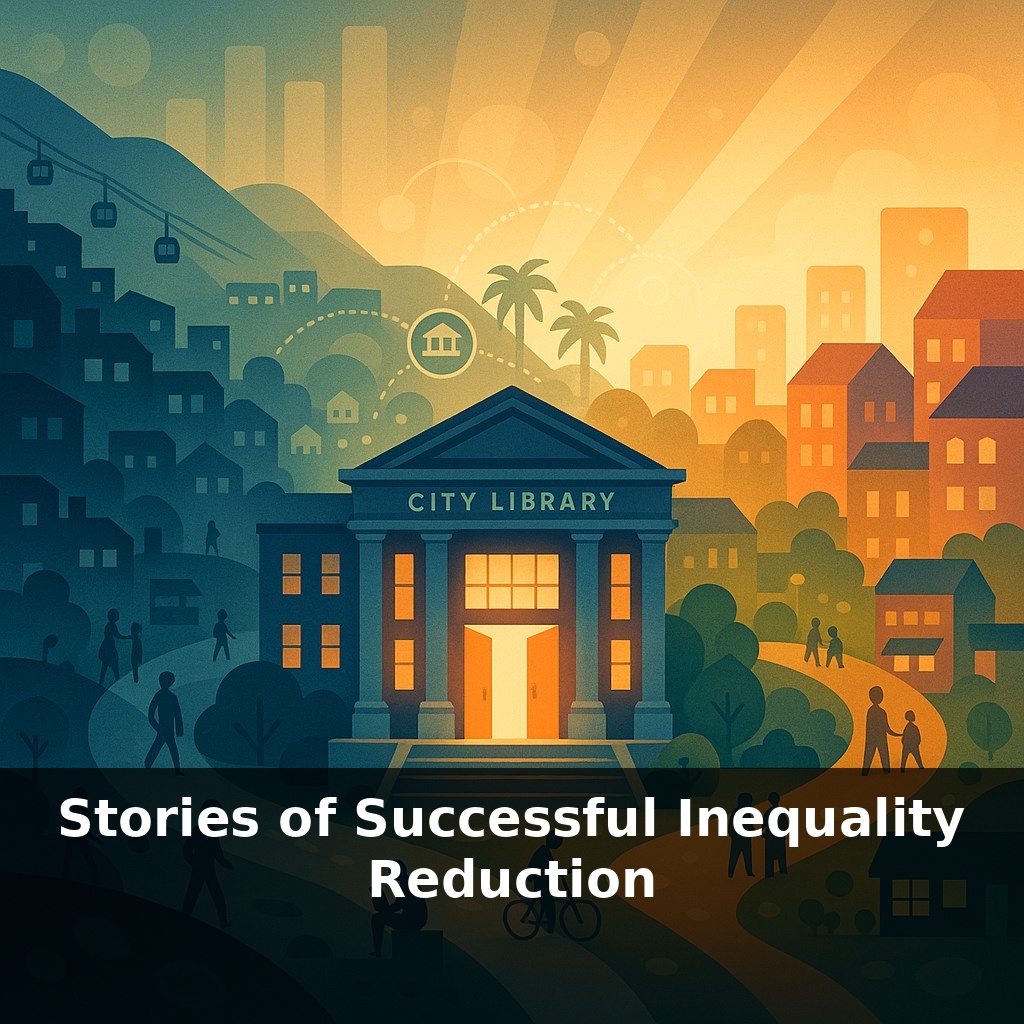
A city once ranked among the world’s most dangerous now boasts public libraries as its proudest landmarks. In another place, local councils quietly shifted everyday spending and sparked a jobs boom. How did ordinary budget choices end up reshaping who gets opportunity?
Kerala, Medellín, and Preston didn’t stumble into fairer economies by luck; they built them step by step, often against national and global headwinds. Each started from a different place—one with strong social movements, one scarred by violence, one facing deindustrialization—but all treated inequality as something you can design against, not just tolerate. Rather than chasing flashy megaprojects or one-off grants, they focused on how money, voice, and ownership flow through everyday life: whose wages rise, whose skills grow, whose streets get upgraded first. Think of their approach less like pulling a single policy “lever” and more like tuning an audio mixing board—adjusting education, transport, housing, and procurement together until the whole track sounds more balanced, and more people can actually hear themselves in it.
Kerala’s story starts with a long tradition of movements pushing for land reform, basic health care in villages, and schools in even the smallest settlements—decisions that slowly shifted who could plan a future beyond survival. Medellín paired new transit lines and hillside escalators with scholarships and neighborhood input, so residents of once-ignored districts could reach both jobs and decision rooms. Preston’s shift was quieter: unions, universities, and public institutions re-mapped their supply chains, then invited local co-ops and small firms to fill the gaps instead of defaulting to distant giants.
Kerala, Medellín, and Preston look different on the surface, but under the hood they share three disciplined habits: they spent steadily on people, they shared decision-making, and they rewired where everyday money goes.
Kerala’s numbers didn’t move just because more classrooms appeared; they moved because schooling, especially for girls, was treated as a non‑negotiable public good over decades. Village assemblies helped decide where new facilities went and which groups had been left behind. That combination—stable funding plus local voice—meant female literacy didn’t just rise on paper; it altered bargaining power inside households and workplaces. When more women can read contracts, understand benefits, and organize collectively, you don’t just get higher test scores—you get narrower gaps in who can refuse exploitation.
Medellín’s shift was equally intentional. Cable cars and escalators grabbed headlines, but they were tied to scholarships, training centers, and youth programs in the very neighborhoods that had been written off. Residents helped map unsafe routes, underused spaces, and missing services. The city then layered cultural centers, small-business support, and public spaces on top of new transport links. Jobs created by these projects weren’t treated as temporary: apprenticeships, local hiring clauses, and support for neighborhood enterprises turned once‑marginalized zones into places where income could actually grow and stay.
Preston focused on something quieter but powerful: who gets the contracts when hospitals, colleges, and city agencies buy food, repairs, software, or security. Instead of assuming the cheapest national bidder was always best, anchor institutions broke big contracts into pieces local firms could realistically win, supported co‑ops to form where suppliers didn’t yet exist, and tracked how much of each pound stayed nearby. Over time, that meant more stable employment, more bargaining power for workers, and more taxes reinvested in the same streets.
Across all three, the pattern is clear: when investment, participation, and ownership reinforce each other, inequality shifts from feeling like “the weather” to something people can deliberately re‑engineer, one coordinated decision at a time.
Think about a town that decides every new youth sports facility must be planned with the kids who’ll use it, built by firms that hire locally, and maintained by workers on decent contracts. You’re not just adding a football pitch; you’re creating coaching jobs, safe routes home, and a place where teenagers from different blocks actually mix. Inequality shrinks a bit every time those side‑effects are designed on purpose instead of left to chance.
A tech analogy helps: when companies moved from one big mainframe to distributed networks, power over data and decisions spread out. These places did something similar with their economies—breaking up oversized, distant control and distributing earning and decision‑making capacity closer to everyday life.
You can see smaller versions of this in worker‑owned cleaning co‑ops winning school contracts, or neighborhood broadband projects that train residents as installers. Each example links three things at once: who earns, who decides, and who ultimately benefits when the money circulates.
Kerala, Medellín, and Preston hint at a next step: treating equality like long‑term infrastructure, not a side project. As automation reshapes work, places that pair community ownership with constant re‑skilling may adapt faster than those chasing the next “big investor.” Think of a city routing its climate upgrades—solar roofs, flood defenses, insulation—through local co‑ops and training hubs. You cut emissions, build assets in low‑income areas, and turn climate risk into shared civic hardware.
These stories suggest a practical test for any policy: does it shift who learns, who earns, and who decides—all at once? If not, it’s probably decoration, not transformation. Like redesigning a stadium so every seat has a real view, the goal isn’t perfection; it’s steadily removing the structural blind spots that kept whole sections in the dark.
To go deeper, here are 3 next steps: 1) Pull up the “World Inequality Database” (wid.world) and the latest OECD “Income Inequality” country snapshots, and compare your country’s top 10% vs bottom 50% trends so you can see where your context most resembles (or differs from) the success stories mentioned. 2) Read one concrete case study this week—either the Bolsa Família chapter in Esther Duflo & Abhijit Banerjee’s “Good Economics for Hard Times” or the South Korea land reform section in Ha‑Joon Chang’s “Kicking Away the Ladder”—and jot down 3 policy design features (like conditional cash transfers, targeting, or monitoring) that made it work. 3) Go to the website of a local organization working on wage, housing, or education inequality (for example, a workers’ center, tenants’ union, or legal aid clinic), download any public campaign toolkit they offer, and commit to using one template (an email to a representative, a petition, or a data brief) to support a concrete inequality-reducing policy they’re pushing right now.